Tag Archives: Carroll Baker

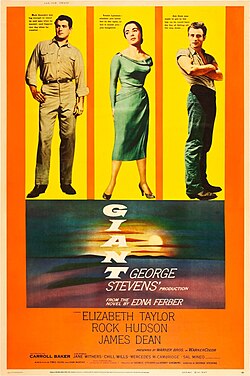
Giant-1956

Giant-1956

Director George Stevens

Starring Rock Hudson, Elizabeth Taylor, James Dean

Top 250 Films #235

Scott’s Review #898
Reviewed May 14, 2019

Grade: A

Giant (1956) is a sweeping epic firmly ensconced in both the Western genre and the dramatic field.

The film is a flawless Hollywood production featuring three of the most recognizable stars of the time and a slew of powerful supporting actors who deliver rich performances and strong characterizations.

The thunderous melodrama plays out over decades with the dry and dusty locale and the superb cinematography, among the finest aspects of the film experience.

Dashing and wealthy Texas rancher Jordan Bick Benedict Jr. (Rock Hudson) falls in love with and marries socialite Leslie Lynnton (Elizabeth Taylor) after a whirlwind romance in Maryland.

The pair begin their married life on Bick’s immaculate Texas ranch, but not before two central figures thwart their happiness. Jett Rink (James Dean) falls obsessively in love with Leslie while Bick’s sister, Luz Benedict (Mercedes McCambridge) despises Leslie, taking out her vengeance on Leslie’s horse.

The trials and tribulations continue as the characters age through the years.

The trifecta of talents Taylor, Hudson, and Dean make Giant the ultimate in treats as one fawns over the good looks of each (or all!) over the long three hours and eleven minutes of illustrious screen time.

Making for more powerful poignancy is that the film is Dean’s final appearance on-screen before his tragic death in a car accident, his death occurring before it was even released to the public.

Dean plays Jett to the hilt as a surly ranch hand, jealous of Bick’s riches and wanting to take Bick’s woman for himself. Jett is an unsympathetic character and the one I find the most interesting.

Decades-long rivals, Jett and Bick’s lives continue to overlap as Jett finally becomes rich and dates Bick and Leslie’s daughter, much to their chagrin.

Jett is a racist, which was common in the early to mid-1900s, especially in southwestern Texas. Sadly, he never finds happiness, which is central to his depth.

The screenplay is peppered with meaningful, relevant social issues that lend sophistication and a humanistic approach.

The film inches towards a liberal slant as the plot progresses, the most famous example occurring in the final act as Benedict stops at a roadside diner with a racist sign, implying the restaurant will not serve Mexicans.

Bick takes a dramatic stance and shows heart as his family, now multi-racial, needs his help. Culminating in a fight, the scene reveals the enduring love Bick and Leslie share.

Criticisms of the films’ enormous length and scope are wrong, as these aspects deepen and the components I find the most appealing.

Director George Stevens never rushes through a scene or makes superfluous edits to limit running time. Instead, he allows each scene to marinate and graze like real life.

Lengthy scenes unfold through honest conversations and a slow buildup, allowing the characters’ opinions and motivations to take shape gradually.

On the surface, a drama and western, the film can be peeled back like an onion to reveal deeper nuances. The racism, love story, and class structure ideals are mesmerizing, especially given the true-to-life humanitarian that Taylor was.

One can sit back and revel in the knowledge that she must have been enjoying the rich character.

Along with great epics like Gone with the Wind (1939), Lawrence of Arabia (1963), and The Godfather (1972) sits a film that is rarely mentioned with the other stalwarts, and that is a shame.

With magnificent shot after shot of the vast Texas land and with enough gorgeous stars to rival the landscape, Giant (1956) is a must-see.

A Western soap opera with terrific writing, rife with racism, prosperity, and fortitude, the film deserves more praise than it’s given.

Oscar Nominations: 1 win-Best Motion Picture, Best Director-George Stevens (won), Best Actor-James Dean, Rock Hudson, Best Supporting Actress-Mercedes McCambridge, Best Screenplay-Adapted, Best Music Score of a Dramatic or Comedy Picture, Best Art Direction-Color, Best Costume Design-Color, Best Film Editing

Golden Globe Nominations: 1 win-Best Motion Picture-Drama, Best Director-Motion Picture-George Stevens, New Star of the Year-Actress-Carrol Baker (won)
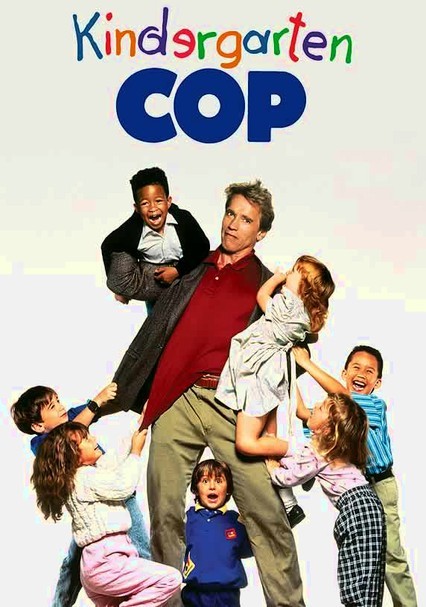
Kindergarten Cop-1990

Kindergarten Cop 1990

Director Ivan Reitman

Starring Arnold Schwarzenegger

Scott’s Review #1,306

Reviewed October 12, 2022

Grade: C+

Before Arnold Schwarzenegger found politics and after he left professional bodybuilding, he starred in a string of films during the 1980s and 1990s.

At first, he was solely a bankable action figure due to his bulky frame, but he later delved into more comedic, friendlier film roles.

Kindergarten Cop (1990) is one of those films, yet there is enough mild violence to draw in the male crowd as well.

Some of his films were better than others, with the best being The Terminator (1984) and True Lies (1994).

Kindergarten Cop is a fair-to-middling effort that attempts to transport the brawny star into a likable teacher, but the result feels more forced than genuine.

Naturally, the main character finds himself in a quandary over whether to fight crime or teach youngsters after he falls in love with them and with another teacher.

The setup is way too similar to other films in the action-comedy genre, and it’s very standard fare. The bad guy and love interest are tired and cliched, and the gags involving the kids are overly juvenile and mostly fall flat.

Despite these trite characteristics, Kindergarten Cop is not a terrible film, thanks to Schwarzenegger’s appeal. He is good-natured, and his transition from grizzled cop to a kindly teacher is not unfun.

It provides some family-friendly light entertainment that can be enjoyed on a rainy Saturday afternoon.

Unusual circumstances force cop John Kimble (Schwarzenegger) to pose as a kindergarten teacher to apprehend the major drug lord Cullen Crisp (Richard Tyson) and his accomplice and mother, Eleanor, played by Carroll Baker.

While pretending to be a kid-friendly instructor, Kimble falls for pretty fellow teacher Joyce Palmieri (Penelope Ann Miller) as he tries to balance unruly children with the dangerous bad guys.

In a twist seen coming a mile away, Joyce and her son are the people that Cullen is pursuing.

Kindergarten Cop all seems so perfectly thought out.

It’s like a bunch of suits were sitting at a round table making sure the elements were all included: hero, bad guy, love interest, kids, enough action sequences, and a chase finale.

There is even one standard black kid and one Asian kid to check off the diversity box.

And enough precociousness to last a lifetime.

The comedy mostly comes in the classroom, where it’s frequently humorous to watch a gigantic man teach little kids, especially when he has no idea what to do.

Careful not to be too silly, there are a couple of sentimental moments and social situations, like when Kimble threatens a father who is abusing his son.

Director Ivan Reitman, quite familiar with screwball comedies, directed funnies such as Meatballs (1979) and Stripes (1981), so he knows what makes people chuckle.

The action sequences do not work well, other than providing a reason for Kimble to run around and protect the kids and Joyce. We all know he will eventually best Cullen, which he does.

Even the amazing Linda Hunt is wasted as a one-dimensional principal who initially hates Kimble but then comes around and accepts him.

Kindergarten Cop (1990) is too blueprint-ready to recommend since it contains elements used in hundreds of other films. But for fans of the hulking Schwarzenegger, the film is a safe offering that sees the star in a softer light.

The Game-1997

The Game-1997

Director David Fincher

Starring Michael Douglas, Sean Penn

Scott’s Review #1,226

Reviewed February 5, 2022

Grade: A-

The Game (1997) is a fantastic cat-and-mouse ‘game’ created by director David Fincher, who always gets some street cred where I’m concerned.

The thrills come a mile a minute, reaching a crashing crescendo in the final act.

It’s a film that produces a roller coaster, edge-of-your-seat thrill-ride, or whatever metaphor serves you best. The result is the same- a fantastic and deliciously wicked experience.

Hollywood A-listers Michael Douglas and Sean Penn team up with chemistry and radiance as brothers with a rivalrous streak.

But who is the cat and who is the mouse is the question of the day as the puzzle pieces continue to mount.

Anyone who knows Fincher’s work, especially films like Seven (1995) and Zodiac (2007) realizes that atmosphere and storytelling are his sweet spot and The Game never disappoints.

It grasps the viewer by the neck and never lets go.

The screenplay is intelligent and daring. Now, before anyone gets their knickers in a bit of a twist, I do not dare say that The Game is on the level of Zodiac or Seven, both masterpieces in my opinion.

But The Game plays its cards well and measures up well if we are ranking Fincher films.

Nicholas Van Orton (Douglas) is a successful banker who keeps mostly to himself, spending most nights alone in his luxurious home. When his estranged brother Conrad (Penn) returns to town on his birthday with an odd gift, Nicholas’s suspicions are piqued.

The gift is a personalized, real-life game that he cannot resist accepting. Beginning slowly, the game grows increasingly personal, and Orton fears for his life as he eludes agents of the mysterious game’s organizers.

With no one left to trust and his money all gone, Orton must find answers for himself before he goes off the rails into psychosis.

Let’s discuss everything but the story first.

The look of The Game is stunning, with perfect lighting and shadows exhibiting the mood. The editing, whether in rapid-fire motion or slow-motion, is brilliantly effective.

Do we feel sorry for the characters? That would be a resounding no, but that’s also the fun of The Game. As Orton spirals down a dark and mysterious path, we are not too invested in the character, so watching the ‘game’ is all the more enjoyable for the viewer.

The message delivered after The Game can either be loved or hated by viewers. I, for one, loved it. Chaos and uncertainty can be argued to be better than complacency, but is it? Nicholas may argue his case when his life is turned on its head.

The conclusion, while unsettling, is riveting and mind-blowing.

Penn has rarely been better, given a healthy dose of mystique and caginess, matched against a musical score that casts a ghostly light on his scenes. The actor does his best when playing a black sheep or an estranged character type, so Conrad is ripe for the picking.

Sandwiched in release between Seven (1995) and Fight Club (1999), both much better remembered than The Game (1997), that is a bit of a shame.

The film deserves a good dusting off, and fans of Fincher will undoubtedly enjoy piecing together a good, solid perplexity, or at least attempting to.

Easy to Love-1953

Easy to Love-1953

Director Charles Walters

Starring Esther Williams, Van Johnson

Scott’s Review #86

70123585

Reviewed July 2, 2014

Grade: D

Easy to Love (1953) is a romantic comedy from 1953 starring competitive swimmer turned actress Esther Williams.

Williams plays a (surprise!) swimmer in love with her boss, who does not return her affections. She also has two other suitors madly in love with her, so it’s a love triangle film with Williams having a side-kick, played by Edna Skinner.

They go from Florida to New York on a job adventure.

The main problem with this film is the silly script. It’s a romantic comedy of its day, with Williams scampering from one beau to the next. By the end, she has three suitors all vying for her affection, but the viewer hardly cares whom she chooses or which one was meant to be the hero.

The endless scenes of Williams swimming around were necessary since she was known for it, but the film is a dud on almost every level.

Williams, hardly known for her acting ability, spends much of the film jet-skiing and prancing around in swimwear while men lust after her.

That pretty much sums up Easy to Love (1953).

Williams is not a terrible actress, though she is hardly Katharine Hepburn. The movie is lackluster, relatively trivial, and not too much fun.