Tag Archives: Richard Schiff

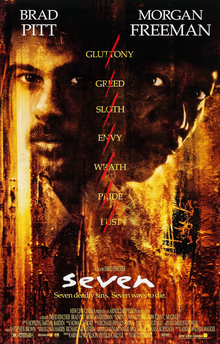
Seven-1995

Seven-1995

Director David Fincher

Starring Brad Pitt, Morgan Freeman

Top 250 Films #230

Scott’s Review #780
Reviewed June 29, 2018

Grade: A-

Many films containing a similar theme as Seven (1995) have come along over the years- some good, most mediocre.

The mixture of homicidal detectives tracking crazed killers has been done ad nauseam and more often than not, done with either poor writing or a predictable outcome, or both.

Instead of being a run-of-the-mill film, Seven serves as a blueprint for the tautness and unpredictability achievable with a familiar yet compelling concept, provided there is good writing and direction.

The film is incredibly brutal and riveting.

Respected director David Fincher assembles an all-star cast of Hollywood heavies, including Brad Pitt, Morgan Freeman, Kevin Spacey, and Gwyneth Paltrow, all of whom lend their talents to the well-crafted script.

It also raises the talent level to a respectable level, and, as great as the story is, with weaker actors, the stakes would not have been as high, and the film might even have been ruined.

A serial killer is on the loose in Los Angeles- detective duo William Somerset (a very good Freeman) is set to retire and is tasked with finding the killer. He is partnered with David Mills (Pitt), a young, hot-tempered man who has just moved to the city with his wife, Tracy (Paltrow).

Unbeknownst to David, Tracy is pregnant and unsure whether to keep the child- this point factors in heavily as events unfold.

The killer is using the seven deadly sins: greed, gluttony, sloth, lust, pride, envy, and wrath, as his motivation for the creative slayings.

In retrospect, Seven is very similar to the still-to-come Fincher work, 2007’s Zodiac, so much so that both films could be watched in sequence- one being a true story, the other pure fiction.

Both focus on the serial-killer element with a message; each has marvelous psychological intrigue and purpose. There are cat-and-mouse scenes aplenty for fans to enjoy.

At the risk of this point being a total stretch, I’d also argue that 1971’s Dirty Harry influenced Zodiac, Seven, and The Silence of the Lambs (1991).

A heinous killer shrouded in intelligence, danger, and motivation is a commonality of all of the aforementioned films, and numerous studies of each of the killers could be dissected if time permits.

Each killer is calculating and manipulative.

On that note, Kevin Spacey gives a tremendous performance as the cold and villainous John Doe. Clever and inventive, his victims are intended to suffer and suffer greatly.

Some of the kills could be included in the best of the torture-horror franchise, Saw (2004), as they are very twisted and brutal.

A supermodel is disfigured after being given a choice to call for help or overdose on pills, representing pride. A man is forced to consume food until his stomach ruptures, representing gluttony.

Spacey portrays his role as calm, cool, and collected, eliciting a terrifying response from audiences, especially as he toys with the detectives.

Still coming into his own as an actor in 1995, Pitt proves he can almost measure up (though not quite) with big-boy acting talents Spacey and Freeman.

Playing an ambitious man eager to prove himself in “the big city” with his pretty wife in tow, Pitt’s David is wholesome and family-oriented, yet has an edge.

All around the likable hero, Pitt is perfectly cast in the role and a large part of the film’s success.

The frightening final sequence still resonates with me after all of these years since Seven was released. In a classic standoff between Doe and the detectives, as is typical in these films, the climax is twisted, psychological, and gruesome.

I did not see this shocker coming, as it culminates in lives being forever changed. The expressions and actions of Freeman, Pitt, and Spacey are superlative.

Seven (1995) is a film basking in riches. On par with the best of the best in serial killer films, it is powerfully directed by Fincher. The film is fraught with grisly symbolism and its share of suspenseful sequences.

With powerful performances, it is a film that remains relevant and watchable decades after its original release.

Perhaps not quite on the level as Dirty Harry or The Silence of the Lambs, but pretty damned close, and that is impressive in itself.

Oscar Nominations: Best Film Editing
I Am Sam-2001

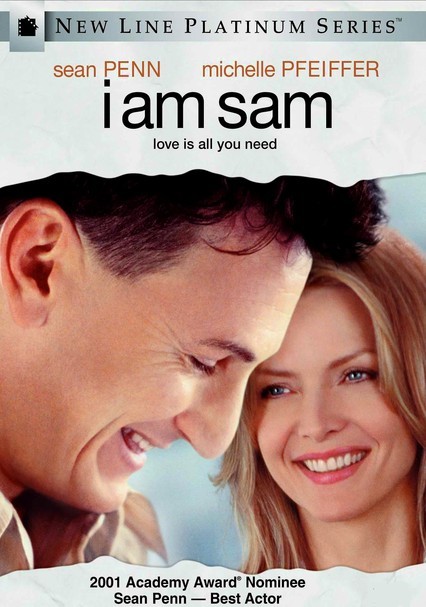
I Am Sam-2001

Director Jessie Nelson

Starring Sean Penn, Michelle Pfeiffer

Scott’s Review #1,097

Reviewed December 30, 2020

Grade: B-

Sean Penn stars as a mentally disabled man who fathers a child and is determined to cling to the custody of her after he is deemed unfit to parent in I Am Sam (2001), a drama that garnered Penn an Oscar nomination.

The brilliant actor may have deserved the win, since he breathes life into a film riddled with every imaginable cliché.

Aside from his performance and that of the novice Dakota Fanning, the film would be drivel.

As it is, it’s mediocre at best.

Somewhere, sometime, somehow, in cinema history, the consensus became that if an actor plays a mentally challenged character, they are assured an Academy Award nomination.

Juliette Lewis tried and failed with the cringeworthy The Other Sister (1999), but Penn has better credibility. Dustin Hoffman also succeeded with Rain Man (1988).

Sam (Penn) is a well-adjusted man and has a supportive group of friends with disabilities.

His neighbor, Annie (Dianne Wiest), assists in raising Sam’s daughter, Lucy (Fanning), but the eight-year-old quickly exceeds her father’s mental capacity, leading to frustration and conflict.

Lucy’s mother, a homeless woman, has vanished from the scene.

The justice system determines that Lucy must be placed with a foster family led by Randy (Laura Dern), prompting Sam to hire a no-nonsense attorney, Rita (Pfeiffer). Both Randy and Rita sympathize with Sam and must convince the courts that he can raise her.

Jessie Nelson, who directed I Am Sam, also directed safe films like Corrina, Corrina (1994) and Stepmom (1999), so her intention to present a warm, soft experience is easy to discern.

This is not meant to criticize her direction style as much as to point out that the result is not a hard-edged, gritty experience.

It’s a crowd-pleaser, and there is never a moment where Nelson wants the audience to root against Sam keeping custody of Lucy, regardless of the reality.

Penn saves the film from being a complete stereotype. It’s apparent that Sam adores Lucy, and the actor is not afraid to cry and express genuine emotion on cue. He’s a great actor and makes the most out of the role.

He does his best to insinuate that mentally challenged people are like everyone else- they can keep a job, pay bills, hire a lawyer, and fight for their kids. His task is tough, but he succeeds.

That’s what raises I Am Sam as an overall product.

Fanning, who in 2001 was about to embark on a fabulously rich acting career, is wonderful. Unlike many child actors, cast because they are cute or bubbly, she has real acting chops. She is neither girly nor overly sad.

Fanning is as strong, focused, and detailed as her eight-year-old character is.

Speaking of stereotypes, Pfeiffer is awarded the grand prize in female attorney banality. She is haggard, absorbed in her work, and has no time for her son, taking Sam’s case only to prove she is a kind person, since she agrees to pro bono work.

Predictably, she realizes through Sam that she is wasting her life away, leaving her husband and spending more time with her son.

Dern does her best with a weak role as the one-dimensional foster parent who realizes she cannot be half the parent Sam can be.

The film’s title is derived from the opening lines “I am Sam / Sam I am” of the book Green Eggs and Ham, which is read in the movie.

This makes the film showcase sentimentalism and hammers home the point that the mentally disabled are child-like and need the help, patience, and understanding of non-disabled adults, as if that isn’t obvious.

The conclusion to I Am Sam is expected.

The lengthy courtroom scenes are wrapped in a nice, shiny bow as Sam predictably retains custody of Lucy. At the same time, the supporting cast gathers on a soccer field and dutifully gushes with delight at how great a father he is.

This is a fine tribute or fantasy, and if only real life were like this, what a better world it would be. I would have preferred a story with more meat.

I Am Sam (2001) is recommended only for huge Sean Penn fans or those who desire an overly sentimental experience.

It might have been better suited for Lifetime television.

Oscar Nominations: Best Actor-Sean Penn

Clemency-2019

Clemency-2019

Director Chinonye Chukwu

Starring Alfre Woodard, Richard Schiff

Scott’s Review #1,068

Reviewed October 7, 2020

Grade: A-

I will be candid. Clemency (2019) is not a film that will appeal to everybody’s taste.

The topics of prison, execution, and psychological conflict among its characters are pretty heavy.

After a long day of work and the desire to snuggle on a comfy couch with a tall glass of wine, this film may not be recommended. But, for those seeking a thought-provoking experience about timely and serious social issues, with racial overtones, Clemency is a riveting and powerful story.

This film is written well, and it matters.

Haggard, prison warden Bernadine Williams (Alfre Woodard) trudges along day after day, managing the multitude of tasks that her job requires of her. She is committed to overseeing the prison executions and experiences her twelfth at the start of the film.

The procedure is botched, causing the prisoner excess pain, and an investigation is launched. Bernadine is conflicted and consumed by her job, causing her marriage to Jonathan (Wendell Pierce) to deteriorate and her visits to a local watering hole to increase.

When Bernadine takes interest in Anthony Woods (Aldis Hodge) a prisoner slated for execution in a case receiving national media attention and prison protests, her conflict escalates.

Anthony’s ex-girlfriend (Danielle Brooks) and attorney (Richard Schiff) play vital roles, especially when the convicted cop killer’s innocence is called into question.

Will he or won’t he receive a last-minute pardon from the governor sparing his life?

Chinonye Chukwu, a rookie director, is a black, Nigerian female with lots of interesting things to say and a bright future ahead of her. She also penned the screenplay and tackles a weighty issue of great controversy in the United States.

The age-old debate of whether capital punishment is inhumane or even deters crime is not the focus of the film’s narrative, but neither is it about that per se.

The fact that Chukwu and her characters, Bernadine and Anthony, are both black introduces an additional racial element.

In the time of “Black Lives Matter”, this is a powerful statement.

To say that Clemency is a downer is an understatement, though it leaves the viewer with some sense of hope amid an ambiguous ending. I won’t spoil the film, but we wonder what will become of Bernadine.

Has she had enough of the prison lifestyle and decided to fly off in a new direction, or does her work so consume her that she is trapped for life, too far gone for any growth?

The final sequence is brilliant.

An impending execution, emotional goodbyes are said, and a full minute or so of a close-up scene focused on Woodard’s face taps a range of emotions that include compassion, disgust, and unbridled sadness.

The gloomy and stark atmosphere that Chukwu presents fills the film with a bleakness that is eclipsed ever so slightly by the possibility of change.

A common theme, and not only with Bernadine, is the need to be heard and the frightening perception of being invisible. Jonathan, in a strong supporting role by Pierce, is the perfect husband. A teacher, he is responsible, loyal, and even prepares a surprise dinner on their anniversary.

He feels diminished by Bernadine and resides in a motel after he has had too much. Anthony’s attorney and a priest, both of whom plan to retire soon, feel their jobs are pointless, as they are not heard and their work is neither appreciated nor noticed.

Interesting that Chukwu does not reveal which state within the United States the twelve or thirteen executions take place in, though we can only guess it’s somewhere in the south.

Clemency (2019) is a bold offering fraught with debate, questions, and character conflict. A slow build, there is much to savor and mull over, and the story feels personal.

Woodard delivers a soaring performance, backed by exceptional work from all the supporting players.

I cannot wait to see what Chukwu comes up with next.

Independent Spirit Award Nominations: Best Feature, Best Female Lead- Alfre Woodard, Best Screenplay