Tag Archives: Kim Novak

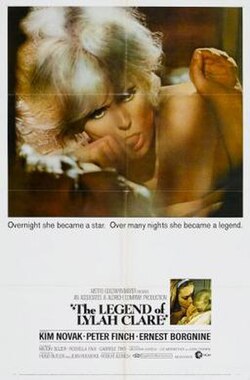
The Legend of Lylah Clare-1968

The Legend of Lylah Clare-1968

Director Robert Aldrich

Starring Kim Novak, Peter Finch

Scott’s Review #1,554
Reviewed September 27, 2026

Grade: B

Kim Novak stars in a 1968 psychological thriller named The Legend of Lylah Clare, a film on the surface similar to her legendary turn in Hitchcock’s Vertigo ten years earlier.

Like Vertigo, she plays two characters, both shrouded in ghostly mystery, as one is dead. Other characters are obsessed with the dead one.

Lylah Clare isn’t as good as Vertigo, so the parallels are limited.

The film has positives and negatives that create an uneven viewer experience. The bizarre environment raises suspicions of story changes or behind-the-scenes conflict, as something feels a bit off.

I much preferred the first half to the second, as what starts as an intriguing, mysterious promise goes off the rails and leads to more confusion than satisfaction.

A renowned German actress who died years earlier, Lylah Clare (Novak) is the subject of a film developed by volatile movie producer Barney Sheean (Ernest Borgnine).

An agent, Bart Langner (Milton Selzer), finds Elsa Brinkmann (also Novak), a beautiful woman who looks just like Lylah, and sets about getting the movie off the ground.

Lylah’s ex-husband, Lewis Zarken (Peter Finch), directs the film and begins to fall in love with Elsa as he coaches her to act just like his late wife.

Director Robert Aldrich has a vast filmography, but Lylah Clare most resembles What Ever Happened to Baby Jane? (1962) and Hush…Hush, Sweet Charlotte (1964), mostly in terms of a gothic environment and the fear of being made irrelevant.

Zarken’s looming Los Angeles mansion is the backdrop for much of the film. Its illustrious yet stuffy veneer hides dark secrets revealed through flashbacks, and the set is a main highlight.

I was immediately drawn into the story and the ‘legend’ by hints of what’s to come. Enormous portraits of Lylah adorn the estate, the most prominent being a lavish one on the steep staircase in the living room.

Shown to have been attacked by a fan who gained access to the mansion, Lylah was able to make the man fall down the staircase to his death. Afraid of heights, Lylah then fell and died after looking down at the corpse.

Is this the truth? What is Zarken hiding? Does Lylah’s acting coach, Rossella, know secrets? Did the fan have secrets?

The past is shrouded in mystery, and multiple characters’ obsessions with Lylah are very tantalizing.

Additionally, Elsa seems obsessed with Lylah even before she is cast to play her. Are they the same, like in Vertigo?

A deliciously satisfying scene is delivered at a party meant to debut Elsa’s new look as Lylah. Mean journalist Molly Luther (Coral Browne) prods and insults Elsa until Lylah emerges to put the wicked witch in her place.

It’s the first public appearance of Lylah as Elsa, and she quickly pounces on her foe in shocking form.

These elements make The Legend of Lylah Clare so compelling in the first half.

Slowly, the film began to unravel.

As Elsa begins to belt out a perfect German accent and switch into Lylah mode, summoning her wardrobe staff, or refusing to emerge onto the set, it feels terribly uneven and out of character.

I love Novak, but I’m not sure I love her in these roles. Since the characters don’t feel right, it must have been hard for the actress to play them well.

I couldn’t help but wonder whether Elsa couldn’t get into Lylah, or whether Novak couldn’t do the same.

And the obvious dubbing of Lylah’s German accent is very weird.

Zarkan’s back-and-forth personalities are too much. He goes from madly in love and smitten with Lylah to berating her on the movie set, back and forth.

In the final chapter, he basically causes Elsa’s death by coaxing her to look down from a trapeze set for no reason.

The film is billed as a satire and is assumed to examine the shark-like Hollywood world. The number of hateful characters (Molly, Zarkan, Barney) reinforces this.

A seemingly added TV commercial for dog food interrupts the film itself, suggesting that Hollywood is literally a dog-eats-dog world.

The last scene of Rossella drunkenly sitting on the couch watching the commercial and loading a gun, assumed to be to shoot Zarkan, is murky at best.

While confusing, The Legend of Lylah Clare (1968) has enough appeal to be a suggested watch.
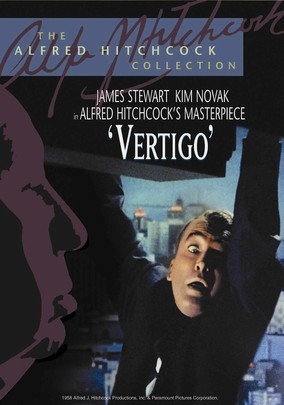
Vertigo-1958

Vertigo-1958

Director Alfred Hitchcock

Starring James Stewart, Kim Novak

Top 250 Films #1

Scott’s Review #151

1089727

Reviewed August 7, 2014

Grade: A

Over the years, Vertigo (1958) has quickly become one of my favorite Alfred Hitchcock films. With each repeated viewing, I learn, appreciate, or see something new.

It is an absolute masterpiece.

The primary appeal of Vertigo lies in its mystique and dream-like quality, which offer a beautiful cinematic experience. It is sometimes ominous, psychological, gloriously complex, and even confusing.

That is what makes it extraordinary.

Considering the time, the colorful opening visuals are dynamic, groundbreaking, and stunning.

The story involves a retired detective, Scottie, played by Hitchcock stalwart Jimmy Stewart. Scottie suffers from vertigo, which hinders his daily life.

After an incident in which a police officer is killed, and Scottie blames himself and his vertigo for causing the death, he whiles away the days brooding and keeping companionship with Midge, a college friend to whom he was once engaged.

One day, he is hired by another college friend to follow his wife, played tremendously by Kim Novak, who is acting strangely and periodically disappearing, obsessed with a painting of a woman from years past.

From this point, the plot twists and turns in a mysterious fashion, and a romantic, bizarre, and obsessive love story is intertwined.

Is Scottie in his right mind? Will his vertigo continue to haunt him? What is the secret to Madeleine and Judy? Is Midge as sweet as she appears?

The score to Vertigo is haunting and unforgettable, adding significantly to the film’s mood and ambiance.

Several location shots are featured in San Francisco, including the Golden Gate Bridge, steep streets, the Mission District, and the Redwood Forest.

As with all Hitchcock films, every set and detail is perfect, from paintbrushes, coffee mugs, curtains, and furniture to the gorgeous, bright red décor of the restaurant, which is heavily featured in the film.

How exquisite does Kim Novak look in the film??

Initially, it was critically panned upon its release, but it is now considered one of the greatest films. Its unique camera angles and slow, methodical pacing have influenced other films.

The film is not always an easy watch; it is complex, to be fair, but, like a fine wine, it improves with age.

Vertigo (1958) is a layered psychological thriller that gains more appreciation with each viewing.

Oscar Nominations: Best Sound, Best Art Direction

Picnic-1955

Picnic-1955

Director Joshua Logan

Starring William Holden, Kim Novak

Top 250 Films #81

Scott’s Review #550

Reviewed December 19, 2016

Grade: A-

Picnic is a classic 1955 film that is wonderful to watch over Labor Day weekend or anytime during the summer.

The film perfectly depicts summertime in a tiny town in Kansas. It is a slice-of-life story about life in middle America during the 1950s, despite its trials and tribulations.

William Holden stars as a “wrong side of the tracks” type of guy who arrives in a quiet Kansas town on Labor Day weekend, disrupting the town’s events and causing scandals for the townspeople.

He is a hunky former college football player and exudes sexuality.

He then falls in love with his best friend’s girlfriend, Madge Owens, played by Kim Novak. The chemistry between the two stars is the film’s main appeal.

The supporting cast makes this film unique (Arthur O’Connell and Rosalind Russell star as townspeople who are in a relationship of their own).

Picnic also features a gorgeous, lovely musical score, specifically “Theme from Picnic” and “Moonglow”.

It is shot on location in Kansas, mostly in and around Hutchinson, and is considered classic summer enjoyment.

Based on the Pulitzer-award-winning play.

Oscar Nominations: 2 wins-Best Motion Picture, Best Director-Joshua Logan, Best Supporting Actor-Arthur O’Connell, Best Scoring of a Dramatic or Comedy Picture, Best Art Direction, Color (won), Best Film Editing (won)

Golden Globe Nominations: 1 win-Best Director-Joshua Logan (won)

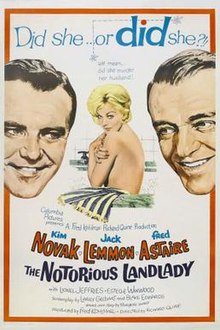
The Notorious Landlady-1962

The Notorious Landlady-1962

Director Richard Quine

Starring Kim Novak, Jack Lemmon, Fred Astaire

Scott’s Review #1,390

Reviewed August 16, 2023

Grade: B+

If viewers can overlook The Notorious Landlady (1962) ‘s messy nature and intermittent schizophrenic pacing, the film is enjoyable.

It’s not platinum status, but it’s a decent enough flick, especially for Kim Novak and Jack Lemmon fans, who were big stars. This is the third and final film that the duo starred in.

Like the film, their chemistry fluctuates, but it is appealing to see Novak in a comic role, whereas the genre is familiar territory for the funny Lemmon.

After her husband mysteriously disappears, Carly Hardwicke (Novak) finds renting a room in her lovely London apartment impossible because everyone assumes she’s responsible.

American diplomat William Gridley (Jack Lemmon) is new to the city and desires to live with Carly. It doesn’t hurt that Carly is easy on the eyes. William becomes smitten with her, unaware of her troubles.

When his boss, Franklyn Ambruster (Fred Astaire), learns what Gridley has stumbled into, the two men try to clear her name. A series of lies and misunderstandings catapult events into a compelling mystery.

Even though neither William nor Carly is British, the foggy locale works well and provides a foreign mystery. They reside in a courtyard-type home, from which neighbors can see in or out to other apartments. This comes into greater play towards the end of the film.

This is just one example of Alfred Hitchcock’s influence on 1954’s Rear Window, which director Richard Quine heftily borrows. He’s wise to do so since he secured Novak, fresh from her role in Vertigo (1958) two years earlier.

Shit, even the title ‘The Notorious Landlady’ borrows the title of the 1946 Hitchcock masterpiece, ‘Notorious.’

There’s also a secret locked door that Carly references and forbids anyone from entering, adding suspense and foreboding.

Despite the tepid chemistry between the stars, I ultimately enjoyed their romance. It’s a hard sell that the gorgeous Carly would fall head over heels for the everyman William, but she does.

They win me over during a dramatic scene where an attempted romantic dinner of steaks goes awry, and instead, a massive fire erupts. The burgeoning lovers cling together in a sweet embrace that cements their appeal.

The tension is supposed to be about whether Carly murdered her husband and has designs on William. Red herrings like kitchen poisons and the like make an appearance, but I was more interested in the impending mystery of said husband than really believing she’d want to kill William.

The last act introduces a threatening character, an unexpected villain, and a race to save another character in dangerous peril.

A courtroom scene also adds to the tension.

The central storyline is satisfying, edge of your seat, and suspenseful. I assume Quine was going for it.

The Notorious Landlady shifts genres a whopping three times in the story! The tone is all over the place: first, romantic comedy, then suspense and drama, and finally, slapstick.

During the finale, when Carly and William race to a retirement community and scramble to stop an out-of-control wheelchair, I half expected Laurel & Hardy or The Little Rascals to make a cameo.

Poor Fred Astaire has little to do and struggles to be relevant compared to Novak and Lemmon’s characters. At times, I even forgot he was still in the film.

The Notorious Landlady (1962) is an entertaining vehicle and a must-see for fans of Novak or Lemmon eager to see a largely forgotten film that offers something fun.

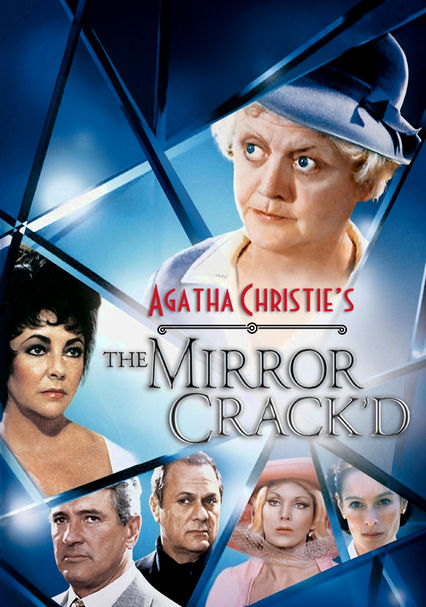
The Mirror Crack’d-1980

The Mirror Crack’d-1980

Director Guy Hamilton

Starring Angela Lansbury, Elizabeth Taylor, Rock Hudson

Scott’s Review #1,371

Reviewed June 22, 2023

Grade: B+

I’m a sucker for any sort of whodunit, especially based on an Agatha Christie novel.

Some of her treasures, like Murder on the Orient Express (1974) and Death on the Nile (1978), have made for quality crime-thriller filmmaking.

With The Mirror Crack’d (1980), director Guy Hamilton (he directed four James Bond films) gathers some of Hollywood’s finest stars and crafts an adaptation with British authenticity and a knock-it-out-of-the-park finale twist I didn’t see coming.

Fans of the long-running CBS sleuth series Murder, She Wrote from the 1980s are treated to gleeful clues that the film influenced the show. Both star the iconic Angela Lansbury.

The main character and murder solver in The Mirror Crack’d is a kindly older woman named Miss Marple, played by Lansbury. The actress is aged via makeup to look much older than she was at the time. Lansbury does a good job with the speech and mannerisms of her character’s age.

Jane Marple (Lansbury) is tickled pink when two glamorous Hollywood actresses, Marina Rudd (Elizabeth Taylor) and Lola Brewster (Kim Novak), arrive in her quaint English village to shoot a movie.

Drama is sprinkled in when it’s revealed that the two actresses despise each other.

At a film-related welcome reception, Marina engages in conversation with a longtime fan, Heather Babcock, and is momentarily distracted. Soon afterward, the fan collapses and dies, poisoned by a drink intended for Marina.

Pleasure is had by the incorporation of so many stars, some way past their prime.

My favorite is the dynamic duo of Taylor and Hudson as a married couple. Fans will recall that Hudson’s sad death due to A.I.D.S. in 1985 led to Taylor championing a crusade for research with which the government then refused to be associated.

Her efforts and star power led to tremendous progress to be made as the disease ravaged the world’s LGBTQ+ community.

So, any scene centered on Taylor and Hudson is heartfelt and a pure treat.

Otherwise, the cast of characters is arranged in a familiar pattern, revealing that almost everyone would have a reason to kill the glamorous star. Could it be her sexy blonde rival? Or the cranky producer of the film played by Tony Curtis? Or even her hubby, Jason?

Geraldine Chapman appears as Ella Zielensky, who is secretly in love with Jason and has a good reason to want Marina out of the way. Especially suspicious are her trips to a phone booth to call an unknown person, accusing them of murder.

The setting adds value as the small English village is cute and picturesque. Marple’s cottage is perfectly dressed with colors and patterns well suited to her character.

The Mirror Crack’d has a couple of misfires and sometimes a television-movie feel. The comparisons to Murder, She Wrote, while nice, are also detractors since they make the film seem like a small-screen effort.

The time is supposed to be 1953, and the characters are dressed appropriately, but it doesn’t feel authentic. The real year 1980 feels more believable despite the costumes.

While it doesn’t drag a bit, it also isn’t quite as good as the aforementioned Murder on the Orient Express (1974) or Death on the Nile (1978).

For a good old-fashioned detective story based on a storied author, one could do worse than watching The Mirror Crack’d (1980).

Sure, there are other, better-produced efforts, but the film is a solid, entertaining watch with glamorous stars incorporated.

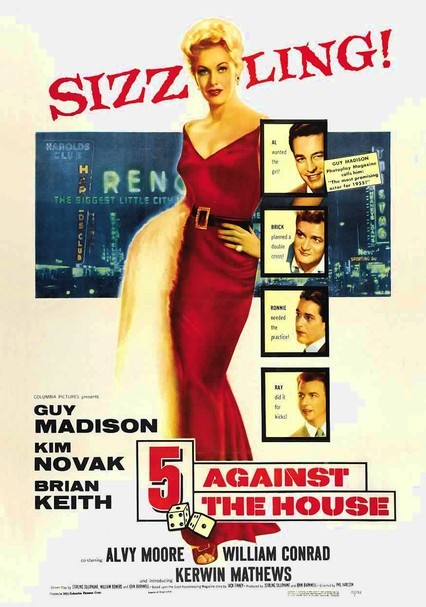
5 Against the House-1955

5 Against the House-1955

Director Phil Karlson

Starring Brian Keith, Kim Novak

Scott’s Review #998

Reviewed March 11, 2020

Grade: C-

5 Against the House (1955) is a film that may have influenced heist films such as the Rat Pack Ocean’s 11 (1960) or countless other films featuring groups of young men holding up an establishment for money.

The film is mediocre and lacks memorable content. Nothing distinguishes it from other movies with similar themes.

Star Brian Keith is charismatic in the lead, but the chemistry with Kim Novak goes nowhere with any of the actors.

The film is mildly interesting, with a few tense moments but little more. 

Four Midwestern University college pals, Brick (Keith), Al (Guy Madison), Ronnie, and Roy, devise a grand casino heist while drunk and partying one weekend in Reno. The idea is to go through with their plan and then return the cash to prove they can get away with the high-stakes prank.

But when one of the group betrays the others and plots to keep the money for himself, he imperils them all.

Novak plays Kaye, Al’s girlfriend, who recently became a singer at a local nightclub.

The standouts from the cast are Keith and William Conrad because the then-unknown actors became television stars in later years, for Family Affair and Jake and the Fat Man, respectively.

Keith is great in the lead role of Brick, the tormented and conflicted ex-veteran of the Korean War, unable to forget tragedies he saw while abroad. He is a remarkable every man with an edge, angry and out to prove something to the world. He also needs the money that the heist will provide him.

The character is interesting and empathetic.

Conrad is gruff and memorable as a cart operator who plays an essential role in the film’s finale. Sent to retrieve cash from the money room, using the prerecorded message to make him believe that there is a desperate man with a gun in the cart who will shoot him if he does not cooperate, Conrad does wonders with his eyes and facial expressions.

The luscious Novak, soon to be a household name in the stunning and cerebral Alfred Hitchcock film Vertigo (1958), is not as compelling as Kaye.

The main reason is that she has little to do but stand around and serve as window dressing. This is too bad since the actress has talent and charisma for miles, but this work is beneath her.

It was not her debut but one of her early films, What’s a Girl to Do? To add insult to injury, another singer dubbed her voice. Novak needed the paycheck.

Director Phil Karlson is unsuccessful at bringing the picture entirely- circle but does pepper in some nice exterior night scenes of Reno. The casino sequences are commendable, and the set pieces are properly zesty and flashy when appropriate.

However, trimmings never complete a film, and 5 Against the House needs more meat on the bone than it serves up.

The heist is the main attraction. Some tension does exist, but not enough, and the finale is a letdown. After the unspectacular robbery, Brick leaves the others behind and escapes with the money. A pursuit ensues. Kaye, having alerted the police, follows them, and a tepid standoff follows.

Ultimately, Brick changes his mind while Al and Kaye embrace on a crowded street. The feeble final scene is a romantic sendoff for the couple, who didn’t have much chemistry.

5 Against the House (1955) contains an adequate cast and a few positive tidbits worth mentioning, but the story is way too predictable. The conclusion, which should be the high point, disappoints, and the actors are too old to be believable as college-aged students.

Many other film noir or heist films released before or after this film are superior and better crafted.