Tag Archives: Mia Wasikowska

The Kids Are All Right-2010

The Kids Are All Right-2010

Director Lisa Cholodenko

Starring Annette Bening, Julianne Moore

Scott’s Review #560

Reviewed December 24, 2016

Grade: A

The Kids Are All Right is a fantastic film!

In my opinion, the film is one of the best of the year 2010 and was rewarded with a deserving Best Picture nomination.

Annette Bening and Mark Ruffalo were also honored with acting nominations. Bening gives the best performance in the film.

Continuing the trend of more exposure to LGBT issues, The Kids Are All Right tells of a same-sex-centered family dealing with real issues.

Though not dark, the film is not light or played strictly for laughs. It is a family drama that shows how same-sex family units face problems like everyone else, and how they deal with them, never forgetting how much they love each other.

The writing is intelligent, deeply layered, and rich. The acting is superb, and the characters are complex.

The best scene is one where the entire family is eating dinner- suddenly the camera focuses on one person and goes into slow motion; the other voices become muffled and distant, and painful emotion is portrayed on one of the characters’ faces as a revelation comes to the surface.

Brilliant.

Even the seemingly unimportant dialogue throughout the film is smart, as it shows the bond of the family that cannot ultimately be broken.

The Kids Are All Right (2010) is a worthwhile and compelling film.

Oscar Nominations: Best Picture, Best Actress-Annette Bening, Best Supporting Actor-Mark Ruffalo, Best Original Screenplay

Independent Spirit Award Nominations: 1 win-Best Feature, Best Director-Lisa Cholodenko, Best Female Lead-Annette Bening, Best Supporting Male-Mark Ruffalo, Best Screenplay (won)

Maps to the Stars-2014

Maps to the Stars- 2014

Director David Cronenberg

Starring Julianne Moore, Mia Wasikowska

Scott’s Review #266
80013474

Reviewed August 14, 2015

Grade: A-

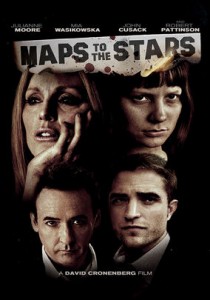
Maps to the Stars (2014) is a bizarre, unpleasant film that is as dark and perverse as it is provocative and fascinating to observe and ponder.

It feels more like an independent art film than a blockbuster Hollywood project, and it was made by an arguably mainstream director, David Cronenberg (Crash-1996, The Fly-1986).

I am surprised it could be made on a large-scale budget given its negative portrayal of actors and celebrity types, specifically troublesome starlets and child stars.

One must be wary of biting the hand that feeds.

Maps to the Stars is a film where almost all the central characters are unlikable- difficult, unstable, self-absorbed, or all of the above.

The subject matter is ugly but fascinating to me.

The wealthy and glamorous are interesting and, at times, the film is like a Greek tragedy containing Shakespearean elements- think Romeo and Juliet in an incestuous way times two.

You have to watch this film to see what I mean. Hint: it contains the ick factor.

The plot centers on a Hollywood family in which the son is a famous child star and the primary breadwinner. They are the Weiss family- all struggling to either find success or hang on to it, all the while each of them is neurotic.

The father, Dr. Samuel Weiss, played by John Cusack, is a TV psychologist, hired by Havannah Legrand (Julianne Moore), a highly self-centered, aging actress, struggling to land a coveted role-playing her mother.

Her mother was a young actress in her day, who tragically died in a fire. Havannah despises her due to claimed childhood abuse.

Cristina Weiss (Olivia Williams) is Samuel’s wife. This controlling, ambitious woman strives to get the most money out of her son Benjie, a Justin Bieber-type character with a troubled streak.

Rounding out the family is Agatha Weiss, a troubled teenager, sent away for years after giving her brother pills and setting her parents’ house on fire.

Though not directly related to the Weiss family, Havannah and the limo driver, Jerome Fontana (Robert Pattinson), become heavily involved as events unfold.

It reminded me of a myriad of other influential film directors in peculiar ways.

I noticed elements of David Lynch’s Mulholland Drive (1992), for instance, in a dark, clever mood and the obvious setting of Los Angeles- even the score is similar during parts of the film, as the moody, monotone sounds play in the background.

The Ice Storm (1997), American Beauty (1999), and Magnolia (1997) also sprang to mind for their dark, strange worlds (Magnolia) and their inclusion of the dysfunctional-family element (The Ice Storm and American Beauty).

Furthermore, to a lesser extent, I saw some Robert Altman ingrained in Maps to the Stars.

These aspects are a major reason I loved the film so much.

A prevalent theme throughout Maps to the Stars is one of burning- a victim of burning, a fire set, a character setting oneself on fire. Some characters see dead people. Havannah regularly sees her dead mother.

Benjie sees a young girl whom he visited in the hospital before she died; her last wish was to meet the big star.

She suffered from non-Hodgkin’s lymphoma, which he foolishly thought was AIDS. He sees her in visions and tries to strangle her, instead of strangling an innocent living person.

The film is a weird trip, and the viewer dreads an oncoming dark moment.

When Benjie carelessly plays with a gun that he assumes is unloaded, we know trouble will occur. He is showing off at an actor friend’s party along with equally obnoxious starlets while talking about poop, all selfish and wanting to party.

When Havannah belittles Agatha, her assistant, we see Agatha’s past anger come back into play as she slowly unravels with rage- Havannah is unaware of Agatha’s knowledge of her betrayal.

One small gripe is the continued use of gross toilet talk in multiple scenes, including a raunchy discussion of a fan buying a well-known actor’s waste for thousands of dollars.

What was Cronenberg’s motivation for this? This was a silly, tasteless, unnecessary element of an otherwise great film.

Maps of the Stars (2014) is dirty and ugly but is also a quirky treasure about bad people in Hollywood. Unpleasant characters whom I could not take my eyes off of.

A brilliant film that delves into Hollywood shallowness and madness and does it in a daring, twisted, wonderful sort of way.

Only Lovers Left Alive-2014

Only Lovers Left Alive-2014

Director Jim Jarmusch

Starring Tilda Swinton, Tom Hiddleston

Scott’s Review #237

Only_Lovers_Left_Alive_English_film_poster

Reviewed April 24, 2015

Grade: B

Only Lovers Left Alive (2014) is a bizarre trip into the strange and unusual world of vampires.

The film moves slowly but becomes hypnotic, drawing me into the plot, though the plot itself seems almost secondary to the film’s gothic mood and dark ambiance.

Thanks to the wonderful Tilda Swinton, who I find mesmerizing in every film role she appears in, the methodical film never completely bored me and, at times, even fascinated me.

Set in the present, Swinton and Tom Hiddleston play vampires named Adam and Eve, lovers separated by distance. Adam is a musician living in a vast Victorian house in Detroit, and Eve resides in Tangier.

Realizing that Adam is lonely and suicidal, Eve makes the international trek to the United States to be with her love.

As they settle into a quiet existence immersed in music and thought, Eve’s rebellious sister, Ava (Mia Wasikowska), from Los Angeles wreaks havoc on their lives.

Also in the film is John Hurt, who plays Marlowe, an ancient vampire who assists Adam and Eve, who succumbs to sickness from tainted blood.

The film is a creative, atmospheric offering from edgy independent film director Jim Jarmusch, known for left-of-center fare like Broken Flowers (2005) and Coffee and Cigarettes (2003), both visual and visceral achievements.

While I didn’t completely love this film, I felt the story is its weakest point; the magical, beautiful arrangements almost make up for it.

Set entirely at night (when vampires are awake) and featuring several shots of Adam and Eve posed naked or almost naked in lovely, artistic angles, I think the film aims as much for a “look” as for storytelling and doesn’t fully center on the plot.

It is also a lovely romantic film, though not in the typical sense of silly misunderstandings and comical moments, but rather in romantic artistry, as Adam and Eve connect spiritually.

Married hundreds of years ago, Adam and Eve have been inexplicably separated by thousands of miles and coasts, though the reason is not explained.

Why are they the few remaining vampires alive? Does the human race know they are vampires or think they are odd-looking people?

They both have money to burn and pay a high cost for being vampires, as they either pay a contact to steal blood from hospitals to survive or obtain the blood elsewhere.

They are tempted to bite humans but resist those urges.

The film doesn’t explain why they are two of the few vampires left in the world, or answer other questions. Adam, supposedly a famous musician, is wealthy beyond words and lives in a haunted-looking mansion surrounded by music and musical instruments.

The plot holes, of course, are secondary to me. None of them matter.

The film has beautiful moments; it is musically centered, and Adam and Eve share tender dances on more than one occasion. The film is a pure love story, but a very left-of-center one.

I admire the film’s creativity and its willingness to go where most filmmakers dare not. Jarmusch dares to be different and deserves much praise.

My main critique is the pacing; the story barely matters, as the film feels more like an art experience than a “mainstream” film with a strong plot and focus.

Only Lovers Left Alive (2014) is a different type of film and one worth admiring.

Independent Spirit Award Nominations: Best Female Lead-Tilda Swinton, Best Screenplay