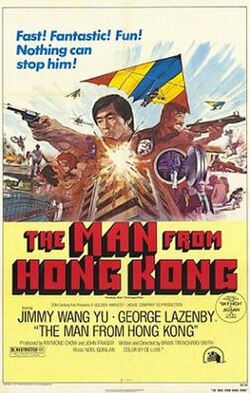
The Man From Hong Kong-1975
Director Brian Trenchard-Smith
Starring Jimmy Yang Yu
Scott’s Review #1,556
Reviewed November 9, 2026
Grade: B+
The Man from Hong Kong (1975) is a fast-paced action vehicle that satires James Bond and Dirty Harry films of the late 1960s and early 1970s.
Our hero high-glides over Sydney, Australia, effortlessly dispatches villains, and is suave with the ladies. Just like Bond or Harry would.
The movie even features George Lazenby, who played Bond in On Her Majesty’s Secret Service in 1969.
It’s a kung fu film new to me, since this is officially the first kung fu film I’ve ever seen, and the fight scenes are plentiful.
The main reason to see the film is that it highly influenced director Quentin Tarantino, who I am a huge fan of. Fans will easily spot sequences in films like Kill Bill (2003-2004) and his other work that follow patterns from The Man from Hong Kong.
A mix of Australian and Hong Kong cultures is used since it’s set in both locales.
I mostly enjoyed the film for Tarantino’s influence and for how he pinpointed aspects he found unique and fascinating. I suspect this is mostly in the fight scenes.
I could easily picture the director as a little kid, mouth gaping open in wonderment in a dark theater.
This felt good to me since I champion cinema and its influences.
Kung fu isn’t my favorite genre, so I quickly got tired of the endless action scenes. I would have preferred a strong plot, but I then realized that wasn’t the point of the film.
A Hong Kong policeman, Inspector Fang Sing Leng (Jimmy Wang Yu), who is a kung fu expert, pursues an Australian drug lord, Wilton (George Lazenby), who’s not afraid to fight back with devious tactics.
Fang arrives from Hong Kong to extradite a Chinese drug smuggler after first bedding a sexy Australian kite flyer and journalist, Caroline Thorne (Ros Speirs).
He meets up with her again later.
The rest of the film involves Fang attempting to find and capture Wilton while Wilton and some henchmen try to evade authorities.
I admire that an Asian character is the central figure of the plot. Fang is charismatic, firm, and tough, but also tender and understanding.
While clearly patterned after Bond or Dirty Harry, he has a likability all his own, mixed with sensitivity.
The fact that he beds caucasian women is a testament to the film’s progressive nature. Too often in cinema pre-1970s, races rarely mixed, and usually Asian characters were linked romantically with other Asian characters.
Lazenby’s Wilton is more cartoonish and played over the top, complete with a silly mustache intact. Still, Lazenby’s cartoon performance is fun, given that he was Bond and now plays a villain.
One can’t help but think the actor loved doing an about-face and given goofy material to sink his teeth into.
I quickly realized it would be wise to focus less on the plot and character development and more on the stunts, action sequences, and visuals.
The choreography and quick nature of the fight scenes are very impressive. With quick editing, snappy camera cuts, and a light-hearted humor, this is the winning formula of The Man From Hong Kong.
The cinematography is impressive and adds a bold statement to both locales. I noticed at least two extended flyover sequences featuring Hong Kong and Sydney, underscoring the multi-regional action.
Since Hong Kong was offered first, it immediately piqued my interest, especially given that I have never been to the region of China or China itself.
Long, aerial shots of the coastal high-rises and lavish sand and waves are featured.
More or less a mirror image of the cinematography used for Hong Kong, the gorgeous beaches and magical lights of Sydney are breathtaking.
Cheesy and not to be taken seriously, The Man From Hong Kong (1975) is an entertaining martial arts film that mixes car chases, romance, and fights in a bombastic way.
And thank you, Quentin Tarantino, for encouraging me to see this film.