Tag Archives: Roy Thinnes

Airport 1975-1974

Airport 1975-1974

Director Jack Smight

Starring Charlton Heston, Karen Black, George Kennedy

Scott’s Review #1,060

Reviewed September 8, 2020

Grade: B+

Possessing all the disaster film genre schmaltz, proper trimmings, and then some, Airport 1975 (1974) is good, hammy entertainment that gleefully satisfies. However, artistic types will be embarrassed to admit how much they like it.

The Towering Inferno (1974) and Earthquake (1974) were among the highest-grossing films of the year, and it is little wonder why. The offering has enough adventure and peril to satisfy the entire family.

I watched this film practically in tandem with Airport (1970) and it feels a letdown by comparison, but that hardly matters. Both are very good.

With great anticipation, the filmmakers paid a ton of cash to secure a bevy of Hollywood stars of yesteryear, ensuring they could rake in the box office.

Most are past their prime but still marketable. What a treat to see legendary silent film star Gloria Swanson playing herself as a passenger.

The unequivocal star and hero of the film is Charlton Heston, as he also was in Earthquake. Karen Black, Myrna Loy, Linda Blair, Susan Clark, Nancy Olson, and George Kennedy (reprising his role from the first Airport) round out the stellar cast.

Worth its price of admission is watching the opening credits to see who is in the cast.

Unlike Airport, which wisely spent much of its time inside the actual airport setting up the events and stories, Airport 1975 takes flight right away and crafts its trials and tribulations within the aisles and cockpit of the plane.

We learn right off the bat that the main romantic couple is Heston and Black. Captain Alan Murdock (Heston) apparently cannot commit to Chief Stewardess Nancy Pryor (Black), and they plan to meet up in Los Angeles to discuss the drama further.

We know they will have more to do with each other as her flight to La La Land takes off.

Quickly, a small plane flown by businessman Scott Freeman (Dana Andrews) is diverted to Salt Lake City airport, and he suffers a massive heart attack while descending.

His plane naturally crashes into the cockpit of the enormous Boeing 747, killing two pilots and blinding the other.

With no one able to fly the plane, Nancy must figure out how to avert disaster as it cascades over mountains and contemplates a fuel leak. Murdock and crew try to land the plane remotely or get somebody up there to save the day.

Predictably, Murdock is that man.

If Airport 1975 weren’t so damned fun, it would be offensive since it’s riddled with gender stereotypes. Screenwriter Don Ingalls composes a project so fraught with machismo and masculinity that the female characters have little chance to do much of anything without being saved by a man.

Let’s cite a couple of examples. Nancy is left alone in the open cockpit to navigate the plane.

Worth mentioning is that her hair remains perfect throughout.

Anyway, Murdock must explain to her how to check various controls, which he does as if she were a five-year-old learning the alphabet, referring to a picture of the “little airplane” and calling her “dear”.

She rattles off a puzzled “what?” before figuring out where or what the “little airplane” is.

Secondary Stewardess Bette (Christopher Norris) is boy-crazy, asking Nancy if the flight crew is “sexy” before making googly eyes at the Latin pilot, Julio (Erik Estrada). He is married, but that doesn’t seem to bother either of them.

They flirt while he orders her to bring him a cup of coffee. The male characters telling the female characters to get them drinks is a common theme in Airport 1975.

Naturally, Murdock eventually makes it on board to take over the controls and land the plane.

We imagine Nancy’s character thinking, “Good Heavens, thank goodness a man arrived just in the nick of time to save all of us!” She is promptly sent to get Murdock a drink and fluff pillows.

But these are gripes I can look past, given that if this film were made in 2020, Nancy would either land the plane or Murdock would be a female character and Nancy a male character.

Imagine that!

The real threats are the peril and drama associated with the events on the flight.

A sick kid (Linda Blair) must reach land quickly so that she can be provided medical assistance, while a crack in the airplane’s ceiling could burst at any moment, killing everyone on board.

For popcorn-fueled entertainment sure to please any viewer, Airport 1975 (1974) is a perfect late-afternoon, rainy-day suggestion.

It is advisable not to look too deeply into the stereotypes and contrived setups, or this will ruin the fun. Instead, hop aboard and enjoy the bumpy flight from the comfy cushions of your living room with the assurance that you will land safe and sound.

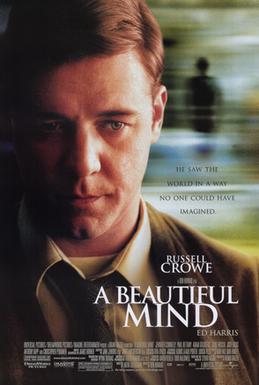
A Beautiful Mind-2001

A Beautiful Mind-2001

Director Ron Howard

Starring Russell Crowe, Jennifer Connelly

Scott’s Review #1,003

Reviewed March 25, 2020

Grade: A-

A Beautiful Mind (2001) is a superior-made film based on the life and times of American mathematician John Nash, a Nobel Laureate in Economics and Abel Prize winner.

The biography explores Nash’s battles with schizophrenia and the delusions he suffered, causing tremendous stress on friends and family.

The film is well-written and brilliantly acted, but deserves a demerit for factual inaccuracies, especially related to Nash’s complex sexuality and family life.

This leaves a gnawing paint-by-the-numbers approach for mass appeal only.

The film was an enormous success, winning four Academy Awards, for Best Picture, Best Director, Best Adapted Screenplay, and Best Supporting Actress. It was also nominated for Best Actor, Best Film Editing, Best Makeup, and Best Original Score.

Arguably one of the best films of 2001, it cemented director Ron Howard’s reputation as a mainstream force to be reckoned with in the Hollywood world.

The project was inspired by the Pulitzer Prize-nominated book of the same name.

Starting in 1947, we meet Nash (Russell Crowe) as a virginal and socially awkward college scholar, studying at Princeton University. He is a whiz at science and mathematics, coming up with unique and dynamic ideas for problem-solving.

Rising the ranks in respectability, he is given an important job with the United States Department of Defense, tasked with thwarting Soviet plots. He becomes increasingly obsessive about searching for hidden patterns and believes he is being followed, sinking further into depression and secrecy.

A Beautiful Mind is an important film because it brings to light the overwhelming issue of mental health and the struggles one suffering from it is forced to endure. Nash largely lives in a fantasy world and has imaginary friends who have followed him for decades by the time the film ends.

Nash conquers his demons with little aid of medication causing a controversial viewpoint. Amazing that the man was able to rise above, but is this a realistic message for those suffering from hallucinations?

Russell Crowe carries the film, fresh off his Oscar win the year before for his stunning turn in Gladiator (2000). He would have won for portraying Nash had he not recently received the coveted prize.

Crowe, hunky at this point in his life, convincingly brings the brainy and nerdy character, rather than the stud, to life, adding layers of empathy and warmth to the role.

We root for the man because he is as much sensitive as he is a genius.

Jennifer Connelly, in what is disparagingly usually described as the wife or the girlfriend role, does her best with the material given. My hunch is her Oscar nomination and surprising win have more to do with piggybacking off the slew of other nominations the film received.

She is competent as the supportive yet strong Alicia, the wife of Nash. In her best scene, she flees the house after a confused Nash leaves their infant daughter near a full bathtub, putting her life in danger.

The most heartfelt scene occurs during the conclusion. After many years of struggle, Nash eventually triumphs over this tragedy, and finally, late in life, receives the Nobel Prize. This is a grand culmination of the man’s achievements and a sentimental send-off for the film.

The aging makeup of all principal characters, specifically Nash and Alicia is brilliantly done.

Despite the heaps of accolades reaped on A Beautiful Mind, several factual points are reduced to non-existence. Questionable is why Howard chose not to explore Nash’s rumored bisexuality, instead of passing him off as straight.

Admittedly, the film is not about sexuality, but isn’t this a misrepresentation of truth? Nash had a second family, which is also never mentioned.

These tidbits eliminated from the film leave a glossy feel like Howard picked and chose what to tell and not to tell for the sake of the mainstream audience.

Bringing needed attention to a problem of epic proportions, A Beautiful Mind (2001) recognizes the issue of mental health in the United States.

The methods may be questionable, and the film has an overall safe “Hollywood” vibe but must be credited for a job well done in a film that is not only important but displays a good biography for viewers eager to learn about a genius who faced unrelenting issues.

Oscar Nominations: 4 wins-Best Picture (won), Best Director-Ron Howard (won), Best Actor-Russell Crowe, Best Supporting Actress-Jennifer Connelly (won), Best Screenplay Based on Material Previously Produced or Published/Adapted Screenplay (won), Best Original Score, Best Makeup, Best Film Editing