Tag Archives: Cyril Delevanti

The Killing of Sister George-1968

The Killing of Sister George-1968

Director Robert Aldrich

Starring Beryl Reid, Susannah York

Top 250 Films #210

Scott’s Review #228
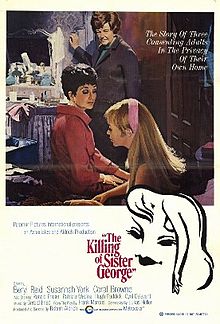
220px-Original_movie_poster_for_the_film_The_Killing_of_Sister_George

Reviewed March 13, 2015

Grade: A-

The Killing of Sister George is a British film drama, adapted from a 1964 stage production that was a risky subject matter to tackle for the times- lesbianism- in the late 1960s.

Directed by Robert Aldrich, well known for Whatever Happened to Baby Jane, The Killing of Sister George is a similarly dark tale of loneliness, desperation, and an actress who falls from former grace and success into despair, confusion, and anguish.

It also has witty, crackling comedic moments that keep it from being a true downer.

Sister George is a successful, well-regarded actress on a popular soap opera named Applehurst. Her character is the wholesome presence in a town fraught with manipulation and drama. She is the show’s moral focal point.

In real life, however, George (interestingly called by her character’s name) is troubled.

She is bitter, angry, and an alcoholic, and she frequently berates and even abuses her partner, Childie, played by Susannah York.

A third central character is TV Producer Mercy Croft, who is powerful and confused about her sexuality.

When the soap opera powers-that-be decide to kill off the beloved Sister George, the real George’s life begins to spiral out of control.

As enjoyable a film as it is and certainly featuring the competent talents of Beryl Reid in the title role, I cannot help but ponder and fantasize how wonderful the casting of Bette Davis- reportedly considered for the role and inexplicably not cast- would have been.

Davis, famous for playing grizzled, mean, unsympathetic characters, would have knocked this role out of the park, and sadly, she didn’t get the chance.

At its core, the film is a sad character study of one woman’s pain and anguish at being discarded. Presumably unable to be hired anywhere else, her soap opera character is her life.

She loves Childie but is not entirely fulfilled by her, either, and the vibrant, polished Mercy threatens that relationship.

This is an interesting triangle as George does not always treat Childie well, but loves her all the same. Childie is a simple character, childlike, and needs a strong mate to counter-balance the way she is- someone to take care of her.

Without a job or prospects, this would be difficult for George. Does Childie love George, or does she want a meal ticket?

The film is understandably rated X for content, presumably for a very explicit sex scene between Mercy and Childie, and when a drunken George molests two nuns in the back seat of a London taxi cab.

These scenes are both cutting-edge and admirable in their risk-taking.

The scene set at the real-life London lesbian club (the Gateway Club) and featuring mostly real-life lesbians is excellent. It provides a real-life glimpse into the gay/lesbian world and lifestyle during the period.

A brave, groundbreaking, risk-taking film with bravura direction from Aldrich, The Killing of Sister George (1968) is a forgotten gem that film fans everywhere need to rediscover and an early journey into gay and lesbian cinema.

Golden Globe Nominations: Best Actress- Drama- Beryl Reid
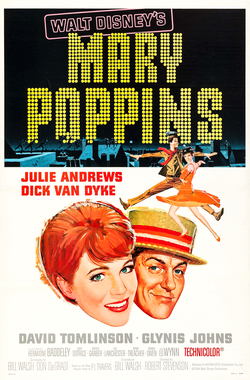
Mary Poppins-1964

Mary Poppins-1964

Director Robert Stevenson

Starring Julie Andrews, Dick Van Dyke

Scott’s Review #965

Reviewed December 9, 2019

Grade: A-

Mary Poppins (1964) is a lovely Walt Disney production that shines with zest and an ample supply of good, cheery tunes. A family affair, it will hardly disappoint, with sing-alongs and enchanting stories for miles.

It’s tough to knock a film that has it all, but it sometimes borders on sickeningly sweet wholesomeness with too much schmaltz mixed in.

This can easily be forgiven because of the robust music, dazzling visual effects, and perfect casting, which make the film enjoyable entertainment for all.

The Banks family resides in London, England. The foursome consists of George and Winifred Banks, along with children Jane and Michael. They live a comfortable and happy upper-middle-class existence.

When their nanny quits after the children run away to chase a kite, the panicked George requests a stern, no-nonsense nanny, while the children (now returned home) desire a kind, sweet one.

Through magic, a young nanny (Julie Andrews) descends from the sky using her umbrella.

Mary Poppins teaches the children to enjoy chores through tunes with the help of a kindly chimney sweep, Bert (Dick Van Dyke).

Mary Poppins cheerily takes the children on several adventures, teaching them valuable lessons. The drama involves light situations such as the irritable George threatening to fire the nanny because she is too cheerful or a mini-scandal at the bank where George works.

These side stories are trivial and non-threatening since the film is really about the antics of the magically odd nanny and her relationship with the children.

The film is unique because it combines live-action with animation and is magical and inventive.

This is most evident during sequences that feature animals, especially the superb scene where Mary Poppins transports Bert, Jane, and Michael into a picture where they ride a carousel and stroll the day away.

The appearance of horses and a fox makes the scene beautifully crafted and filled with joy.

The casting could be no different and is flawless across the board. Standouts are Andrews and Van Dyke, the former appearing in her very first film role.

Not to be usurped by her most iconic role as Maria in the following year’s brilliant The Sound of Music (1965), Andrews possesses a benevolent and delightful spirit that works perfectly in the role, to say nothing of her powerful voice.

Van Dyke, as the romantic interest, is equally well-cast, and together the chemistry is easy and apparent.

Mary Poppins was met with critical acclaim when it was released, when Disney ruled the roost and musicals were a dime a dozen.

It received thirteen Academy Award nominations, including Best Picture—a record for any film released by Walt Disney Studios—and won five: Best Actress for Andrews, Best Film Editing, Best Original Music Score, Best Visual Effects, and Best Original Song for “Chim Chim Cher-ee.”

This was quite a feat as the film was up against My Fair Lady (1964), which won the biggest prize.

Rated G and a box-office success, Mary Poppins (1964) is a legendary Walt Disney film that uses creative techniques and musical numbers to develop a finely finished product.

The song standouts are “A Spoonful of Sugar”, “Chim Chim Cher-ee”, and “Supercalifragilisticexpialidocious”, as each offers candy for the ears and immeasurable fun.

The classic songs and the cohesive sentimentality make this one easy to enjoy with repeated viewings.

Oscar Nominations: 5 wins-Best Picture, Best Director-Robert Stevenson, Best Actress-Julie Andrews (won), Best Screenplay Based on Material from Another Medium, Best Song-“Chim Chim Cher-ee” (won), Best Music Score-Substantially Original (won), Best Scoring of Music-Adaptation or Treatment, Best Sound, Best Art Direction, Color, Best Cinematography, Color, Best Costume Design, Color, Best Film Editing (won), Best Special Visual Effects (won)

Golden Globe Nominations: 1 win-Best Motion Picture-Musical or Comedy, Best Performance by an Actor in a Leading Role-Musical or Comedy-Dick Van Dyke, Best Performance by an Actress in a Leading Role-Musical or Comedy-Julie Andrews (won), Best Original Score-Motion Picture

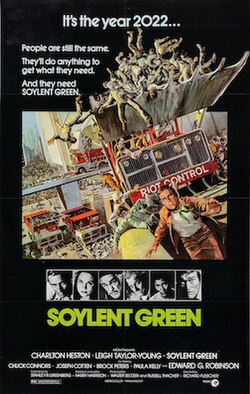
Soylent Green-1973

Soylent Green-1973

Director Richard Fleischer

Starring Charlton Heston, Leigh Taylor-Young, Edward G. Robinson

Scott’s Review #943

Reviewed October 8, 2019

Grade: B

Soylent Green (1973) is a rather obscure offering starring the big-named star Charlton Heston in a dystopian science-fiction film.

The story is futuristic and eerily reminiscent of Planet of the Apes (1968), though not nearly as compelling nor as layered.

The result is admirable for its progressive message, cool colors, and sets, but it feels dated and of its time and treats female characters more like props than characters, leaving an uneven result.

It’s a one-and-done sort of film.

The year is 2022, and because of the Industrial Revolution, 40 million people live in New York City, suffering year-round from extreme humidity due to the greenhouse effect and from shortages of water, food, and housing.

Only the wealthy are afforded necessities, and residents of the rich (mostly female) are referred to as “furniture” and enslaved.

Detective Frank Thorn (Heston) is tasked with investigating the murder of an affluent and prominent man, which leads him to dire details surrounding Soylent Industries and the food they produce.

The film seems like someone’s visionary idea that turned into a Hollywood movie.

Loosely based on a 1966 novel entitled “Make Room! Make Room!” by Harry Harrison, Heston is cast as the lead while his career was slowly declining, but he is still the star and quite hunky for an older gentleman.

He plays a role similar to George Taylor in Planet of the Apes, especially during the final climactic reveal, which will make viewers question what is in their dinner.

Heston carries the film well and mixes wonderfully with character actor Edward G. Robinson, who plays Sol Roth in his final role. The old character decides to “return to the home of God” and seeks assisted suicide at a government clinic.

The final scene between the actors is poignant and heartfelt as they say goodbye. Eagle-eyed viewers will spot a young Dick Van Patten in a tiny role during this scene.

Any romantic chemistry is lacking in Soylent Green as a potential love match between Frank and Shirl (Leigh Taylor-Young) strikes out. Mismatched and with little thunder together, the couple does not look good.

Making matters worse is that Shirl is mere “furniture,” limiting the character’s potential. She is reduced to assisting with Frank’s investigation.

The main detraction is that the film does not feel very futuristic or authentic. The characters look like actors from the 1970s dressed up to look like they are from the future, always with a tint of Hollywood thrown in.

The story loses its way halfway through and teeters between pure science fiction and a standard detective story, seen nightly at that time on network television.

Still, the film does contain a robust amount of potential but does not reach it. The progressive slant and social commentary are admirable, and the bright green, nutritious, synthetic canned food is almost a character in its own right.

The final scene will shock the viewer with horror, and I wish more jaw-dropping scenes existed throughout the experience, not just at the end.

A film that attempts to do something different or provide a provocative message is worthy of a certain amount of praise.

Soylent Green (1973) offers a bit of thought-provoking provocation but seems more relevant to the 1970s than to much interest decades later.

Heston is dazzling as the main character, and the trimmings are impressive, but Invasion of the Body Snatchers (1956) or The Day the Earth Stood Still (1951) resonate more as similar genre films.

Dead Ringer-1964

Dead Ringer-1964

Director Paul Henreid

Starring Bette Davis, Karl Malden

Scott’s Review #67

70001706

Reviewed June 24, 2014

Grade: B+

Dead Ringer (1964) is a black-and-white thriller starring Bette Davis in her final leading role before she took on the character and supporting roles.

Davis plays an interesting dual role, and as a massive fan of hers, I believe two are better than one.

The story centers on a wealthy widow and her twin sister, a struggling bar owner. The two have not spoken in decades and renewed their feud at a funeral.

One sister schemes to cause the other’s death, which results in an entertaining game of mistaken identity.

Davis carries this film and is dynamic in every scene. With her eyes, facial expressions, and throaty voice, her characteristic sexy pose with the cigarette is often utilized.

She is simply dynamic.

The story and plot are carefully crafted, and the angles that show both characters are impressive for the time (1964).

The differing lifestyles of the characters also make for a more challenging performance by Davis.

Karl Malden is a treat as a love interest of one of the sisters.