Tag Archives: Dick Van Dyke

Chitty Chitty Bang Bang-1968

Chitty Chitty Bang Bang-1968

Director Ken Hughes

Starring Dick Van Dyke, Sally Ann Howes

Scott’s Review #1,490

Reviewed August 13, 2025

Grade: B

With a strong connection to James Bond, especially when looking beneath the most obvious details, Chitty Chitty Bang Bang (1968) offers pure escapist fun in the fantasy genre.

Albert R. Broccoli, who produced many of the 007 films, also serves as producer, a surprise given the differing genres. Furthermore, Ian Fleming, who wrote a series of James Bond books, also wrote the novel Chitty Chitty Bang Bang in 1964.

The screenplay was written by the famous British children’s author, Roald Dahl (James and the Giant Peach and Charlie and the Chocolate Factory), whose handprint can be noticed as well.

I missed some of the subtle and not-so-subtle trimmings upon my viewing until taking a deeper dive into research. I also did not know the James Bond connection before watching the film.

One day, in rural England, young siblings Jeremy and Jemima meet the striking Truly Scrumptious (Sally Ann Howes), who falls for their widowed father, Caractacus Potts (Dick Van Dyke), despite coming from different backgrounds.

Potts tinkers with various oddball inventions, including the family’s noisy rebuilt car, Chitty Chitty Bang Bang, which they name because of its unusual engine noises.

Caractacus tells Truly and the children a fantastical fable about the villainous Baron Bomburst (Gert Fröbe) and his evil designs on the Potts family car.

This becomes the central part of the film and the adventurous events that the family experiences.

For much of the film, events meander a bit more than I would have liked, and there seems not to be a clear direction. There were also too many over-the-top moments, mostly involving Caractacus’s wacky father (Lionel Jeffries) and various bumbling villain accomplices.

While enjoyable, the action felt silly and cartoonish.

After the intermission, the family ‘flies’ by car to a lavish castle owned by Bomburst in the childless nation of Vulgaria. There, they encounter frightened townspeople and the scary Child Catcher, wonderfully played by Robert Helpmann.

The colorful sets and art direction lend a helping hand to the secret of why there are no children in Vulgaria. We experience an odd yet witty toymaker played by Benny Hill and a splendid cat and mouse sequence involving human jack-in-the-boxes.

Later, a hidden grotto beneath the castle explains the mystery of where the town children are being kept and why.

While the Baron and Baroness (Anna Quayle) are unbelievably silly, the romance between Caractacus and Truly takes off and cements my investment in the pair.

Obviously and satisfyingly, they experience a happily ever after send-off after a couple of hiccups.

Van Dyke and Howes have dynamic chemistry despite Howes being a runner-up to Julie Andrews, who turned down the role, fearing it was too similar to Mary Poppins.

Fröbe (the diabolical title character from 1964’s Goldfinger) and the actor who played the familiar Bond character, Q (Desmond Llewelyn), make appearances. 

The Chitty Chitty Bang Bang car is practically a character in itself, boasting special powers and gadgets reminiscent of numerous unique Bond cars, and serves as a good comparison.

Finally, the name Truly Scrumptious is a similar character name, albeit much more family-friendly, to Pussy Galore from Goldfinger.

Of course, since Roald Dahl is involved, it’s no wonder children are in peril.

Other than the award-nominated title song, which is easy to hum and hard to forget, the other songs pale in comparison to this standout. I’d give second place to Trudy’s earnest ‘Lovely Lonely Man, a decent song.

For a family-ready affair with deeper particulars for eagle-eyed viewers to spot, Chitty Chitty Bang Bang (1968) is recommended around holiday time when other pleasant children’s musicals make their emergence.

The film would serve as a perfect warm-up act to the superior but companionable Oliver! (1968).

Oscar Nominations: Best Song- Original for the Picture, ‘Chitty Chitty Bang Bang’

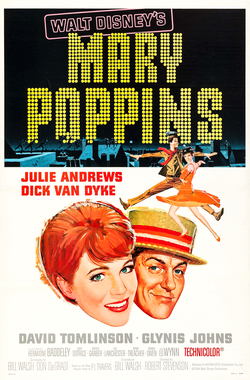
Mary Poppins-1964

Mary Poppins-1964

Director Robert Stevenson

Starring Julie Andrews, Dick Van Dyke

Scott’s Review #965

Reviewed December 9, 2019

Grade: A-

Mary Poppins (1964) is a lovely Walt Disney production that shines with zest and an ample supply of good, cheery tunes. A family affair, it will hardly disappoint, with sing-alongs and enchanting stories for miles.

It’s tough to knock a film that has it all, but it sometimes borders on sickeningly sweet wholesomeness with too much schmaltz mixed in.

This can easily be forgiven because of the robust music, dazzling visual effects, and perfect casting, which make the film enjoyable entertainment for all.

The Banks family resides in London, England. The foursome consists of George and Winifred Banks, along with children Jane and Michael. They live a comfortable and happy upper-middle-class existence.

When their nanny quits after the children run away to chase a kite, the panicked George requests a stern, no-nonsense nanny, while the children (now returned home) desire a kind, sweet one. Through magic, a young nanny (Julie Andrews) descends from the sky using her umbrella.

Mary Poppins teaches the children to enjoy chores through tunes with the help of a kindly chimney sweep, Bert (Dick Van Dyke).

Mary Poppins cheerily takes the children on several adventures, teaching them valuable lessons. The drama involves light situations such as the irritable George threatening to fire the nanny because she is too cheerful or a mini-scandal at the bank where George works.

These side stories are trivial and non-threatening since the film is really about the antics of the magically odd nanny and her relationship with the children.

The film is unique because it combines live-action with animation and is magical and inventive. This is most evident during sequences that feature animals, especially the superb scene where Mary Poppins transports Bert, Jane, and Michael into a picture where they ride a carousel and stroll the day away.

The appearance of horses and a fox makes the scene beautifully crafted and filled with joy.

The casting could be no different and is flawless across the board. Standouts are Andrews and Van Dyke, the former appearing in her very first film role.

Not to be usurped by her most iconic role as Maria in the following year’s brilliant The Sound of Music (1965), Andrews possesses a benevolent and delightful spirit that works perfectly in the role, to say nothing of her powerful voice.

Van Dyke, as the romantic interest, is equally well-cast, and together the chemistry is easy and apparent.

Mary Poppins was met with critical acclaim when it was released when Disney ruled the roost and musicals were a dime a dozen.

It received thirteen Academy Award nominations, including Best Picture—a record for any film released by Walt Disney Studios—and won five: Best Actress for Andrews, Best Film Editing, Best Original Music Score, Best Visual Effects, and Best Original Song for “Chim Chim Cher-ee.”

This was quite a feat as the film was up against My Fair Lady (1964), which won the biggest prize.

Rated G and box-office success, Mary Poppins (1964) is a legendary Walt Disney film that uses creative techniques and musical numbers to develop a finely finished product.

The song standouts are “A Spoonful of Sugar”, “Chim Chim Cher-ee”, and “Supercalifragilisticexpialidocious”, as each offers candy for the ears and immeasurable fun.

The classic songs and the cohesive sentimentality make this one easy to enjoy with repeated viewings.

Oscar Nominations: 5 wins-Best Picture, Best Director-Robert Stevenson, Best Actress-Julie Andrews (won), Best Screenplay Based on Material from Another Medium, Best Song-“Chim Chim Cher-ee” (won), Best Music Score-Substantially Original (won), Best Scoring of Music-Adaptation or Treatment, Best Sound, Best Art Direction, Color, Best Cinematography, Color, Best Costume Design, Color, Best Film Editing (won), Best Special Visual Effects (won)

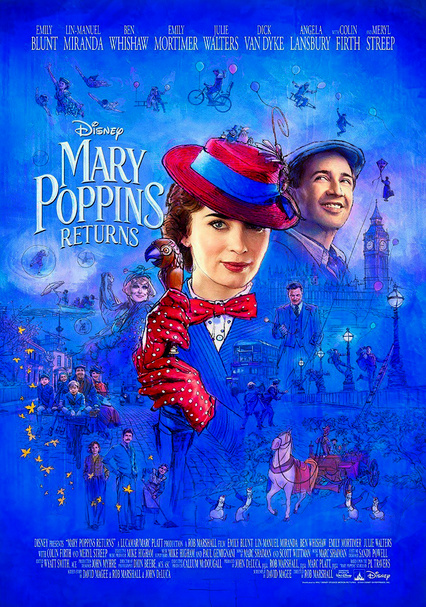
Mary Poppins Returns-2018

Mary Poppins Returns-2018

Director Rob Marshall

Starring Emily Blunt, Lin-Manuel Miranda

Scott’s Review #848

Reviewed December 29, 2018

Grade: A-

Mary Poppins Returns is a charming mixture of reboots and sequels to the immeasurably glorious original, Mary Poppins (1964).

Although it is impossible to live up to the magic of that film, the 2018 version comes quite close with a delightful turn by Emily Blunt, numerous Hollywood stalwarts in small roles, and gleeful musical numbers sure to leave audiences humming upon their exit from theaters.

Events begin to percolate twenty-five years after the original story, and the setting is 1935 London amid the Great Depression. His recently deceased wife, Michael Banks (Ben Wishaw), lives in the house he grew up in with his three children and housekeeper (Julie Walters) in tow.

His sister Jane lives and works nearby as a labor organizer.

Faced with the dreary reality that the historic Banks house may be foreclosed, Mary Poppins (Blunt) arrives elegantly on her umbrella to restore order and save the day.

Though her character does not overtake the film, Emily Blunt is dynamic in the title role. Her prim and proper good British charm and sensibilities crackle with wit and poise. It is tough to imagine anyone but Blunt in the role, as she puts her stamp on it so well.

With a smirk and a quick, matter-of-fact tone, the character is no-nonsense and utterly kind. The casting of Blunt is spot-on as she becomes Mary Poppins.

The London setting is adorable and fraught with good culture and sophisticated manners. Including the storied Big Ben is meaningful to the tale in a significant way and a teachable moment for children unfamiliar with London.

Furthermore, including a negative period in history—the Great Depression—is immeasurably positive.

The supporting characters are rapturous and a treat for elders familiar with the original Mary Poppins film. Meryl Streep plays Topsy, Mary Poppins’s eccentric eastern European cousin to the hilt, but never teeters over the top.

Colin Firth adds snarky charm as the villainous bank president, and Angela Lansbury gives grandmotherly zest as The Balloon Lady, an ode to the original novel.

Finally, Dick Van Dyke is a delight as the heroic Mr. Dawes Jr. who comes to the rescue at the last hour.

The real winners, though, are the enchanting musical numbers. With the lovely London landscape in full view, Mary Poppins Returns gets off to a spectacular groove with “(Underneath The) Lovely London Sky”.

Performed by the charming Lin-Manuel Miranda in the role of Jack the Lamplighter, Mary Poppins’ sidekick, the star has what it takes to keep up with Blunt. This is evident as the duo mesmerizes and entertains with a colorful number, “A Cover is Not the Book”, alongside an animated music hall.

Finally, fans will revel in the naughty and clever “Turning Turtle”, performed by Streep.

The costumes and lighting are both big hits. As Jack lights and defuses the street lights, we see the luminous dawn and sunsets, which give the film a nice touch.

During the film’s conclusion and subsequent race against the stroke of midnight, moonlight is featured, giving the film a warm glow.

The period piece costumes are lush, but not garish, adding flavor and capturing the period perfectly.

Although it lacks the oomph of the original Mary Poppins (but really, who expected that?), Mary Poppins Returns (2018) is nonetheless enchanting and inspiring in every way that a remake or sequel should be.

Given the mixing of humans and animations, the film is polite, polished, and filled with authentic zest: a fine creation and splendid entertainment.

Oscar Nominations: Best Original Score, Best Original Song-“The Place Where Lost Things Go”, Best Production Design, Best Costume Design