Tag Archives: Arthur Treacher

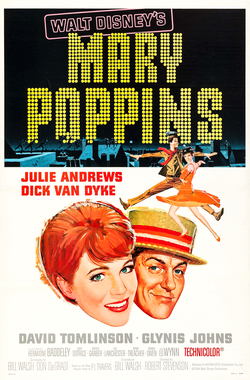
Mary Poppins-1964

Mary Poppins-1964

Director Robert Stevenson

Starring Julie Andrews, Dick Van Dyke

Scott’s Review #965
Reviewed December 9, 2019

Grade: A-

Mary Poppins (1964) is a lovely Walt Disney production that shines with zest and an ample supply of good, cheery tunes. A family affair, it will hardly disappoint, with sing-alongs and enchanting stories for miles.

It’s tough to knock a film that has it all, but it sometimes borders on sickeningly sweet wholesomeness with too much schmaltz mixed in.

This can easily be forgiven because of the robust music, dazzling visual effects, and perfect casting, which make the film enjoyable entertainment for all.

The Banks family resides in London, England. The foursome consists of George and Winifred Banks, along with children Jane and Michael. They live a comfortable and happy upper-middle-class existence.

When their nanny quits after the children run away to chase a kite, the panicked George requests a stern, no-nonsense nanny, while the children (now returned home) desire a kind, sweet one.

Through magic, a young nanny (Julie Andrews) descends from the sky using her umbrella.

Mary Poppins teaches the children to enjoy chores through tunes with the help of a kindly chimney sweep, Bert (Dick Van Dyke).

Mary Poppins cheerily takes the children on several adventures, teaching them valuable lessons. The drama involves light situations such as the irritable George threatening to fire the nanny because she is too cheerful or a mini-scandal at the bank where George works.

These side stories are trivial and non-threatening since the film is really about the antics of the magically odd nanny and her relationship with the children.

The film is unique because it combines live-action with animation and is magical and inventive.

This is most evident during sequences that feature animals, especially the superb scene where Mary Poppins transports Bert, Jane, and Michael into a picture where they ride a carousel and stroll the day away.

The appearance of horses and a fox makes the scene beautifully crafted and filled with joy.

The casting could be no different and is flawless across the board. Standouts are Andrews and Van Dyke, the former appearing in her very first film role.

Not to be usurped by her most iconic role as Maria in the following year’s brilliant The Sound of Music (1965), Andrews possesses a benevolent and delightful spirit that works perfectly in the role, to say nothing of her powerful voice.

Van Dyke, as the romantic interest, is equally well-cast, and together the chemistry is easy and apparent.

Mary Poppins was met with critical acclaim when it was released, when Disney ruled the roost and musicals were a dime a dozen.

It received thirteen Academy Award nominations, including Best Picture—a record for any film released by Walt Disney Studios—and won five: Best Actress for Andrews, Best Film Editing, Best Original Music Score, Best Visual Effects, and Best Original Song for “Chim Chim Cher-ee.”

This was quite a feat as the film was up against My Fair Lady (1964), which won the biggest prize.

Rated G and a box-office success, Mary Poppins (1964) is a legendary Walt Disney film that uses creative techniques and musical numbers to develop a finely finished product.

The song standouts are “A Spoonful of Sugar”, “Chim Chim Cher-ee”, and “Supercalifragilisticexpialidocious”, as each offers candy for the ears and immeasurable fun.

The classic songs and the cohesive sentimentality make this one easy to enjoy with repeated viewings.

Oscar Nominations: 5 wins-Best Picture, Best Director-Robert Stevenson, Best Actress-Julie Andrews (won), Best Screenplay Based on Material from Another Medium, Best Song-“Chim Chim Cher-ee” (won), Best Music Score-Substantially Original (won), Best Scoring of Music-Adaptation or Treatment, Best Sound, Best Art Direction, Color, Best Cinematography, Color, Best Costume Design, Color, Best Film Editing (won), Best Special Visual Effects (won)

Golden Globe Nominations: 1 win-Best Motion Picture-Musical or Comedy, Best Performance by an Actor in a Leading Role-Musical or Comedy-Dick Van Dyke, Best Performance by an Actress in a Leading Role-Musical or Comedy-Julie Andrews (won), Best Original Score-Motion Picture
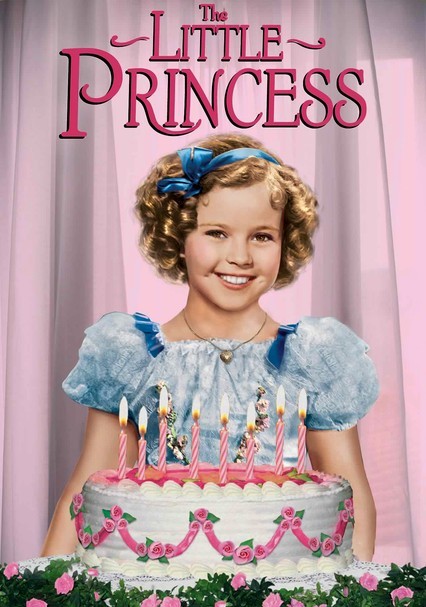
The Little Princess-1939

The Little Princess-1939

Director Walter Lang

Starring Shirley Temple, Ian Hunter

Scott’s Review #827

Reviewed November 6, 2018

Grade: B+

The Little Princess (1939) is a later-day Shirley Temple film released when the child star’s popularity declined.

The film is also Temple’s first production filmed in Technicolor and the last of her major successes. It is perfect, though not the first I would choose as a starting point in her collection.

The film is saccharine, wholesome, and predictable, which are also adjectives audiences adore about the star’s cinematic projects; loosely based on A Little Princess by Frances Hodgson Burnfilm, the film was criticized at the time of release for deviating too far from the original novel.

The time is the turn of the century in England, and the backdrop is the Boer War.

The film’s setting is a highlight for American audiences amidst the First World War and on the cusp of World War II, allowing for a timely and relevant film quality.

In the story, Temple plays Sara, the wealthy daughter of a military Captain (Ian Hunter) who is left to reside in a well-to-do girls’ school when her father is called away to serve in the war.

When he unexpectedly dies in battle, Sara is left penniless and forced to work as a servant in the school she once attended.

At first, the staff treats Sara like royalty, but her treatment gradually harbors resentment among the principals, especially the dastardly headmistress (Mary Nash). Sara keeps her chin up, insisting that her father is not dead, and she becomes determined to find him in a local hospital.

In 2018, Shirley Temple’s films mainly served as a source of nostalgia rather than critical acclaim or cinematic dissection—what was the point?

Her films are a wholesome trip down memory lane to a simpler time for many. Ironic that the film is the first color picture in the collection; this detracts from the enjoyment and adds too much of a modern element foreign to Temple fans.

My preference is for the black-and-white productions of the early and mid-1930s.

The supporting characters spice up The Little Princess quite a bit.

Most notable is Cesar Romero as neighbor Ram Dass, who fills the void Sara needs after losing her father. The chemistry between Romero and Temple is terrific, and in a tender scene, the kindly Dass leaves warm blankets for Sara.

As the main villainous character, common in Temple films, Mary Nash, as Miss Minchin, does her job flawlessly. As the main foil, Nash perfectly blends rigid mannerisms and the brunt of Sara’s tension.

The overall tone of The Little Princess (1939), hence the title, contains a rich-to-rags, Cinderella-in-reverse type of story. The film is above average but not the best in the bunch.

Venturing to say that the film is a forgotten work save for the Shirley Temple series fans, it does what it sets out to do and entertains.

With drama, musical numbers, and a happy ending, the result is a similar experience to her many other films.

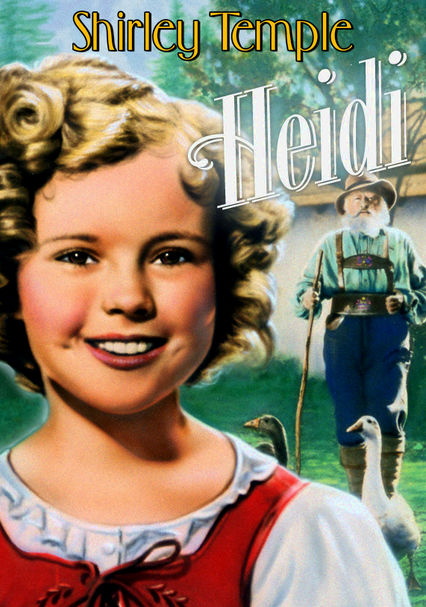
Heidi-1937

Heidi-1937

Director Allan Dwan

Starring Shirley Temple, Jean Hersholt

Scott’s Review #826

Reviewed November 2, 2018

Grade: A-

During the 1930s and 1940s, Shirley Temple was the most prominent and profitable child star around, starring in dozens of films deemed “wholesome” and “cute.”

Heidi (1937) is one of her most popular and best-regarded treasures of earnest and sentimental riches.

The film is forever known in pop culture as the ruination of the 1968 Super Bowl when the Oakland Raiders and New York Jets game was interrupted at a crucial moment due to the film’s scheduled airing.

An interesting side note is that, amazingly, Temple relinquished her Hollywood title with dignity and without scars. She left the scene entirely and became a successful world diplomat.

In an era in American cinema when child stars were treated as property and sometimes like cattle, her relatively healthy exit was a remarkable feat.

The story of Heidi is based on the 1880 Swiss story of the same name. In the title role, Temple plays an orphan living in the cold mountains with her grizzled grandfather, Adolf (Jean Hersholt). At first bitter for being saddled with raising a child, Adolf finally accepts the girl, and he and Heidi become fast friends, exhibiting a warm and tender bond.

Heidi’s self-absorbed aunt ruins the dynamic and whisks the child away to live with a wealthy family. The little girl will be a companion for their disabled daughter, Klara, as Heidi and Adolf are determined to find each other.

Adding drama to the story is Klara’s evil housekeeper and her jealousy of Heidi, leading to attempts to sell Heidi off to gypsies for profit.

By 1937, Temple was beginning to be deemed “too old” for cute roles, but Heidi is one of her best-remembered films, and the actress is in top form.

As one might expect from any Shirley Temple film, musical numbers are included- a dream sequence in Holland culminates with Temple belting out the charming “In My Little Wooden Shoes.”

There are millions of Shirley Temple fans worldwide, but there are also her detractors. Some feel her films are completely dated and that the young star was not as talented as they thought she was.

Admittedly, watching her films approaching the one-hundred-year mark can be peculiar. On the surface, they seem a bit hammy and overly sentimental, but my personal experience elicits a return to childhood days.

Despite being decades before my existence, Shirley Temple films were commonplace in my childhood household.

Heidi is not a groundbreaking cinematic experience or all that deep. What the film does provide, though, is comfort. The audience assuredly must know a film like Heidi has a happy ending, as the child provides warmth and spirit to every person she meets, making their lives better.

Even during peril, the girl has an “awe-shucks” manner of being and makes the best of her lousy situation.

The strongest appeal of Heidi comes from her friendship with Klara, a disabled woman. Klara is kind and naive, unaware of her servant’s jealousy and rage. Helpless, she comes to depend on Heidi, and we root for Heidi to rescue Klara and bring her to a better life.

The film has sappily written all over it but somehow works simultaneously.

Films such as Heidi, the best of all the Temple films, can be watched and enjoyed as an ode to days gone by or a tribute to someone’s grandmother’s favorite film.

Despite being irrelevant and too sappy in today’s modern world, they undoubtedly provide comfort and support to some, which cannot be such a bad thing.

Heidi (1937) can easily be enjoyed because of the film’s popularity and its warm message.