Tag Archives: Martin Benson

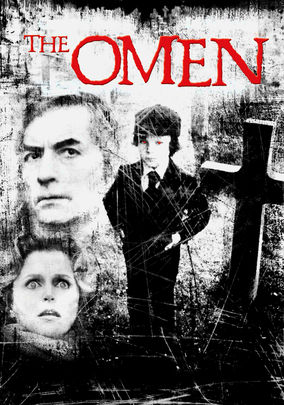
The Omen-1976

The Omen-1976

Director Richard Donner

Starring Gregory Peck, Lee Remick

Top 250 Films #110

Top 40 Horror Films #21

Scott’s Review #331
60002150

Reviewed January 8, 2016

Grade: A

On the heels of similarly themed supernatural horror films, and all three classics, in my view, The Omen (1976) follows suit with a religiously minded, terrifying piece that resembles both The Exorcist (1973) and Rosemary’s Baby (1968).

All three films are cherished gems and among my favorite horror films.

The Omen (the last to be released) is quite possibly the weakest entry, having taken much from the other two films, and at the forefront is a child encompassed by devilish forces.

But to say “weaker” implies it is not good, which is not the case- The Omen is a masterpiece.

Set mostly in London, the film begins in Rome. Gregory Peck plays a powerful diplomat, Robert Thorn. Robert’s wife, Katherine (Lee Remick), has just given birth to a baby, who dies.

Unbeknownst to her, Robert and a priest have taken a newborn whose mother has just died, thereby fooling Katherine into thinking she has delivered a healthy baby boy. They name their child Damien.

Soon, Robert is named U.S. Ambassador to the United Kingdom- an astounding honor. Still, his and Katherine’s lives spin out of control as strange events surrounding Damien begin to occur, and they realize the child is not “right”.

I adore the many aspects of The Omen. The locale of sophisticated and royal London is perfect. The Thorns live in a grand, palatial estate, oozing with potential horror elements.

During a vast party for little Damien’s fifth birthday, the attendees are gathered on the perfectly manicured grounds of the Thorn home. It is a bright and cheery afternoon.

Suddenly, from the top-floor bedroom window, Damien’s fresh-faced nanny publicly hangs herself from the window, proudly shouting, “This is all for you, Damien”!

This scene is one of the most horrific and surprising scenes in the film.

When Damien’s new nanny shows up, she is off-putting and sinister. The inclusion of a pack of black dogs hovering around the estate is fiendish, and an innocent trip to the zoo results in the scared animals fleeing from Damien as if he were the antichrist, which, of course, he is revealed to be.

Fantastic is the religious element of The Omen, a sure measure to frighten and freak out audiences brave enough to watch this film.

Who will not be on edge as a sweet-looking little kid is assumed to be the devil?  Religious elements in horror have been prevalent throughout the ages.

Perhaps it is the Italian and British accents and settings that add layers of fear to the film.

What I love most about the film is its cynicism. The Omen is not a happy film by any means, nor does it result in a happy ending- Satan wins in the end.

Two memorable scenes are the pole through the heart of the priest scene and the gruesome decapitation of a photographer by a sheet of glass. In both scenes, Satan causes the deaths.

The finale of the film is incredibly compelling and downright shocking- the face-off of Robert and Damien in a church, and the prevailing conclusion sets the stage for a sequel, which, of course, there was more than one.

The sinister smile at the end of the film is immeasurably evil.

The Omen (1976) is a film I love to watch and revel in the fright when the chills creep up my back.

What a fantastic film.

Oscar Nominations: 1 win-Best Original Score (won), Best Original Song-“Ave Satani”

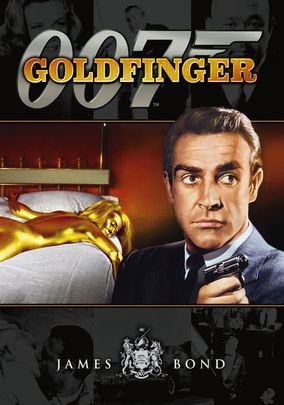
Goldfinger-1964

Goldfinger-1964

Director Guy Hamilton

Starring Sean Connery, Gert Frobe

Top 250 Films #114

Scott’s Review #337

22041809

Reviewed January 9, 2016

Grade: A

By the time Goldfinger (1964) was released, the third in the James Bond franchise, the films were huge successes, and the budget was not to be spared a dime.

The lavish sets prove this, and Goldfinger is one of the best Bond films. It contains all the necessary elements for success: interesting villains, Bond girls, gadgets, and locales.

By 1964’s Goldfinger, Ian Fleming’s franchise had hit its stride and was achieving runaway success.

The intriguing premise immediately sets the tone- 007 is assigned to investigate a massive gold smuggling scheme. The conspirator is Auric Goldfinger (Gert Frobe), who hatches a plot to contaminate Fort Knox’s United States Bullion Depository.

His goal, naturally, is to control the world.!

The adventure takes Bond from the United Kingdom to Switzerland and finally to the United States in  Kentucky and Florida.

The main Bond girl, a villain, is uniquely named Pussy Galore. The film implies that the character is bisexual and she is tough. James Bond becomes intrigued by and smitten with her.

Goldfinger has the honor of containing one of the greatest Bond villains of all time- the title character of Goldfinger. Big and burly, he is menacing-looking, and actor Frobe is perfectly cast.

We first meet the man cheating at gin rummy poolside at a lavish Miami Beach hotel, while Bond looks on from dozens of floors up, with the assistance of Goldfinger’s moll, Jill Masterson.

In one of the greatest scenes in Bond history, a knocked-out Bond awakens to find Jill dead—and completely covered in gold paint! This scene, which occurs early on, sets up the Bond/Goldfinger rivalry outstandingly.

Goldfinger’s henchman, Oddjob, is also a grand Bond villain. He is Asian, menacing, and wears a trademark steel-rimmed hat, which he uses to kill his victims. Jill’s sister, Tilly, seeks revenge on Goldfinger but finds herself a victim of Oddjob’s infamous bowler hat as she flees for her life.

Following 1962’s From Russia With Love, an exceptional Bond film with nary a flaw, Goldfinger excels slightly because it has all the right ingredients and is firing on all cylinders.

Everything flows with precision.

Unforgettable is the climax of Goldfinger at the legendary Fort Knox itself. Goldfinger’s private army, an atomic device, a countdown to destruction, and Oddjob all make for a satisfying and riveting conclusion to one exceptional Bond entry.

Oscar Nominations: 1 win-Best Sound Effects (won)

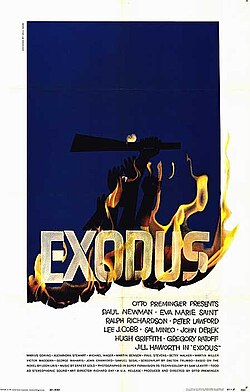
Exodus-1960

Exodus-1960

Director Otto Preminger

Starring Paul Newman, Eva Marie Saint

Scott’s Review #1,005

Reviewed March 30, 2020

Grade: A-

Creating a monumental epic about the modern state of Israel, director Otto Preminger’s vast project Exodus (1960) is a bold adaptation of the Leon Uris novel from 1958.

Starring stars of the day for added Hollywood spice and a romantic element, the result is a sprawling war drama with robust proportions and a hefty running time.

The film sometimes lags or even drags, but the message’s enormous importance and influence on stimulating Zionism should never be forgotten.

With the treacherous World War II barely in the rear-view mirror, Israeli resistance fighter, Ari Ben Canaan (Paul Newman), attempts to bring six hundred European Jewish Holocaust survivors from British-blockaded Cyprus into newly developed Palestine.

At the camp, he meets Kitty Fremont (Eva Marie Saint), an American volunteer nurse. The pair teams up with others to attempt to liberate the survivors.

The action eventually switches to Palestine, where other characters and motives come into play in a complex story. During this time, opposition to the partition of Palestine into Arab and Jewish states was heating up, leading to tension, bombs, and death among similar types of people.

Central to the main plot is a young love story involving spirited Dov Landau (Sal Mineo), a radical Zionist resistance group member, and Karen Hansen Clement (Jill Haworth), a young Danish-Jewish girl searching for the father from whom she was separated during the war.

Exodus has so much story going on and multiple plots to follow.

Besides the tense story, the main draw is the two love stories told amid the political turmoil.

Newman and Saint have marginal chemistry; he is an eye candy who electrifies the screen, and she seems too old for him and does not photograph well. Kitty, a widow, hedges on her romantic feelings for Ari, but they ultimately unite.

A gorgeous sequence occurs when the two share a delicious meal of fish and martinis amid a rooftop restaurant overlooking the dazzling landscape. She later dines with his parents and his mother, a classic Jewish mother who, in stereotypical fashion, cooks and fusses.

The fresh-faced pairing of Dov and Karen is reminiscent of Tony and Maria from West Side Story. Doomed from the start, the youngsters are opposites in many ways: hot-headed, sensible, and resilient. He is bronze and swarthy; she is blonde and blue-eyed.

I fell in love with the couple more than Ari and Kitty and rooted for their happily-ever-after moment, which sadly never occurred.

At nearly four hours, the film is best watched in segments, perhaps even four, to let the action marinate overnight. The sweeping cinematic photography and the lush exterior sequences aid the complex drama.

A drawback was not seeing the film on the big screen, which was almost a must in hindsight and limited by the DVD quality over Blu-Ray.

Nonetheless, the film is delicious in nearly every way. When tedium is about to occur, an event snaps the viewer back to immediate attention.

A notable fun fact is that Preminger boldly hired blacklisted screenwriter Dalton Trumbo, on the dreaded Hollywood blacklist for over a decade for communist leanings, to write the script.

Together with Spartacus (1960), made the same year, Exodus is credited with ending the practice of Blacklisting in the motion picture industry. The importance of what is written on the blank page is arguably surpassed by the man who wrote those pages.

Exodus (1960) nearly rivals the epic of all epics, Lawrence of Arabia (1962), in its cinematography of exotic and sacred landscapes in daring and forbidding lands.

Perhaps twenty minutes could be carved out when the action loses momentum. Still, with great direction, a top-tier cast, and a history lesson in the harshness of war and generations of conflict, the film resonates with the realism of the subject matter.

Oscar Nominations: 1 win-Best Supporting Actor-Sal Mineo, Best Music Score of a Dramatic or Comedy Picture (won), Best Cinematography, Color

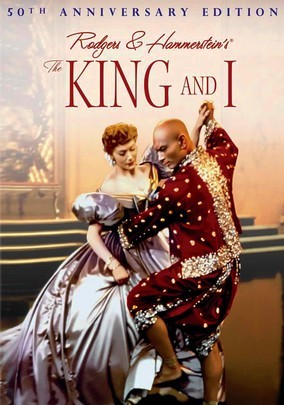
The King and I-1956

The King and I-1956

Director Walter Lang

Starring Yul Brynner, Deborah Kerr

Scott’s Review #26

671936

Reviewed June 17, 2014

Grade: B

The King and I (1956) is another of the many Rodgers and Hammerstein musicals that dominated the 1950s and 1960s film era.

Having seen the stage version, the film contained two gigantic stars of the period (Yul Brynner and Deborah Kerr), Brynner having made this role his legacy.

The story is similar to The Sound of Music, as the teacher takes on the children of the King, but it is not quite as gripping, and the chemistry among the leads is not entirely there.

The Bangkok palace set, and the costumes are stylish and fantastic in design.

As a whole, the songs are not as memorable as some other similar musicals, but that is compared to magnificence.

Much of the cast is not Asian, a characteristic of the stage version that is often overlooked and accepted. This is not a criticism, merely a notice.

It’s a lovely musical, but not as enjoyable as others, but still worth watching.

Oscar Nominations: 5 wins-Best Motion Picture, Best Director-Walter Lang, Best Actor-Yul Brynner (won), Best Actress-Deborah Kerr, Best Scoring of a Musical Picture (won), Best Sound Recording (won), Best Art Direction-Color (won), Best Cinematography, Color, Best Costume Design, Color (won)