Tag Archives: Jacob Vargas

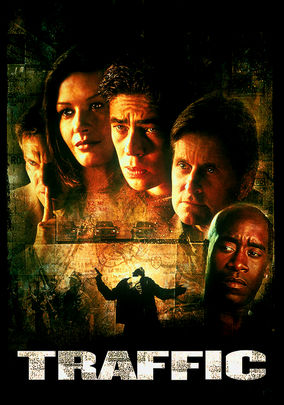
Traffic-2000

Traffic-2000

Director Steven Soderbergh

Starring Michael Douglas, Catherine Zeta-Jones, Benicio del Toro

Top 250 Films #143

Scott’s Review #333
60003243

Reviewed January 8, 2016

Grade: A

Simply put, I adore this film. I loved Traffic when it was first released in 2000, and I still love it today.

In an age when overlapping stories with hefty casts were still in their infancy (Crash-2006 and Babel-2006, similar films, would not be released for several years), Traffic was groundbreaking, compelling, thought-provoking, and just a damned good drama!

With drug use still a continuing problem in the United States, the film remains both relevant and important.

Featuring three main, intersecting stories with a central theme of drug trafficking, each is told from various perspectives: users, political figures, law enforcement, and criminal traffickers.

Traffic also wisely shows how the drug problem knows no specific classes- affluent, middle-class, and poor are all represented in the film.

A strong political story is represented- led by conservative Ohio judge Robert Wakefield (Michael Douglas), who is appointed “drug czar” as the President’s Office of National Drug Policy leader, he vows to end all drug trafficking and is the moral center of the film.

However, his prep school daughter, Caroline (played exceptionally well by Erika Christensen) and her equally affluent friends are dabbling in cocaine, heroin, and other drugs, so much so that their lives are slowly spiraling out of control.

The Mexico story involves the riveting tale of Mexican police officer Javier Rodriguez (played convincingly by Benicio del Toro). He becomes heavily involved in a web of deceit, money, and drugs.

His partner, Sanchez, makes a deal with the devil, and his fate is thereby sealed. Javier has moral questions to ask himself and only wants to do right by some local, neighborhood boys.

Finally, San Diego is the setting for a story of corruption involving the DEA’s investigation of a drug lord, Carl Ayala. After being arrested, his wife Helena (Catherine Zeta-Jones) faces a moral dilemma- either carry on the illegal proceedings or come clean.

She,  up until this point unaware of her husband’s business, faces enormous pressure, both financially and through the threat of violence.

My favorite aspect of Traffic is that all of the aforementioned stories are fascinating in their own right- and could make terrific films on their own- but as the film progresses, they begin to intersect. Keys to the puzzle slowly unlock themselves.

I love how many of the central characters (Helena, Javier, and Wakefield) begin as “good” people only to have their moral intentions challenged, and in some cases, threatened.

Each is conflicted in some way.

The film poses an interesting, crucial question of what can be done about the United States drug trafficking problem. The answer at the end of the film is a disappointing, perhaps even depressing, realization.

Drugs will never stop being a problem, and Traffic explains how drugs show no barriers when it comes to either wealthy or more financially challenged individuals.

How wonderful to see a stellar cast, even in smaller roles (Dennis Quaid and Amy Irving immediately come to mind), with all of the characters having a purpose in a wonderful example of how a mainstream Hollywood film can achieve a true ensemble effort that works.

Great job, Steven Soderbergh!

Oscar Nominations: 4 wins-Best Picture, Best Director-Steven Soderbergh (won), Best Supporting Actor-Benicio del Toro (won), Best Adapted Screenplay (won), Best Film Editing (won)


Devil-2010

Devil-2010

Director John Erick Dowdle

Starring Chris Messina

Scott’s Review #523

70142822

Reviewed November 23, 2016

Grade: B

Devil (2010) is an enjoyable thriller/horror film deemed the first in a trilogy, though it is unknown if the subsequent films will see the light of day since this film was not a smash success at the box office nor was it critically acclaimed.

A fun fact is that the screenplay is based on a story written by respected director, M. Night Shyamalan.

The premise is delicious;  set in Philadelphia, a man suddenly jumps from a tall skyscraper to his death. We learn from a narrator that the devil takes many forms and makes his presence known by suicide.

Detective Bowden (Messina) is called to investigate the death.

Eventually, five people are stuck in an elevator and one is a killer, presumably the devil. The film is a whodunit of sorts and a tale of morality, good versus evil.

Parts of the film are a bit hokey and suspension of disbelief is certainly required, but Devil is also a decent, edge-of-your-seat thriller.

Being only rated PG-13, the film tones down the gore and the death in favor of lighter, tamer activity.

The revelation of the actual killer is surprising and rather enjoyable.

Go for Sisters-2013

Go for Sisters-2013

Director John Sayles

Starring Edward James Olmos

Scott’s Review #177

70272916

Reviewed September 27, 2014

Grade: B-

Go for Sisters is a 2013 independent feature film about a female parole officer (Lisa Gay Hamilton) with a troubled, missing son named Rodney, feared to be mixed up with the murder of a drug dealer.

The film takes place in California and Mexico.

Hamilton plays Bernice, a middle-aged black woman, who has always done the right thing. Widowed and recently dumped by a new boyfriend, she runs into ex-convict Fontayne, played by Yolonda Ross, at her parole office.

Initially wanting nothing to do with her former high school friend, Bernice decides to use Fontayne’s criminal connections to locate Rodney.

From this point, they hire retired Mexican police officer Freddy Suarez, played by Edward James Olmos, and the trio embarks on an adventure across the border of Mexico.

I love the story involving the two female leads (Hamilton and Ross) who share a Thelma and Louise-type bond.

The characters reconnect with each other and develop independently. Straight-laced Bernice toughens up and breaks a few rules while Fontayne, determined to go straight, struggles to keep her head above water, resisting drugs and attempting to hold down a job.

The two forge a bond based on trust, respect, and loyalty, and their friendship grows throughout the film.

One gripe about Fontayne’s character- she admits to being a lesbian but then mentions she is not sure if she is or if she is not. This sexual identity crisis seems strange- why couldn’t the film make her a lesbian? Why the hedging?

The remaining aspects of the film are mediocre to weak.

Adding the character of Freddy to the mix is unnecessary. He adds little to the plot except helping the women get into Mexico and being male comic relief.

Either way, I didn’t find the character very interesting or care about him and the film would have been better off without Freddy.

What was the reasoning behind making him have poor eyesight? What was the point of Freddy taking a young woman and her daughter to breakfast and realizing they were crossing the border to find her estranged husband? Who cares?

It had nothing to do with the plot.

All the audience knows about Freddy is that he is retired due to a misunderstanding, accepts money to help Bernice and Fontayne, and tags along with them for the rest of the film.

The stereotypes should have been eliminated. The Chinese dragon lady and the corrupt Mexican police officers have been played to death in films and are rather insulting to smart and serious movie-goers.

I found the plot a bit tough to follow and I still don’t understand how or why Rodney was involved with the Chinese mob in the first place other than to help Chinese immigrants cross the border.

Was he involved in the money or wanted to help the immigrants cross to the United States?

The film mentions countless times how Rodney is a decent person so what’s his motivation? The film never wholly explains why he is kidnapped and a suspect in a murder case.

Also, countless characters are introduced to help the women on their journey with some connection to the kidnap victim but are written haphazardly with no character development.

The ending of Go for Sisters (2013) is too predictable and leaves the audience not caring about the outcome.

Despite numerous negatives, the heart of the film belongs to the talents of Hamilton and Ross and their characters’ interesting and warm friendship that develops throughout the film.

Independent Spirit Award Nominations: Best Supporting Female-Yolonda Ross