Tag Archives: Cara Seymour

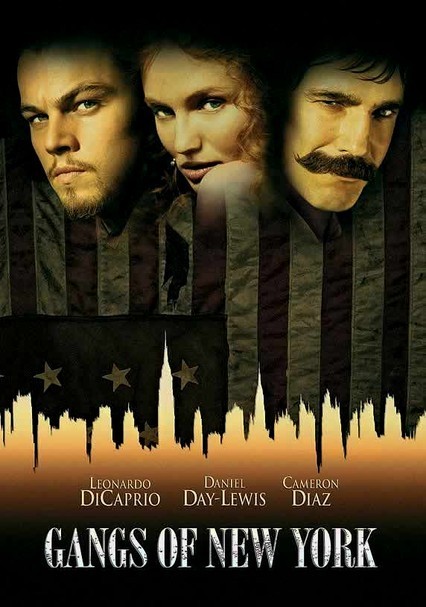
Gangs of New York-2002

Gangs of New York-2002

Director Martin Scorsese

Starring Leonardo Dicaprio, Daniel Day-Lewis, Cameron Diaz

Scott’s Review #1,327
Reviewed December 26, 2022

Grade: A-

Gangs of New York (2002) is an extremely violent and bloody epic by director Martin Scorsese that is an exquisite piece of filmmaking nearly flawless in every way except maybe its length and story.

On the one hand, it’s a beautifully choreographed and filmed crime drama with perfect costumes, art direction, and cinematography. Still, on the other, it’s tedious and lengthy, especially during the final hour, with choppy storytelling and seemingly one long continuous battle.

Scorsese being Scorsese and knowing his way around crafting an excellent film or two left me ruminating over the cinema and pondering whether I’d ever need to see it again.

Usually, I’m all in when it comes to repeated viewings of his films,  especially Raging Bull (1980) or Goodfellas (1990) but with Gangs of New York, the sobering almost three hours running time and the non-stop bloodshed gives me pause.

It’s not a mafia film but it is an Irish-centered crime drama harkening back to the mid-1800s so there are historical lessons to be exposed to. Familiar with most of his films there are good guys, bad guys, and a criminal, feuding overtone, and lots of grit and grime to plow through.

I can’t say it’s one of Scorsese’s top 10 but it’s a grandiose, epic-length behemoth that features a host of top-name talent but there are nonetheless aspects that leave it slightly beneath his most famous works.

But that’s nearly akin to comparing the works of Beethoven, Rembrandt, or other geniuses of one art form or another. Anyone respecting Scorsese or appreciating good cinema should see Gangs of New York.

Amsterdam Vallon (Leonardo DiCaprio) is a young Irish immigrant released from prison. He returns to the Five Points seeking revenge against his father’s killer, William Cutting (Daniel Day-Lewis) also known as ‘The Butcher’, a brutal and powerful anti-immigrant gang leader.

He knows that revenge can only be attained by infiltrating Cutting’s inner circle. Amsterdam’s journey became a fight for personal survival and to find a place for the Irish people in 1860’s New York.

The most delicious part of the film is the rivalry between Amsterdam and ‘The Butcher’. DiCaprio and Day-Lewis make powerful sparring partners and as much as Amsterdam’s motivations are admirable it’s Day-Lewis who has the more interesting character.

To no one’s surprise, the actor channels his inner dictator as he method acts throughout the film. To no one’s additional surprise, he steals the show away from other tremendous actors like DiCaprio, Jim Broadbent, and John C. Reilly in supporting roles.

However, I need to ask why Day-Lewis was selected for the Lead Actor Oscar category when he is a supporting one.

Worthy of mention is Cameron Diaz who, for once, plays the dramatic role of a pickpocket. Typically cast in comedic roles she shows she has acting chops.

The story gets a bit wayward about halfway through and I stopped giving the story much credence about three-quarters of the way through. It’s as if Scorsese had frenetic schizophrenia moments with tons of good ideas but none of them formulating a cohesive plot.

The New York City setting is a favorite of mine especially pre-civil war and well before the NYC of modern times even existed. The prevalence of Canal Street and various others make this northeasterner heavily invested in geography.

Finally, to bring it all full circle, Gangs of New York powerfully reminds the audience of the age-old topic of immigration and how those who have citizenship too often oppose those who desire to enter a country they once also did.

‘The Butcher’s’ brutal opposition is a sad reminder of how the United States of America was never united and the senseless violence towards immigrants is never-ending.

Gangs of New York (2002) may not be Scorsese’s best work but even on his worst day, he creates a film worth watching. Mixing toxic masculinity, and revenge with a crazy story he succeeds where other directors might fail by providing compelling filmmaking with all the fixings.

Just don’t get too hung up on the story points.

Oscar Nominations: Best Picture, Best Director-Martin Scorsese, Best Actor-Daniel Day-Lewis, Best Original Screenplay, Best Art Direction, Best Cinematography, Best Costume Design, Best Film Editing, Best Original Song-“The Hands That Built America”, Best Sound

Birth-2004

Birth-2004

Director Jonathan Glazer

Starring Nicole Kidman, Cameron Bright

Scott’s Review #1,124

Reviewed March 18, 2021

Grade: B+

Due to the difficult nature of the film’s storyline, Birth (2004) is a tough sell to most cinema lovers.

A grown woman embarking on any sort of romance with a ten-year-old boy will turn off viewers, though can you even imagine if the genders were reversed? I was fascinated by the premise and the endless possibilities of a conclusion.

I’m not quite sure what I expected to ultimately happen but I felt slightly underwhelmed by the ending.

All in all, it is a daring effort that I wish had more payoff.

The first hour or so is extremely provocative.

Nicole Kidman excels at making the unbelievable material as believable as she can and the film is directed very well by Jonathan Glazer who gives it a haunting and mysterious Stanley Kubrick vibe.

The director would come into name recognition following his 2013 masterpiece Under the Skin.

The film opens with a voiceover of an unknown man, a professor, lecturing about his disbelief in reincarnation. The audience then sees the man jogging through New York City’s Central Park where he collapses and dies.

It takes Anna (Kidman) ten years to recover from the death of her husband, Sean, (the professor) but now she’s on the verge of marrying her boyfriend, Joseph (Danny Huston), and finally moving on. We suspect she may not be completely keen on marrying Joseph but most of their relationship is unclear. We know that she aches for Sean.

On the night of their lavish engagement party, a young boy named Sean (Cameron Bright) turns up, saying he is her dead husband reincarnated. At first, she ignores the child, thinking it’s a joke, but his knowledge of her former husband’s life is uncanny, leading her to slowly realize that he could be telling the truth.

Anna is conflicted to say the very least and Kidman effortlessly makes the audience believe that what is considered ridiculous might be true.

Is there a supernatural element here?

Her family members, led by her mother Eleanor (Lauren Bacall) are disbelieving and antagonistic towards the boy for disrupting Anna’s life.

An issue is that other than one supporting character, Clara (Anne Heche), who has a great opening sequence burying mysterious letters, the others have next to nothing to contribute to the story except to brood and get angry.

Bacall, in particular, is completely wasted in a role that could have been played by any other older actress.

Parallels to Rosemary’s Baby (1968) are hard not to make. Anna dons a similar pixie hair as Rosemary. They both reside in swanky old-style New York City high-rises that have a ghostly, haunting feeling. The ambiance is positive.

My favorite camera shot that Glazer includes is a lengthy one of Kidman’s Anna. In a close-up, the character’s reactions are on full display for what feels like several minutes. Kidman gets to show her tremendous range- tears, shock, realization.

I’ve noticed a similar shot in a handful of modern films and it’s an actor’s delight- a viewer’s too!

The finale, without giving much away, is interesting to a point. The big reveal involving Clara is intriguing until the viewer backtracks and tries to add up all the events. The fact is they don’t add up and I longed for something more concrete or believable.

There is not a good payoff.

Birth (2004) doesn’t always add up to satisfaction but it’s edgy, gloomy, and unpredictable and I enjoyed those facets enough to recommend it. This is not a mainstream film like Ghost (1990) with a similar theme- it’s much more cerebral and thought-provoking.

Kidman’s performance is the main draw here but it’s tough to find a film the actress is not great in.

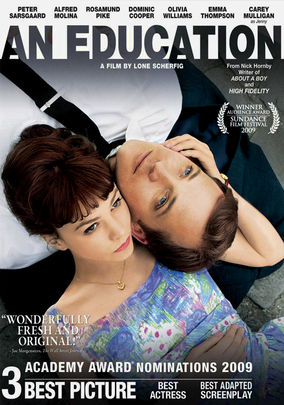
An Education-2009

An Education-2009

Director Lone Scherfig

Starring Carey Mulligan, Peter Sarsgaard

Scott’s Review #584

Reviewed January 4, 2017

Grade: B+

An Education, a British film released in 2009, is a small, little gem of a film. The story-telling and the acting are very good.

Since it is a British film, the accents can be a little distracting for some, but I enjoyed it very much.

It tells the story of an intelligent, college-driven teenager, named Jenny (Mulligan), who falls in love with an older, charismatic man (Sarsgaard). She is faced with conflict from her family and teachers, most notably her father, played by Alfred Molina.

The individuals in her life have differing opinions on which path Jenny should choose in her life. This leads to the main conflict in the film.

The setting is rainy, cold, London in 1961. Headed for Oxford and a successful career (not common for a female in those days), Jenny is willing to risk it all for love, but is she being taken advantage of?

The film is romantic, comical, and serious all rolled into one. The story is nothing original, to be frank, but specifically, the excellent acting makes it worth seeing.

An Education (2009) proves filmmakers can take a good story, told before, and make it compelling to an audience.

Carey Mulligan deservedly received an Oscar nomination for this film and made her debut as a high-caliber young actress to watch.

Oscar Nominations: Best Picture, Best Actress-Carey Mulligan, Best Adapted Screenplay

Independent Spirit Award Nominations: 1 win-Best Foreign Film (won)

Dancer in the Dark-2000

Dancer in the Dark-2000

Director Lars von Trier

Starring Björk

Scott’s Review #365

Reviewed January 9, 2016

Grade: A

Dancer in the Dark is, in my opinion, one of the most important, inventive films of the 2000s and is proudly one of my favorites of all time.

However, the film is not pleasant to watch and is quite painful and depressing, if the truth be told.

But the relevance and sheer emotion the film elicits are more than enough reason to be exposed to it, if only once, perhaps.

Director Lars von Trier is a master of creative and disturbing, dreamlike films that are odd, non-linear, or otherwise open to interpretation.

He has directed such gems as 2011’s Melancholia and 1996’s Breaking the Waves, to name but two.

In Dancer in the Dark, he uses handheld cameras, which add a lot of grit to the film, giving it an almost documentary-style, grainy, shaky look.

The addition of musical numbers mostly written and performed by the star, Björk, is a wonderful touch.

Speaking of Björk, words cannot express what a brilliant performance she gives in the film, and the raw emotion she expresses in her starring role is awe-inspiring.

So great was the stress of filming Dancer in the Dark that, to my knowledge, she has never made another film.

She was shamefully overlooked in the Best Actress Oscar category- an omission that is one of the biggest fails in Oscar history.

Tensions were reportedly high on the set of Dancer in the Dark, as Björk reportedly despised her director, never missing a chance to tell him so, disappeared from the set for days on end, and spat in his face.

Co-star Deneuve, a former French megastar, reportedly did not get along with Björk.

Despite all the drama, the stars managed to pull together a masterpiece.

Björk plays Selma, a Czech immigrant living in Seattle with her young son. The year is 1964. Selma is poor, struggling to survive by working in a clothing factory alongside her best friend, Cvalda (Deneuve).

Selma and Cvalda escape their dull lives by watching classic musical films at their local cinema. To make matters worse, Selma is suffering from a degenerative eye disease, causing her to lose her sight gradually.

She struggles to save enough for surgery for her son, who is sure to suffer the same fate without it.

Selma frequently imagines musical numbers in her day-to-day life involving friends and co-workers. When a tragic event occurs, and Selma is accused of a crime, the film takes a very dark turn.

The conclusion of the film will always require handkerchiefs as it is as powerful as it is gloomy.

The aspect I love most about Dancer in the Dark is that it smashes barriers about what film art is and throws all of the rules out the window.

Lars von Trier, famous for this, created a dreamy, independent hybrid musical-drama, a dynamic, tragic, emotional experience all rolled into one great film.

Oscar Nominations: Best Original Song-“I’ve Seen It All”

Independent Spirit Award Nominations: 1 win-Best Foreign Film (won)