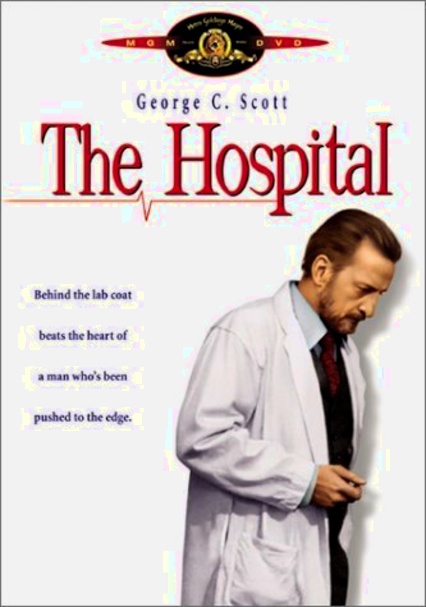
The Hospital-1971
Director Arthur Hiller
Starring George C. Scott
Scott’s Review #1,369
Reviewed June 11, 2023
Grade: A
An example of the freedom to craft one’s vision in cinematic works during the first half of the 1970s, The Hospital (1971) is a testament to creativity and exceptional writing, and to what can happen when studios and producers leave the creatives alone to make the film they want to make.
One can dismiss any preconceived notions of the classic medical dramas that flooded television networks during the 1970s and 1980s. The Hospital is not formulaic or contrived.
No, The Hospital is a dark work dripping with satirical examples of the politics and shenanigans within the medical community. Oftentimes, secondary activities come at the cost of reasonable care and quality medicines.
Before you imagine a doctor and nurse cavorting in a janitor’s closet, it’s a deeper film than it appears on the surface, despite the inclusion of witty comedy.
Lax patient care, staff deaths, and the dismissal of nearby residents because of a new drug rehabilitation project are explored in this fascinating film.
At a rundown Manhattan teaching hospital, chief of staff Herb Bock (George C. Scott) is riddled with multiple personal and professional problems after two doctors and one nurse are found dead almost simultaneously.
He assumes the rash of deaths is due to dimwitted staff who are overworked amid the chaos.
Suicidal, he meets the intelligent daughter of a patient who knocks him off his feet with her studious personality and reflections on the world. Diana Rigg plays Barbara Drummond.
The immediately noticeable, clever, well-paced screenplay is by Paddy Chayefsky, who won the Oscar for writing the film.
The chaos of a city hospital is exposed immediately, but not in a clichéd way like a series like ER or Grey’s Anatomy might show.
Nobody is going into cardiac arrest on the operating table or having convulsions in the waiting room amid lame dramatic music.
The Hospital is more cerebral than that.
Unknown patients and little-known hospital staff go about their everyday business like clockwork until confusion with daily tasks causes events to go awry.
Like real-life.
The brilliance is how director Arthur Hiller casts regular-looking actors in almost all the roles.
They look and act like everyday hospital staff, setting the proper tone. This is even before we meet and get to know Herb and Barbara. They answer phones, walk around with charts, and hustle after emergencies.
Chayefsky and Hiller mirror director Robert Altman in many ways, mostly in their dialogue and in how seemingly unimportant scenes can mean a whole lot.
In robust soliloquy-style scenes between Herb and Barbara, the audience ‘gets them’. They are both desperate, wounded, and unhappy, yet possess the sophistication and awareness to realize how similar they are.
They immediately connect, fall in love, and nearly run off together. It’s that simple. They are willing to flee their lives after meeting for five minutes. But will they ultimately take that plunge?
A key character is revealed to be Barbara’s father, and a whodunit begins when it becomes clear the deaths are not accidents. Who is responsible and what their motivation is is the key to the story.
Scott does terrific work with his character, rivaling his excellent performance a year earlier in Patton (1970). Herb is more introspective with the world on his shoulders.
The Hospital has more than one daring scene. Herb, though impotent, basically throws Barbara down on the table and rapes her. The shocker is that she makes light of it the next day and almost seems to have enjoyed it.
Barbara and Herb are both complex characters that the audience needs to ruminate over.
My favorite part of The Hospital (1971) is the setting. Hiller’s decision to put you inside what a real urban hospital was like in 1971 is brilliant.
The satire comes through in the writing, which questions decision-making and incompetence within the hospital walls.
The result is a scathing look at hospital practices that will resonate with anyone terrified of entering a hospital, only never to come out again.
Oscar Nominations: 1 win-Best Actor-George C. Scott, Best Original Screenplay (won)
Golden Globe Nominations: 1 win-Best Actor-Drama-George C. Scott, Best Supporting Actress-Diana Rigg, Best Screenplay (won)