Tag Archives: Paul Herman

Goodfellas-1990

Goodfellas-1990

Director Martin Scorsese

Starring Ray Liotta, Robert De Niro, Joe Pesci

Top 250 Films #46

Scott’s Review #349

70002022

Reviewed January 9, 2016

Grade: A

Director Martin Scorsese adapts Goodfellas, a crime-mob film, from Nicholas Pileggi’s 1986 nonfiction book. Pileggi helped Scorsese write the screenplay.

The film is more matter-of-fact in its telling than the purely dramatic The Godfather, with added wit and humor, and excellent editing.

Featuring powerful acting by Ray Liotta, Robert De Niro, and Joe Pesci, it is a memorable classic mob film that can be enjoyed via repeated viewings.

Largely ad-libbed, the film is rich in good dialogue and contains one of the highest totals of curse words in film history.

The film is told from the first-person narrative of the lead character, Henry Hill.

Henry, now in the Witness Protection Program, recounts his years affiliated with the mob from 1955 to 1980.

We meet Henry as a youngster in Brooklyn, New York. He is half-Italian, half-Sicilian. He idolizes the “wise guys” on the streets and intends to join their ranks one day.

From there, the film describes the trials and tribulations of Henry’s group of miscreants. Henry meets and falls in love with Karen (Lorraine Bracco), and their tumultuous love story is explored through tender moments and affairs.

What I love most about Goodfellas is the characters’ love and the sense that you are part of the action.

The film is a highly stylized family drama- gritty nonetheless, but the viewer feels like they are part of things and a family member- milestones are celebrated, and meals are shared.

We see Henry grow from a gullible teenage boy who idolizes the neighborhood men to a member of the group.

The other characters, such as the vicious and volatile Tommy DeVito (Pesci) and Jimmy “The Gent” Conway (De Niro), are older and more mature.

Bracco’s character is interesting. Unlike most of the female characters in The Godfather films, she is not content to merely sit on the sidelines and look past her husband’s shenanigans and torrid affairs with floozies.

She is a more modern, determined woman, and Bracco plays her with intelligence and a calm demeanor. She wants to be Henry’s equal, not just some trophy wife.

Pesci deservedly won the Best Supporting Actor Oscar for his role; he is brutal and filthy, but a mesmerizing character.

During a memorable scene, his character, Tommy, jokingly teases Henry, but when Henry responds in a way that displeases him, the scene grows tense, and Tommy becomes increasingly disturbing.

His famous line “What am I, a clown- do I amuse you?” is both clever and haunting in its repercussions.

I adore the soundtrack Scorsese chose for the film—spanning decades, he selects songs true to their times, such as “Layla” (1970) and “Remember (Walking in the Sand)” (1964), which are just perfect.

Worth noting is that when a scene plays, the song is sometimes mixed into the narrative to enhance the scene altogether—becoming a part of it rather than simply background music.

If one is looking for the perfect mob film, one that contains music, wit, charm, and fantastic writing, Goodfellas is among the best.

I prefer The Godfather and The Godfather II, but while Goodfellas has similarities to these films, it is also completely different and stands on its own merits.

Oscar Nominations: 1 win-Best Picture, Best Director-Martin Scorsese, Best Supporting Actor-Joe Pesci (won), Best Supporting Actress-Lorraine Bracco, Best Screenplay Based on Material from Another Medium, Best Film Editing
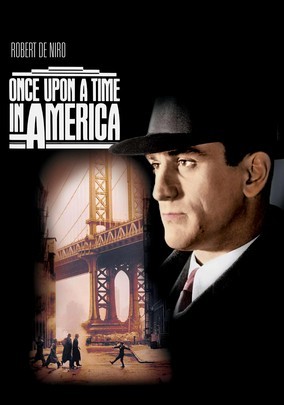
Once Upon a Time in America-1984

Once Upon a Time in America-1984

Director Sergio Leone

Starring Robert De Niro

Top 250 Films #85

Scott’s Review #218

60028306

Reviewed January 19, 2015

Grade: A

An epic film, the extended director’s cut of 1984’s Once Upon a Time in America is more than four hours in length and a directed by Sergio Leone, who also directed the 1968 masterpiece Once Upon a Time in the West and numerous other westerns starring Clint Eastwood.

This particular film is in a different vein and not to be confused as any sequel or related to the aforementioned film- this time Leone explores the crime drama genre rather than the western, and does so in remarkable fashion.

The film tells the story of a group of Jewish friends who became involved in organized crime in New York City during the 1920s.

The main story is told via flashbacks as the central character, Noodles, played by Robert De Niro, returns to Brooklyn thirty years later to reunite with his former mobster friends.

In this way, the film is sectioned- the group of youngsters and kids, and the same characters as adults.

Once Upon a Time in America has been met with considerable controversy since its release. At the time of its release, the film was butchered, with over an hour of footage cut by the studio heads, leaving it largely uneven.

Fortunately, the restored version, over three hours long, is available for viewing. Furthermorethe director’s cut clocks in at well over four hours and is the best version to watch. Due to so many cuts, other versions appear shoddy and out of order, making the viewing experience difficult.

Once Upon a Time in America is largely underappreciated, except among die-hard cinema lovers, most of whom are patient with the film, and it deserves mention as an excellent crime epic drama.

The film shares many similarities with The Godfather and The Godfather Part II, and the role De Niro plays is not too different from that of Vito Corleone in Part II.

However, the greatest contrast is that Once Upon a Time in America is more visually artistic than The Godfather films.

The film centers on Noodle’s perspective as he enjoys his youth in the Lower East Side of Manhattan, where he meets his lifelong friends.

The focal point is his friendship with Max, the adult character played by James Woods, and his undying love for Deborah, played by Elizabeth McGovern as an adult.

As kids, they are worry-free but gradually fall in with a group of older mobsters, first doing their dirty work, then venturing out on their own.

The film’s themes are loyalty, childhood friendship, betrayal, and greed, as all the characters change (or die) over the course of the film.

When a mysterious letter forces Noodles to resurface in Brooklyn, we begin to understand the backstory and the history between the friends as layers are slowly peeled back.

The film drags slightly in the middle section, but the first and last parts are very well made and absorbing.

Leone has a way of pacing the film that works- it is methodical and nuanced, with wonderful set pieces and each period explored- 1920s, 1930s, and 1960s seem equally as authentic as the next one does.

I especially enjoyed the 1920s art direction- it revealed such a state of genuineness and felt like truly being there in that period.

The relationship between Noodles and Deborah is an interesting one worth mentioning. Falling in love as youngsters (when a very young Jennifer Connelly played Deborah), they had an innocent puppy-love relationship.

As adults, they are ruined by a violent, disgraceful act, and one might argue that one of the characters becomes quite unsympathetic.

Once Upon a Time in America (1984) is a sprawling epic film sure to be enjoyed by intelligent fans of the crime epic drama genre and specifically Sergio Leone fans- an underappreciated gem.

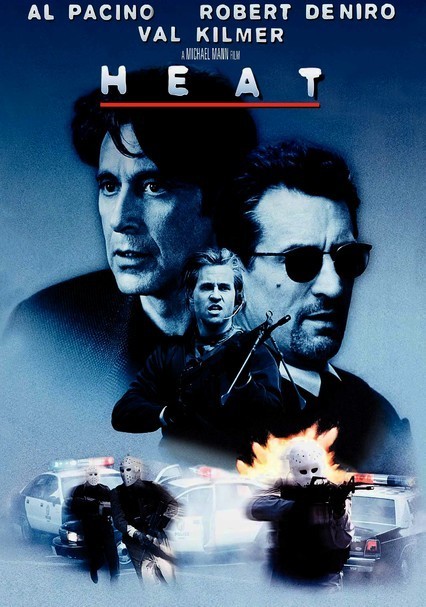
Heat-1995

Heat-1995

Director Michael Mann

Starring Al Pacino, Robert De Niro

Scott’s Review #1,228

Reviewed February 12, 2022

Grade: A-

Fans of the popular 1980s NBC television series, Miami Vice, will recall that Michael Mann was the Executive Producer of the show during its run.

He has a distinctive crime-thriller style that pairs perfectly with Heat, a sizzling 1995 offering starring two film greats, Al Pacino and Robert De Niro.

The fact that the pair do not appear together on screen too often can be forgiven because, when they do, the stars align, and the power of quiet scenes cannot be outdone. I savored the moment when they first appeared together.

Quality over quantity.

De Niro plays Neil McCauley, a lifelong criminal who is trying to handle the damage caused by one of his men while also planning one last big heist before retiring to parts unknown.

He meets a lovely young Los Angeles-based artist, played by Amy Brenneman, in a diner, and the two plan to relocate abroad.

Meanwhile, Lieutenant Hanna (Al Pacino) is a seasoned officer attempting to track down McCauley and his cohort while dealing with the chaos in his own life, including his wife’s (Diane Venora) infidelity and his stepdaughter’s (Natalie Portman) unhinged mental health.

McCauley and Hanna discover mutual respect, even as they try to thwart each other’s plans. The two characters become doppelgangers of one another.

The situation culminates in a cat-and-mouse chase on the tarmac at LAX airport.

To say that Heat is a by-the-numbers 1990s thriller is a fair assessment, although it’s way better than that classification, and it’s of that genre.

For starters, the acting is superior, and obviously, De Niro and Pacino bring a level of professionalism to the film in the lead roles.

My favorite scene is not the one you’d most expect me to say, but rather a quiet and powerful chit-chat in a small coffee shop. They are rivals, having lived opposite lives, yet their troubled lives mirror each other.

Without a doubt, Hanna wants to bring McCauley to justice, yet he admires him and sees parts of himself in him. The feeling is mutual, and the two actors relay this revelation without actually speaking the words.

Viewers immerse themselves in the characters, pivoting from this powerful scene.

There are a ton of characters in Heat, but each one feels like they have much to offer.

Juicy storylines are introduced but never forgotten, even if not part of the main canvas. Hanna’s wife and stepdaughter play a central role in the final act, even though they appear only in the first chapter.

In supporting roles, Val Kilmer and Ashley Judd share beautiful chemistry and a melancholy storyline as a damaged couple trying to survive surrounded by a life of crime.

At two hours and fifty-two minutes, there is plenty of time for each character to make their mark.

I love the rich character development that Heat offers, but sometimes it’s admittedly tough to keep track of the characters’ motivations and how they tie into the main action.

Mann’s style is all over the place, and even the musical score brought me back to the episodic song intervals that Miami Vice created.

The moody, dark atmosphere of dingy, crime-infested Los Angeles is perfectly set against glossy, glamorous high-rise and sprawling estate scenes. The bright and luminous city skyline is a feast for the eyes.

The cop/criminal dynamic is the main draw as Heat flexes its masculine muscles scene after scene. A bloody bank heist gone wrong at the beginning of the film cements what Mann is trying to create here.

A guy’s film with enough juice to hook the introspective film viewer, too.

Not remembered as well as it probably should be, Heat holds up surprisingly well when compared to similar but hokey 1990s action films like Lethal Weapon and the Die Hard films.

Though there’s not a whole lot new in Heat (1995), rich writing and powerful acting win out every time, and, of course, Pacino and De Niro are worth the price of admission.

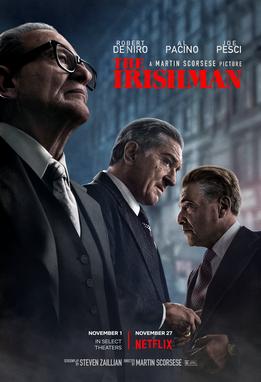
The Irishman-2019

The Irishman-2019

Director Martin Scorsese

Starring Robert De Niro, Al Pacino, Joe Pesci

Scott’s Review #960

Reviewed November 20, 2019

Grade: A

Any film created by legendary director Martin Scorsese is sure to impress legions of adoring followers and most critics.

Every project he touches results in something fantastic, and it’s easy to revel in, with good analysis and discussion about the movie moments after the closing credits have rolled.

The Irishman (2019) is a film that demands repeated viewings and thoughtful consideration to appreciate the rich and diverse cast of characters fully.

The picture may not be on the same level as Goodfellas (1990) or The Godfather (1972), which it seems patterned after, but the work is awe-inspiring and should stand the test of time, resulting in a fine wine analogy.

The years will likely be kind to the film and enrich the experience- it’s that kind of film.

With stars like Robert De Niro, Al Pacino, Joe Pesci, and Harvey Keitel on board, the viewer expects a plethora of riches, and that is precisely what is delivered.

The film spans the period from the 1950s to the 1970s.

It follows the life of Frank Sheeran (De Niro), a truck driver who becomes a hitman and becomes involved with mobster Russell Bufalino (Pesci) and his crime family, including his time working for the powerful Teamster Jimmy Hoffa (Pacino). Sheeran is dubbed “the Irishman”.

He narrates much of the story, now quite elderly and residing in a nursing home, of his time in the mafia and the mystery surrounding the death of Hoffa.

The only negatives to the film are the suspension of disbelief that De Niro is Irish – was there ever a more quintessential Italian New Yorker? However, this film is directed by Scorsese and produced by De Niro, so they could tell me the sky is green, and I would readily nod in agreement.

At three hours and twenty-nine minutes, the film is a long haul, and towards the middle, the film meanders a bit. Perhaps twenty or thirty minutes could have been sliced to the cutting room floor.

The rest of the experience The Irishman serves up is brilliance, with rich characters and a fantastic atmosphere. Have I mentioned that Scorsese directed this film? The cast of characters is endless and drips with zest, speaking volumes for what The Godfather did with casting.

Many recognizable actors appear in minor roles, like Ray Romano as attorney Bill Bufalino, Bobby Cannavale as “Skinny Razor”, and Anna Paquin as Frank’s estranged daughter, Peggy.

An endless supply of character actors fleshes out the remaining cast.

Excellent is the plethora of food references that would impress notable food director Alfred Hitchcock, known for incorporating meals into many of his scenes. The delectable early scenes, when Frank delivers meat to grocers and gets into a discussion with a gangster over a good steak, will leave viewers mouth-watering for a tender sirloin.

The conversations between characters are interesting, slowly building and adding robust grit to a packed film. They engage in good, thoughtful dialogue exchanges and discuss life and experiences matter-of-factly.

Characters are given a chance to develop and grow, and even minor characters, such as a nurse or a wife, add a comforting aura. It is evident what treasured films look like when a director can create and develop without outside interference.

The standouts in the acting department are Pacino and De Niro, the former of whom I’m crossing my fingers will receive an Oscar nomination.

The pairing is flawless, and eagle-eyed fans will recall that both actors appeared together in The Godfather Part II (1974) yet never shared a scene.

In The Irishman, they appear together in pivotal scenes. Pacino infuses Hoffa with humor and poise, as only Pacino can, in a character. He is my favorite character and is tough to look away from.

Both actors, along with Pesci, are treated to a recent marvel in cinema —the de-aging process. Each actor, well into his seventies, is transformed to appear in his mid-forties in many scenes and then aged to appear elderly later in life.

While each has a strange, unnatural look as a younger man, the process is impressive and an innovative technique that will surely become more common in film, subsequently offering limitless possibilities.

The Irishman (2019) is a cinematic gem by a storied director advancing in years, but still offering grandiose films. With stalwarts like De Niro, Pesci, and Pacino, the players are well cast, and nuanced touches add dimensions to the finished product.

Offering a gangster film with grace and style, the story is poignant and crisp, and a thoughtful approach to one of the legendary mysteries- what happened to Jimmy Hoffa?

Oscar Nominations: Best Picture, Best Director-Martin Scorsese, Best Supporting Actor-Al Pacino, Joe Pesci, Best Adapted Screenplay, Best Production Design, Best Cinematography, Best Costume Design, Best Film Editing, Best Visual Effects

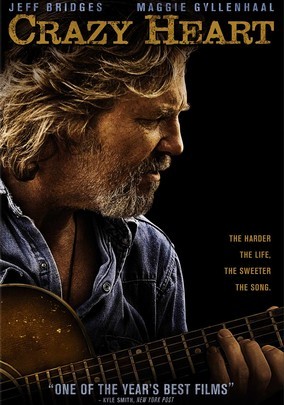
Crazy Heart-2009

Crazy Heart-2009

Director Scott Cooper

Starring Jeff Bridges

Scott’s Review #571

Reviewed December 29, 2016

Grade: A-

Crazy Heart (2009) is a film that is perfectly crafted for Jeff Bridges’ talents as an actor, and the role seems written specifically for him.

To that end, it is a showcase for the actor, and as proof, he was awarded the Best Actor Oscar.

He plays surly, grizzled, and rode hard to the hilt. His chemistry with co-star Maggie Gyllenhaal is fantastic, despite her character being much younger than his.

The first directorial effort by Scott Cooper, who does an outstanding job.

Gyllenhaal plays a reporter, Jean Craddock, who becomes attached and fascinated by Bad Blake (Bridges), a former country-western star turned alcoholic and now a washed-up older man.

He has mentored an upstart played by Colin Farrell, who has since usurped Bad Blake in popularity, leading Blake to depression and alcohol to relieve his pain.

He still performs, but in dirty hotels or bowling alleys, for peanuts.

Bridge’s character reminds me so much of Mickey Rourke’s character “Randy the Ram” in The Wrestler, from 2008, so anyone who enjoyed the latter will enjoy the former.

One might watch the two exceptional films in tandem, and in both, a younger female character meshes well with the stories.

The story portrayed in Crazy Heart is gritty and depressing, yet also heartwarming and sentimental. We root for Blake and Jean to succeed as they battle Blake’s many demons.

Crazy Heart (2009) is very well-acted and genuine.

The film is nice as it is a character-driven film instead of a story-dictated one.

Oscar Nominations: 2 wins-Best Actor-Jeff Bridges (won), Best Supporting Actress-Maggie Gyllenhaal, Best Original Song-“The Weary Kind” (won)

Independent Spirit Award Nominations: 2 wins-Best Male Lead-Jeff Bridges (won), Best First Screenplay, Best First Feature (won)

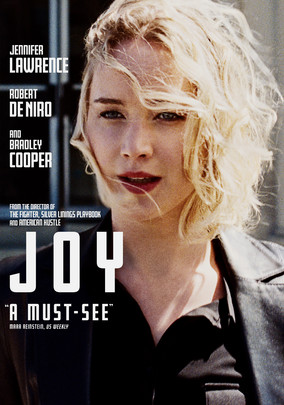
Joy-2015

Joy-2015

Director David O. Russell

Starring Jennifer Lawrence, Bradley Cooper, Robert DeNiro

Scott’s Review #485

80064513

Reviewed September 24, 2016

Grade: B-

Joy is a safe, mainstream, female-centered 2015 film, a biopic written for current star Jennifer Lawrence. She was nominated for a Best Actress Academy Award for her role and she carries the film.

Still, despite her performance, the film is nothing special and is written in a ho-hum manner.

It is simply not very compelling and the supporting characters are not utilized as they could have been. Despite being based on a true story, the writing is lazy and the plot far-fetched.

I expected more.

The film is another collaboration between director, David O. Russell, and big stars of the time- Lawrence, Bradley Cooper, and Robert DeNiro- all used in previous Russell films.

Lawrence plays Joy, a struggling Long Island mother of two, who is divorced from her husband (who still lives in the basement of her house), with multiple family members living with her, forming a support unit.

The sense is that Joy is the breadwinner of the family.

The story is narrated by Joy’s grandmother, who she calls Mimi (Diane Ladd). Mimi always knew Joy would be a success and we see a few scenes of Joy as a child, surviving her dysfunctional family and her parent’s disputes.

DeNiro plays her womanizing father, divorced from her mother (Virginia Madsen), who lies in bed all day watching soap operas. Cooper plays opportunist, QVC executive, Neil Walker, who takes a liking to Joy and helps her achieve her dream as a successful businesswoman after she patents an idea for a new, high-powered mop.

The authenticity of the time, 1989, and through the 1990s is apparent, as we see Joy working for Eastern Airlines, a company that would fold several years later. Also authentic were the automobiles of the time and the dresses and hairstyles.

These points the film does very well. And how cute was it to see famous daytime television stars such as Susan Lucci, portraying soap opera stars, as Joy’s mother lives her life vicariously through their tangled and bizarre soap lives?

Several scenes occur on the television set as we get glimpses of the soap stories.

The film as a whole, though, feels too neat.

Predictably, Joy faces obstacles on her way to success.  Already struggling financially, she takes out a second mortgage on her house. At first, she cannot give away mops, let alone sell them.

On the brink of giving up, she finishes a meeting with execs who laugh at her product, but Walker is there to give her a break because she has a pretty face.

Predictably, things do not go well and there is a rather dull subplot about a company in Texas trying to steal Joy’s idea. When she goes and threatens them they immediately back down and obediently give in to her every whim.

This is both unrealistic and uninteresting.

I would have liked to have seen a messy back-and-forth or some court scenes, but the Texas company is portrayed as nothing but the villain.

The writing has either plot holes or contains missed opportunities altogether and many questions abound. Despite many scenes of Joy’s past we end up knowing little.

Her entire family lives with her in a suburban Long Island house- why does Joy own the house and not her mother or grandmother? Why does Joy have a rivalry with her half-sister, Peggy? Why does Joy’s father own an auto garage and still need to stay with Joy? Why is Joy’s mother mostly in bed?

Madsen as the mother is rather cartoonish and unnecessary to the plot as is Ladd- a dynamic actress given little of substance.  I did not buy DeNiro as a cad nor in love with his wealthy new girlfriend Trudy (though seeing Isabella Rossellini in the part is a win), conveniently there to be Joy’s financer.

Despite an enormously talented cast, which is fantastic to see, most of the supporting parts could have been played by any actors, as the roles are not all that challenging, and the film itself is certainly a vehicle to showcase Jennifer Lawrence, David O. Russell’s current “it” girl.

This is not a slight towards Jennifer Lawrence since she is the best part.  She successfully portrays Joy as a sympathetic, strong-willed, fair, decent human being, with enormous struggles, and a blue-collar sensibility.

Great performance, but I wish the writing and the other talents involved in the film were given better material.

Oscar Nominations: Best Actress-Jennifer Lawrence

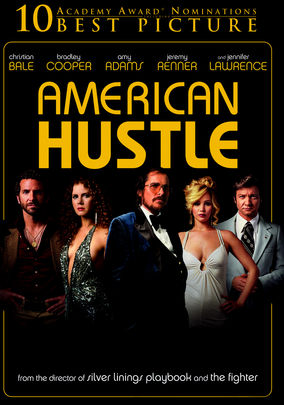
American Hustle-2013

American Hustle-2013

Director David O. Russell

Starring Christian Bale, Bradley Cooper, Jennifer Lawrence

Scott’s Review #39

70281530

Reviewed June 18, 2014

Grade: A

Having seen American Hustle (2013) a month ago and finally getting around to reviewing it, it’s a perfect time as a slew of Oscar nominations has been reaped upon it, thus, undoubtedly more people will be seeing it in the weeks ahead.

I loved this film.

Some were underwhelmed, but I found it quite authentic and stylish.

I loved the 1970’s period and felt the hairstyles, clothes, and props were spot on.

I also felt the film had great acting and, though I’m not a fan, Jennifer Lawrence enraptured me. The same with Cooper, Bale, and Adams, who all deserve their Oscar nods.

I found it similar in style to Boogie Nights, a 1997 masterpiece directed by Paul Thomas Anderson.

The 1970s musical rock score was perfect. The subject matter of political corruption and cat-and-mouse intrigue was effective and resounding.

Oscar Nominations: Best Picture, Best Director-David O. Russell, Best Actor-Christian Bale, Best Actress-Amy Adams, Best Supporting Actor-Bradley Cooper, Best Supporting Actress-Jennifer Lawrence, Best Original Screenplay, Best Production Design, Best Costume Design, Best Film Editing