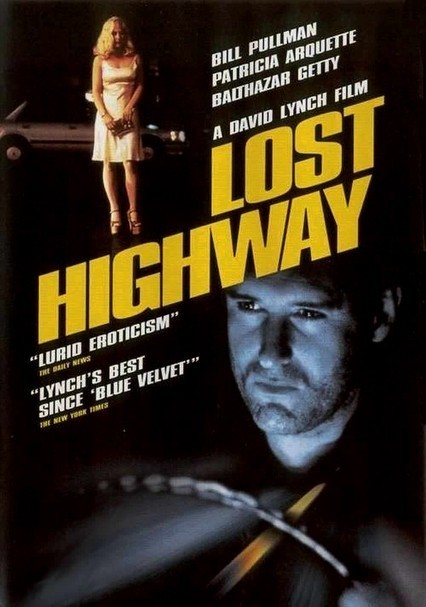
Lost Highway-1997
Director David Lynch
Starring Bill Pullman, Patricia Arquette
Top 250 Films #211
Scott’s Review #868
Reviewed February 17, 2019
Grade: A-
David Lynch, forever known for his odd and mind-boggling productions, released what might be his most bizarre offering, Lost Highway (1997).
Dreamlike and downright hallucinogenic, the film is impossible to dissect and is open to endless interpretation.
Characters morph into younger or different versions of themselves, or even into different characters entirely, making the film best experienced rather than overanalyzed.
The most enjoyment comes from the fabulous atmospheric elements.
Lost Highway is set in Los Angeles, where we meet saxophonist Fred Madison (Bill Pullman), a nightclub employee who lives with his glamorous wife, Renee (Patricia Arquette), somewhere in the Hollywood Hills.
The couple begins receiving envelopes containing VHS tapes of footage of their house, followed by more invasive tapes of them being filmed while sleeping in their bedroom.
Spooked, they enlist the help of a pair of incompetent detectives.
The events begin to grow more complex with the introduction of a menacing mystery man (Robert Blake) and sequences involving a dismembered Renee, and Fred’s subsequent incarceration for her murder.
Fred suddenly morphs into a young auto mechanic named Pete Dayton (Balthazar Getty), who is released into his parents’ care while being followed by the two detectives.
Pete embarks on an affair with Alice Wakefield, a mirror image of Renee, who is the mistress of powerful Mr. Eddy (Robert Loggia). Pete and Alice plan to escape together, leaving their troubled lives behind.
Any attempt to make more sense of the story than outlined above is fruitless, as a torrent of questions could be raised. The obvious ones are why does Fred turn into Pete (looking completely different), and why does Renee turn into Alice (looking similar)?
What do random scenes of a burning desert cabin mean? What does the bizarre and hazy lesbian sequence with Marilyn Manson have to do with anything?
Discerning the logic and attempting to unravel the mystery will lead to frustration.
The best advice is to immerse yourself in the film and let it manifest in your mind. The terms “dreamlike” and “hallucinating” are often used to describe films, but they are perfect adjectives for Lost Highway.
The stories do run parallel, so the challenge is not following each of them but rather understanding how they connect. The stories also merge in a circular pattern with a rhythmic effect and a satisfying ambiance that lured me immeasurably.
My favorite characters are Alice and Pete, largely because of the actors who portray them. Not appearing until the second half, Getty and Arquette infuse their roles with passion and energy.
I immediately rooted for them as a couple, as their tender and smoldering chemistry was immediately felt. Arquette blazes as a sexy temptress and Getty as the handsome and earnest man submitting to her prowess.
Eagle-eyed viewers may notice comparisons to Russ Meyer’s devilish sexploitation film Supervixens (1975).
The most notable are the dual character representations, the auto mechanic occupation, the locales (more than a few Los Angeles roads seem identical), and various sequences featuring a weightlifter, a gas station drive-up, or other eerily similar scenes.
Whether there is a direct correlation between the films is unknown, but it’s fun to observe.
The musical score and soundtrack are high points, adding both mystique and aggression through the featured hard rock songs. Marilyn Manson’s “I Put a Spell on You”, Rammstein’s “Heirate Mich”, and The Smashing Pumpkins “Eye” are used in important scenes.
The soundtrack release was a huge success on modern rock radio, achieving Gold record sales status.
At the time of Lost Highway’s release, the film was not well-regarded by critics and was dismissed as not making much sense.
In the decades following, the film has garnered more acclaim and, as with a fine wine, has aged well. The beautiful cinematic tone, creative design, and images have become more revered over time.
For a perplexing and cerebral experience, look no further than Lost Highway (1997), a delicious companion piece to the Lynch masterpiece, Mulholland Drive (2001).