Tag Archives: Milton Selzer

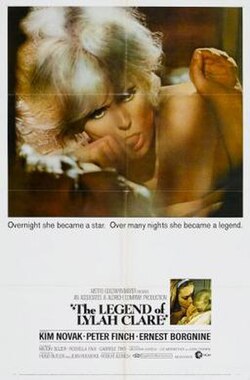
The Legend of Lylah Clare-1968

The Legend of Lylah Clare-1968

Director Robert Aldrich

Starring Kim Novak, Peter Finch

Scott’s Review #1,554
Reviewed September 27, 2026

Grade: B

Kim Novak stars in a 1968 psychological thriller named The Legend of Lylah Clare, a film on the surface similar to her legendary turn in Hitchcock’s Vertigo ten years earlier.

Like Vertigo, she plays two characters, both shrouded in ghostly mystery, as one is dead. Other characters are obsessed with the dead one.

Lylah Clare isn’t as good as Vertigo, so the parallels are limited.

The film has positives and negatives that create an uneven viewer experience. The bizarre environment raises suspicions of story changes or behind-the-scenes conflict, as something feels a bit off.

I much preferred the first half to the second, as what starts as an intriguing, mysterious promise goes off the rails and leads to more confusion than satisfaction.

A renowned German actress who died years earlier, Lylah Clare (Novak) is the subject of a film developed by volatile movie producer Barney Sheean (Ernest Borgnine).

An agent, Bart Langner (Milton Selzer), finds Elsa Brinkmann (also Novak), a beautiful woman who looks just like Lylah, and sets about getting the movie off the ground.

Lylah’s ex-husband, Lewis Zarken (Peter Finch), directs the film and begins to fall in love with Elsa as he coaches her to act just like his late wife.

Director Robert Aldrich has a vast filmography, but Lylah Clare most resembles What Ever Happened to Baby Jane? (1962) and Hush…Hush, Sweet Charlotte (1964), mostly in terms of a gothic environment and the fear of being made irrelevant.

Zarken’s looming Los Angeles mansion is the backdrop for much of the film. Its illustrious yet stuffy veneer hides dark secrets revealed through flashbacks, and the set is a main highlight.

I was immediately drawn into the story and the ‘legend’ by hints of what’s to come. Enormous portraits of Lylah adorn the estate, the most prominent being a lavish one on the steep staircase in the living room.

Shown to have been attacked by a fan who gained access to the mansion, Lylah was able to make the man fall down the staircase to his death. Afraid of heights, Lylah then fell and died after looking down at the corpse.

Is this the truth? What is Zarken hiding? Does Lylah’s acting coach, Rossella, know secrets? Did the fan have secrets?

The past is shrouded in mystery, and multiple characters’ obsessions with Lylah are very tantalizing.

Additionally, Elsa seems obsessed with Lylah even before she is cast to play her. Are they the same, like in Vertigo?

A deliciously satisfying scene is delivered at a party meant to debut Elsa’s new look as Lylah. Mean journalist Molly Luther (Coral Browne) prods and insults Elsa until Lylah emerges to put the wicked witch in her place.

It’s the first public appearance of Lylah as Elsa, and she quickly pounces on her foe in shocking form.

These elements make The Legend of Lylah Clare so compelling in the first half.

Slowly, the film began to unravel.

As Elsa begins to belt out a perfect German accent and switch into Lylah mode, summoning her wardrobe staff, or refusing to emerge onto the set, it feels terribly uneven and out of character.

I love Novak, but I’m not sure I love her in these roles. Since the characters don’t feel right, it must have been hard for the actress to play them well.

I couldn’t help but wonder whether Elsa couldn’t get into Lylah, or whether Novak couldn’t do the same.

And the obvious dubbing of Lylah’s German accent is very weird.

Zarkan’s back-and-forth personalities are too much. He goes from madly in love and smitten with Lylah to berating her on the movie set, back and forth.

In the final chapter, he basically causes Elsa’s death by coaxing her to look down from a trapeze set for no reason.

The film is billed as a satire and is assumed to examine the shark-like Hollywood world. The number of hateful characters (Molly, Zarkan, Barney) reinforces this.

A seemingly added TV commercial for dog food interrupts the film itself, suggesting that Hollywood is literally a dog-eats-dog world.

The last scene of Rossella drunkenly sitting on the couch watching the commercial and loading a gun, assumed to be to shoot Zarkan, is murky at best.

While confusing, The Legend of Lylah Clare (1968) has enough appeal to be a suggested watch.
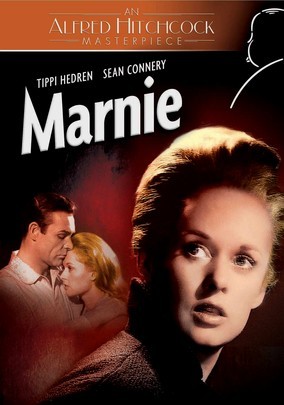
Marnie-1964

Marnie-1964

Director Alfred Hitchcock

Starring Sean Connery, Tippi Hedren

Top 250 Films #45

Scott’s Review #180

60000769

Reviewed October 4, 2014

Grade: A

When evaluating Alfred Hitchcock’s many films, Marnie (1964) is one of the more complicated. In recent years, it has earned higher praise than it did at its release, similar to Vertigo (1958).

It features one of Hitchcock’s most complex psychological characters and is as much a character study as a psychological thriller.

Tippi Hedren stars as Marnie Edgar, a troubled young woman who travels from one financial company to another, using a false identity and her good looks to insinuate herself into a clerical job without references. Over time, she steals thousands from the companies by gaining their trust.

Eventually, she is caught by Mark Rutland, a handsome, wealthy widower and client of one of the firms, played by Sean Connery. Infatuated with Marnie, he strikes a deal with her: She will marry him, but he will not turn her over to the police.

Marnie gives most of her stolen money to her disabled mother, Bernice, in Baltimore, played by Louise Latham.

Why Bernice is crippled, avoids affection with Marnie, and why Marnie despises most men and is terrified of the color red make up the film’s mysterious nature. Diane Baker is compelling as Lil, the sister-in-law to Mark and somewhat nemesis of Marnie.

The film features three scenes I am enamored with each time I watch it. In one scene, Marnie hides and waits in the bathroom until all the employees have gone home for the night. She carefully steals money from her employer’s safe and prepares to make her escape. Suddenly, she notices an unaware cleaning woman with her back to Marnie, yet blocking the exit.

How will Marnie escape unnoticed? The surprise in this scene is excellent. Hitchcock plays the scene without music, which adds to the tension—brilliant.

In an emotional scene later in the film, Marnie’s horse, Forio, is injured, and a sobbing Marnie must choose between killing her beloved friend or letting him suffer until a veterinarian can be summoned.

It is a heart-wrenching scene.

The third scene takes place at a racetrack as Marnie and Mark are enjoying one of their first dates together. However, the date is ruined when a former employer of Marnie’s, who has been victimized, recognizes her and makes accusations.

Marnie turns from a sweet girl to an ice queen seamlessly.

A huge controversial aspect of the film is that, while not shown, it is heavily implied that Mark rapes Marnie on their honeymoon. The following day, Marnie attempts suicide but is rescued by Mark.

This scene was filmed carefully so viewers didn’t hate Mark. Perhaps saving Marnie the next morning lessens what he did the night before in the eyes of the audience? This is open to debate.

Hedren excels at portraying the complexities of Marnie’s character throughout the entire film and does an excellent job in a demanding role.

As excellent as Hedren is (and she is fantastic), I have difficulty accepting her as a poor, icy criminal, and this issue arises each time I watch the film.

Could this be a result of having identified Hedren as the sophisticated, glamorous socialite in The Birds made a year earlier so many times? This is quite possibly so.

The set of Marnie was reportedly fraught with tension during filming. This tension was mainly between Hedren and Hitchcock, who refused to speak with each other throughout the filming. This may have added to the tension, and Hedren appears anxious.

Could this be art imitating life? As the ending nears, Marnie and Mark align and form a team as they try to avoid the police altogether; Mark, more or less, becomes an accomplice.

The final reveal seems rushed. It takes place mostly in flashbacks and wraps up quickly. Marnie has blocked much of her childhood from her memory, which seems far-fetched.

Still, Marnie (1964) is a complex, psychological classic from Hitchcock’s heyday.

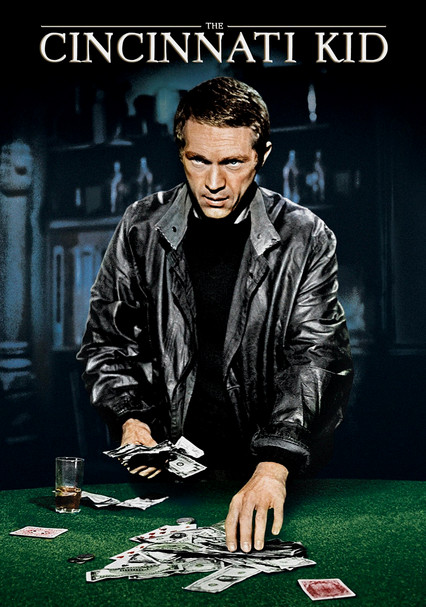
The Cincinnati Kid-1965

The Cincinnati Kid-1965

Director Norman Jewison

Starring Steve McQueen

Scott’s Review #1,138

Reviewed April 29, 2021

Grade: B

I suppose anyone really into poker playing or similar casino games might be partial to The Cincinnati Kid (1965), especially if they are a die-hard Steve McQueen fan.

But for those with no interest in the ‘sport’ and who think that McQueen is a royal douche who received a modicum of film success, the film is a marginally decent effort.

For those who don’t know, Steve McQueen, the actor and not the British filmmaker, was nicknamed the “King of Cool” and played the anti-hero in most of his films.

His heyday was from the mid-1960s through the early 1970s, and he garnered success by repeatedly playing the same role. He was notorious for insisting his hair was perfect, being selfish, and being a royal prick.

He died of cancer in 1980.

An earlier film of his, The Cincinnati Kid (1965), is set in Depression-era New Orleans, though the film’s severe 1960s look makes it almost impossible to determine that it’s not the 1960s.

Eric Stoner (Steve McQueen) is a cocky poker player nicknamed the Cincinnati Kid who challenges longtime champ Lancey “The Man” Howard (Edward G. Robinson) to a showdown at the table, where a war of persistence and luck ensues.

To add energy, Rip Torn plays Slade, a villainous man who seeks revenge against Howard and tries to help Stoner beat him.

In addition to the inevitable final poker game, Stoner is immersed in a romance with good girl Christian Rudd (Tuesday Weld) as he tries unsuccessfully to fend off the seductive advances of his best friend Shooter’s (Karl Malden) girlfriend (Ann-Margret), who is also a close friend of Christian.

Romance and double-dealing are in the air in this film.

The main draw is McQueen because he is charismatic and carries the by-the-numbers film.

The story seems to be a battle between youth (Stoner) and seasoned wisdom (Howard), but aside from the fantastic finale involving (what else!) a tense game of cards, I didn’t find the main story all that interesting.

Other impressive aspects, however, include the trimmings.

The actors handle the playing cards realistically, use the game terminology, and smoke a fat cigar, adding real authenticity to the film.

The New Orleans flavor adds culture, and many Black actors appear in minor roles that at least offer some representation of the actual southern city.

Despite the talented cast, only McQueen shines.

Weld and Ann-Margret are incredibly one-note characters and opposites (good girl and bad girl) with little development. Malden is the film’s moral compass but otherwise has little to do.

Interestingly, Norman Jewison replaced original director Sam Peckinpah shortly after filming began. He described The Cincinnati Kid as his “ugly duckling” film, which let him transition from the lighter films he’d made and take on more serious subjects.

Cinema lovers know he directed the 1971 film Fiddler on the Roof, a completely different film.

I wonder whether Jewison’s heart was in this film, or whether he did the best he could with a subject that wasn’t close to his heart.

Knowing Peckinpah’s brilliant work, I wonder if he would have made The Cincinnati Kid darker and more violent.

One scene that turns my stomach is a gruesome and violent cock-fighting scene. Any animal cruelty makes my blood boil, so I turned my head and refused to watch the scene or the group of merrymakers sitting around cheering the bloodbath.

The Cincinnati Kid (1965) is an enjoyable watch for poker lovers or Steve McQueen fans. It is also not bad for casual fans.

Though I have not seen it, I understand that The Hustler (1961) is a similarly themed and better-made film.

Golden Globe Nominations: Best Performance by an Actress in a Supporting Role in any Motion Picture-Joan Blondell