Tag Archives: Michael Murphy

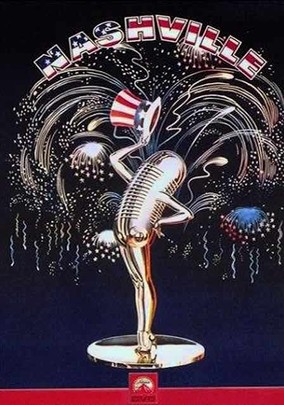
Nashville-1975

Nashville-1975

Director Robert Altman

Starring Lily Tomlin, Keith Carradine, Karen Black

Top 250 Films #3

Scott’s Review #47

60001541

Reviewed June 19, 2014

Grade: A

Nashville (1975)  is a brilliant film.

I have found that with each subsequent viewing, it creeps higher and higher on my list of favorite movies of all time.

The style is unique (largely improvised) and epitomizes creative freedom in the film during the 1970s.

Director Robert Altman lets his actors express themselves, even allowing them to write their songs; the dialogue overlaps at times, which results in a natural feeling as the viewer watches the cast of twenty-four principals intersect over five days at a political rally/country music festival.

It is pure Robert Altman at his finest.

Nashville is a satire of the political arena of the early 1970s, particularly the Vietnam conflict and its politicians.

The film certainly questions and challenges the government with an ironic patriotic setting (Nashville).

The country music industry was in uproar upon the film’s initial release. It is a layered film that can be discussed and appreciated, and every character is cared about.

I cannot adequately describe the multitude of nuances in each scene that are noticed over time.

Each character, even those with limited screen time, is vital to the story, as are the political elements —the questions of war, policies, and so on.

The chaotic bits and individual storylines come together at the end, and many background happenings are exciting to watch and take note of throughout each viewing.

With each experience, the audience will notice more and more. I certainly do.

Lily Tomlin, for example, plays Linnea, a haggard mother of deaf children with a supportive husband, a woman who, on the surface, is heroic; yet, she is a complex character. She is bored with her life and falls in love with a young musician despite the guilt and repercussions.

The musician in question is Tom Frank, played by Keith Carradine. Handsome and self-absorbed, he arrives in Nashville to dump his bandmates in hopes of a solo career and beds many willing females.

He also lashes out at a soldier at the airport, saying, “Kill anyone lately?”

Despite his unlikable character, Carradine gives one of the most beautiful performances in the film when he sings “I’m Easy”.

Several of the female characters assume he is singing the song for them, but who is he truly singing it for — if anyone?

Another character to analyze is Barbara Jean, played by Ronee Blakley. A frail yet very successful country singer, she is in and out of hospitals as she frets about her replacement singer stealing her thunder.

Her insecurities rise to the surface.

Insecurity is a common theme among the characters. Many of them are unsure, afraid, or lack confidence in their musical talent, relationships, or themselves.

These are only three examples of the twenty-four richly layered characters- some ambitious, some falling apart, others meandering through life.

Many songs throughout were written and performed by the actors themselves.

Nashville (1975) is storytelling and filmmaking at its best. A creation by Altman that is deservedly admired, revered, and heralded as a significant influence.

It is studied in film schools as it should be.

Oscar Nominations: 1 win-Best Picture, Best Director-Robert Altman, Best Supporting Actress-Ronee Blakley, Lily Tomlin, Best Original Song-“I’m Easy” (won)

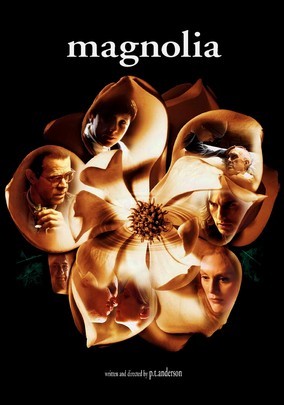
Magnolia-1999

Magnolia-1999

Director Paul Thomas Anderson

Starring Tom Cruise, Julianne Moore, John C. Reilly

Top 250 Films #67

Scott’s Review #777

Reviewed June 21, 2018

Grade: A

Paul Thomas Anderson is one of my favorite modern directors. In my opinion, his best film is Boogie Nights (1997), but he has also created other dark offerings, such as Phantom Thread (2017) and Inherent Vice (2014).

Arguably, his most distinctive effort might be Magnolia (1999), a cerebral film that explores themes of forgiveness and the meaning of life.

An ambitious effort, featuring a stellar ensemble cast, makes the film a fantastic experience.

Set in the San Fernando Valley (a mountainous area of Los Angeles), the film resembles David Lynch’s Mulholland Drive (2001) in its setting and oddness, as well as its unusual dialogue and offbeat characters.

A narrator explains three situations of extreme coincidence and surmises that chance may not be the only responsible party. Anderson then weaves an intricate tale involving numerous characters, intersecting lives, and a riveting climax on a rainy California day (an oddity in itself!).

The plot begins when we meet Jim Kurring (John C. Reilly), a police officer who is called to investigate a disturbance.

After finding a woman’s body in an apartment closet, events turn bizarre as a children’s game show host (Philip Baker Hall), his estranged daughter (Melora Walters), the show’s former producer, Earl (Jason Robards), who is dying from cancer, his drug-addicted wife Linda (Julianne Moore), Earl’s male caretaker (Philip Seymour Hoffman), a former game show champion (William H. Macy), and finally, an intense motivational speaker (Tom Cruise).

Quite a bevy of talented actors!

As the plot progresses mysteriously, the connections among the characters are revealed, and their peculiar motivations begin to take shape.

For example, Linda, who married Earl for his money, seems to have an epiphany and demands her lawyer change Earl’s will. Later, a character may have a connection to Earl and Linda, but is it all as it seems?

In Magnolia, the film is so wonderfully strange that it leaves the audience guessing for most of its running time.

Bizarre scenes are commonplace throughout the film. My favorite one is a marvelously creative scene. Suddenly, frogs begin to fall out of nowhere from the Los Angeles sky, with numerous consequences for the characters.

The incident causes a ripple effect, of sorts, as many of the characters’ fates are determined. Though one may not be able to make heads or tails of this scene or take complete logic from it, it’s enthralling all the same.

Magnolia has an overall quirky tone- sometimes upbeat, sometimes melancholy- that I adore. Films that are tough to figure out and feature an interesting musical score are so rich in flavor.

Aimee Mann is responsible for composing many of the songs on the musical soundtrack, so much so that she received a title credit on the soundtrack itself. Mann infuses her music with moody, diverse richness and ambient essentials.

Many actors make frequent appearances in Paul Thomas Anderson’s films. Magnolia alone seems almost like a Boogie Nights reunion with Moore, Walters, Macy, Baker Hall, and Philip Seymour-Hoffman to name just a handful.

The amazing aspect is that all of the aforementioned actors play vastly different, and arguably even more complex roles than they did in Boogie Nights.

Similar to Quentin Tarantino’s actors appearing in many of his films, this must be a creative treat for them.

There is no doubt that Magnolia (1999) is a complex, dream-like film. Open to interpretation and reflection, I find it a brilliant movie that I would like to revisit and dive into further with each viewing, hopefully for a better understanding and even deeper appreciation.

Oscar Nominations: Best Supporting Actor-Tom Cruise, Best Screenplay Written Directly for the Screen, Best Original Song-“Save Me”

The Year of Living Dangerously-1982

The Year of Living Dangerously-1982

Director Peter Weir

Starring Mel Gibson, Sigourney Weaver, Linda Hunt

Scott’s Review #1,266

Reviewed June 16, 2022

Grade: B+

The Year of Living Dangerously (1982) is a solid political drama with enough intrigue, romance, and superior cinematography by Russell Boyd, to recommend it. It’s not an American film but Australian which gives it an authentic flavor even though events are primarily set in Indonesia.

If Mad Max (1979) didn’t make Mel Gibson a full-fledged pinup star The Year of Living Dangerously certainly did because it made him a romantic ladies’ man in addition to a rugged action star. He has a ton of good looks and charisma at this point in his career and arguably has never looked better.

One could say (okay, I flat out will) that Gibson is upstaged, unintentionally so, by stage actress Linda Hunt who gets the role of her life as a highly intelligent Chinese-Australian man suffering from dwarfism and key to the entire plot.

Hunt won the Academy Award for flipping gender norms on its head and making the film more progressive and memorable than it deserves to be. Her performance is timeless and rich in character flavor.

If not for Hunt and Gibson as the standouts the film is lost in the shuffle amongst the myriad of similar political dramas to emerge in the 1980s.

Missing (1982) starring Jack Lemmon and Sissy Spacek and Victory (1981) starring Sylvester Stallone are the films that The Year of Living Dangerously reminds me of.

Blow Out (1981) and No Way Out (1987) are two of the best political drama films to come out of the decade and all are assuredly influenced by All the President’s Men (1976) which is one of the best from the genre.

There are so many others that The Year of Living Dangerously feels forgotten and too similar to a standard formula to stand out. It also suffers at times from being either a romantic drama or a political thriller and it struggles to mesh the two satisfyingly.

After journalist Guy Hamilton (Gibson) arrives in Jakarta, Indonesia, he forms a friendship with dwarf photographer Billy Kwan (Hunt), through whom he meets British diplomat Jill Bryant (Sigourney Weaver).

Bryant falls in love with Hamilton, and she gives him key information about an approaching Communist uprising. As the city becomes more dangerous, Hamilton stays to pursue the story. However, he faces more threats as he gets closer to the government putting him and others passionate about the political turmoil, in great peril.

The romance between Guy and Jill is not bad but Weaver has had so many better roles than this one that it feels throwaway. She’s a smart lady who falls madly in love with Guy so easily that the formulaic context is obvious.

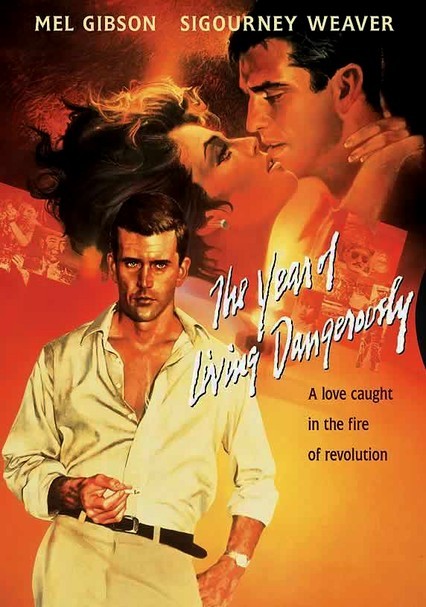
The movie poster makes the pair look like Rhett and Scarlett in Gone with the Wind (1939), unintentionally providing humor and ambiguity about what the film is going for.

It does best when it sticks to the political message.

The film is laden with foreign mystique and intrigue largely due to the exotic locale of Indonesia (the film was shot in the Phillippines which is a good double).

The plot is absorbing for what it is and the peril the journalists face is exciting. This parlays well with the real-life situation in which the film is based. In 1965, Indonesia was a hotbed of corruption and danger, and director, Peter Weir, managed to pull these sequences together well.

The main flaw is Weir doesn’t seem to know if he is crafting a political thriller or a romantic drama.

Back to the astounding Linda Hunt, the best scene of the film occurs when her character dies in Guy’s arms. Forget Weaver, the emotional core of the film belongs to Gibson and Hunt who have tremendous chemistry. The ambiguity of Billy, mostly because we know the gender of Hunt, is delicious.

In the end, the conclusion is mostly a happy one albeit predictable and the storyline feels unsatisfying.

A nice effort and relevant in 1982, The Year of Living Dangerously has energy and polish. It just feels too familiar and similar to other genre films to stand out, save for Linda Hunt and Mel Gibson.

Oscar Nominations: 1 win-Best Supporting Actress-Linda Hunt (won)

What’s Up, Doc? -1972

What’s Up, Doc? -1972

Director Peter Bogdanovich

Starring Barbra Streisand, Ryan O’Neal 

Scott’s Review #1,162

Reviewed July 20, 2021

Grade: B+

Careful trepidation is advised for filmmakers venturing into humorous or slapstick comedy waters, especially if they are better known for dramatic films.

Since we’re talking 1970s cinema here, there is only one Mel Brooks, and plenty of films with physical humor and gags fail miserably.

What’s Up, Doc? (1972) is not one of them and is a refreshing success.

Brooks’s influence can easily be seen throughout the film, and this is no surprise. Before doing any post-film research, I was immediately reminded of the popular television sitcom Get Smart, which ran from 1965 to 1970.

Buck Henry, a frequent Brooks collaborator, co-created Get Smart and wrote the screenplay for What’s Up Doc?

The antics and comedic moments scream Brooks. If one is unfamiliar, it is like watching a Mel Brooks film.

Director Peter Bogdanovich, most notably known for the 1971 masterpiece The Last Picture Show, changes course, opting for comedy with lots of screwball situations and physical comedy that are completely different from his previous work.

Speaking of Brooks, Madeline Kahn, a mainstay of his films, appears as a particularly neurotic character named Eunice Burns. It is her first film role.

I must say I was thoroughly impressed by What’s Up, Doc?, which oddly pairs two Hollywood superstars of the time, Barbra Streisand and Ryan O’Neal.

One might be surprised to think of the duo as romantic partners, and the chemistry comes and goes throughout the film, but the antics and quick dialogue are joyous and timed perfectly between the actors.

What’s Up, Doc? intends to pay homage to comedy films of the 1930s and 1940s, especially popular Warner Bros. Bugs Bunny cartoons, hence the title, but the reference doesn’t appear until the final scene.

This caused me to ponder why the specific title was used.

The premise goes something like this. Doctor Howard Bannister (O’Neal) arrives in San Francisco to compete for a research grant in music. He is accompanied by his overbearing wife, Eunice (Khan).

Already nervous and on edge because of Eunice, he meets a strange yet charming woman named Judy Maxwell, played by Streisand, at the drugstore. They are drawn to each other yet are not sure why. She both annoys and fascinates him.

In a subplot, a woman has her jewels stolen, and a government whistleblower arrives with his stolen top-secret papers. Ironically, all the players have identical red plaid bags and stay in neighboring hotel rooms, adding to the confusion and hilarity.

My favorite moments are the screwball scenes. Especially memorable are the hilarious sequences that take place in and around the hotel guest rooms as a constant in-and-out of parallel rooms unfolds. Each character has a particular motivation as they sneak around the hallways and rooms.

It is delightful fun.

When I realized that Streisand and O’Neal were the romantic leads, I was skeptical at first, but their chemistry is not bad. They are not the sort of couple that he and Ali MacGraw were in Love Story (1970), and certainly have no heavy drama to play, but they play comedy off of each other well.

The film makes a joke about the film Love Story.

Unfamiliar to me, I am glad I took the chance and watched What’s Up Doc? (1972). The film provides laughs, entertainment, and good chemistry among the cast who know how to deliver rapturous humor with perfect timing.

Rated G, the film can be enjoyed by the entire family as there is not a double entendre or otherwise offensive moment to be found—just good, old-fashioned humor. I would argue that the film influenced the 1970s as much as it paid homage to earlier comedy films.

I would see it again.