Tag Archives: Rossella Falk

The Legend of Lylah Clare-1968

The Legend of Lylah Clare-1968

Director Robert Aldrich

Starring Kim Novak, Peter Finch

Scott’s Review #1,554
Reviewed September 27, 2026

Grade: B

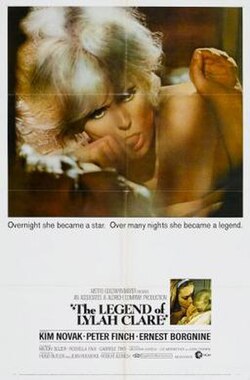
Kim Novak stars in a 1968 psychological thriller named The Legend of Lylah Clare, a film on the surface similar to her legendary turn in Hitchcock’s Vertigo ten years earlier.

Like Vertigo, she plays two characters, both shrouded in ghostly mystery, as one is dead. Other characters are obsessed with the dead one.

Lylah Clare isn’t as good as Vertigo, so the parallels are limited.

The film has positives and negatives that create an uneven viewer experience. The bizarre environment raises suspicions of story changes or behind-the-scenes conflict, as something feels a bit off.

I much preferred the first half to the second, as what starts as an intriguing, mysterious promise goes off the rails and leads to more confusion than satisfaction.

A renowned German actress who died years earlier, Lylah Clare (Novak) is the subject of a film developed by volatile movie producer Barney Sheean (Ernest Borgnine).

An agent, Bart Langner (Milton Selzer), finds Elsa Brinkmann (also Novak), a beautiful woman who looks just like Lylah, and sets about getting the movie off the ground.

Lylah’s ex-husband, Lewis Zarken (Peter Finch), directs the film and begins to fall in love with Elsa as he coaches her to act just like his late wife.

Director Robert Aldrich has a vast filmography, but Lylah Clare most resembles What Ever Happened to Baby Jane? (1962) and Hush…Hush, Sweet Charlotte (1964), mostly in terms of a gothic environment and the fear of being made irrelevant.

Zarken’s looming Los Angeles mansion is the backdrop for much of the film. Its illustrious yet stuffy veneer hides dark secrets revealed through flashbacks, and the set is a main highlight.

I was immediately drawn into the story and the ‘legend’ by hints of what’s to come. Enormous portraits of Lylah adorn the estate, the most prominent being a lavish one on the steep staircase in the living room.

Shown to have been attacked by a fan who gained access to the mansion, Lylah was able to make the man fall down the staircase to his death. Afraid of heights, Lylah then fell and died after looking down at the corpse.

Is this the truth? What is Zarken hiding? Does Lylah’s acting coach, Rossella, know secrets? Did the fan have secrets?

The past is shrouded in mystery, and multiple characters’ obsessions with Lylah are very tantalizing.

Additionally, Elsa seems obsessed with Lylah even before she is cast to play her. Are they the same, like in Vertigo?

A deliciously satisfying scene is delivered at a party meant to debut Elsa’s new look as Lylah. Mean journalist Molly Luther (Coral Browne) prods and insults Elsa until Lylah emerges to put the wicked witch in her place.

It’s the first public appearance of Lylah as Elsa, and she quickly pounces on her foe in shocking form.

These elements make The Legend of Lylah Clare so compelling in the first half.

Slowly, the film began to unravel.

As Elsa begins to belt out a perfect German accent and switch into Lylah mode, summoning her wardrobe staff, or refusing to emerge onto the set, it feels terribly uneven and out of character.

I love Novak, but I’m not sure I love her in these roles. Since the characters don’t feel right, it must have been hard for the actress to play them well.

I couldn’t help but wonder whether Elsa couldn’t get into Lylah, or whether Novak couldn’t do the same.

And the obvious dubbing of Lylah’s German accent is very weird.

Zarkan’s back-and-forth personalities are too much. He goes from madly in love and smitten with Lylah to berating her on the movie set, back and forth.

In the final chapter, he basically causes Elsa’s death by coaxing her to look down from a trapeze set for no reason.

The film is billed as a satire and is assumed to examine the shark-like Hollywood world. The number of hateful characters (Molly, Zarkan, Barney) reinforces this.

A seemingly added TV commercial for dog food interrupts the film itself, suggesting that Hollywood is literally a dog-eats-dog world.

The last scene of Rossella drunkenly sitting on the couch watching the commercial and loading a gun, assumed to be to shoot Zarkan, is murky at best.

While confusing, The Legend of Lylah Clare (1968) has enough appeal to be a suggested watch.
Modesty Blaise-1966

Modesty Blaise-1966

Director Joseph Losey

Starring Monica Vitti, Terence Stamp, Dirk Bogarde

Scott’s Review #1,243

Reviewed April 9, 2022

Grade: B

Modesty Blaise (1966) is a campy, over-the-top escapist film loosely based on a British comic strip. It features a relaxed style but a convoluted plot.

The story doesn’t matter much, and the film feels based on the James Bond film series with some Dick Tracy and Brenda Starr comic elements thrown in.

Throughout the action, I chuckled at the characters’ situational comedy antics. Both heroes and villains get mixed up in one hokey situation after another, and all the actors seem well aware that they are not performing Shakespearean comedy.

They forge ahead, making it as much of a zany offering as humanly possible.

Much of the film is reminiscent of television, Get Smart, a foolish but sweet-natured 1960s spy-genre offering.

I challenge the odd decision to make a film of this genre a bloated one hour and fifty-seven minutes. A spry ninety or ninety-five minutes would have been ample time to wrap up the experience and allow audiences to head for the exits.

This might prevent some from realizing how silly a film they’d just sat through

Modesty Blaise is not a traditionally good film but grooviness and pizazz are the main attractions as characters indulge in an orgy of colorful situations and preposterous setups.

Lavish locales like Amsterdam, and London, and the roaring beaches off the coast of the Mediterranean Sea bring the film back from going too far off the rails and pepper it with some cultivation.

If you’re in the right mood, Modesty Blaise is a chuckle fest, but don’t waste your time if you’re aching for high art. The psychedelic, groovy art design and Mad Men-like sets won me over.

I quickly forgot to try and piece together the complicated plot.

I didn’t care who was who or who was trying to outwit who and why. And I was okay with that.

Gorgeous Italian actress Monica Vitti leads the charge, followed by the dashing English actor Terence Stamp. Together, they make a lusty and good-looking pair, though Vitti gets no acting accolades.

Her looks are the primary reason for her casting win.

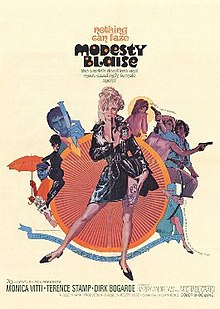
The actress plays a beautiful former criminal named Modesty who decides to go straight and work for the Secret Service. They send her to infiltrate a ring of jewel thieves, but the stuck-up older regime does not especially respect her.

She shrugs it off and offers her best services.

Soon after she joins the gang, sophisticated and dangerous head honcho Gabriel (Dirk Bogarde) grows suspicious of his new charge; Modesty realizes that British Intelligence gave her a mission they could care less if she survives.

She then enlists her former partner, Willie (Stamp), to help her out of her peril while outsmarting both sides.

Most action scenes are ludicrous, and the likelihood of any of the stories being true is slim to none. Plenty of sequences are set on a luxury yacht or some other water transportation, and Vitti and Stamp are clad in as little as possible.

I smirked at more than one James Bond nod, though some influence on the still-to-be-made Diamonds Are Forever (1971) is noticed.

If I’m making Modesty Blaise out to be a terrible film, it’s not.

The gimmicky angle of having Modesty appear with a different hairstyle in every sequence is clever and enjoyable (my preference is for her as a blonde).

When she is imprisoned in a spiraling-colored basement cell and must climb out the roof for help, the set design is one of the best I’ve ever seen. The creative team gets an A-plus for expressiveness and imagination, which is why Modesty Blaise is so fun.

Dirk Bogarde and Rossella Falk play cartoonish criminals Gabriel and Clara, who are deliciously wicked. I was amazed at Gabriel’s towering purple cocktail and craved a sip to see exactly what he was drinking.

Satisfyingly, both main villains get their comeuppance.

The film is foolish, campy, and a silly time wrapped up in fantastic artistry from a creative team that deserves more credit than they probably received.

Modesty Blaise (1966) is a messy but enjoyable film. I found it endearing more than I probably should have. It’s the guiltiest pleasure in a chest of sub-par spy comedy films.

8 1/2-1963

8 1/2-1963

Director Federico Fellini

Starring Marcelo Mastroianni, Claudia Cardinale

Scott’s Review #973

Reviewed December 27, 2019

Grade: A-

For fans of acclaimed and experimental Italian film director Federico Fellini, a straightforward plot is rarely the recipe of the day with his projects.

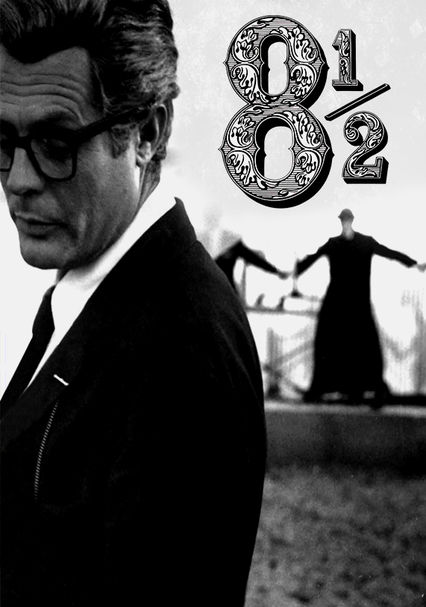
With 8 1/2 (1963), he creates a personal and autobiographical story about a movie director who is pressured into another project but lacks the creative ideas and inspiration to fulfill the task.

We can all relate to this in one way or another.

The film is confusing, beautiful, elegant, and dreamlike, precisely what one would expect of a Fellini production. His film also hints at a more profound message and complexities.

The recommendation is to experience the film rather than analyze or over-analyze it. Let it marinate over time and relish in its offerings.

Guido Anselmi (Marcello Mastroianni) is a famous Italian film director who suffers from director’s block after he is tasked with directing an epic science fiction film and attempts to do so.

Experiencing marital difficulties, he decides to spend time at a luxurious spa where he has strange reoccurring visions of a beautiful woman (Claudia Cardinale), is visited by his mistress Carla (Sandra Milo), and is criticized by a temperamental film critic.

When Guido’s film crew arrives at his hotel to start production, he becomes overwhelmed by the mounting pressures and escapes into a world of memories. He visits his grandmother, dances with a prostitute, and relives his time at a strict Catholic school.

The film critic dismisses Guido’s attempts to incorporate these memories into his new film. The rest of the film is a mishmash of odd occurrences as Guido attempts to make his film.

Fans of Fellini’s other works will undoubtedly fall in love with 8 1/2, and since the film is about film, this scores points in my book.

His other famous works, Roma (1972) and Amarcord (1973) are similarly semi-autobiographical but differ in that they are more straightforward stories- as much as can be said about a Fellini film.

Usually lacking much plot, 8 1/2 resembles Juliet and the Spirits (1965) more than the others for comparison’s sake. Fantasy and reality are interspersed, making the film challenging to follow.

It appears to be about a man on the brink of a nervous breakdown and is a complex and personal study. As Guido spirals out of control and teetering towards insanity, he also muses about his situation. These highs and lows, told comically, make 8 1/2 even more challenging to figure out and react to.

My previous suggestion to experience 8 1/2 becomes credible as the film rolls along. Viewers may be unsure of what is happening, if not downright perplexed, but energy pulls one into its clutches with masterful sequences and potent embraces of life, love, and culture.

This must be attributed to the look and style of the film.

8 1/2 won the Academy Awards for Best Foreign Language Film and Best Costume Design (black-and-white) and is considered a highly respected and influential work of art by most film critics.

Appreciated mostly for its beautiful cinematography, it also delves into the meaning of life with a live-and-let-live approach.

Lovers of avant-garde works of interpretation and expressionism will be giddy while experiencing ruminating thoughts following 8 1/2 (1963).

Having only seen the film once and embraced it wholly as a work of art but frustrated by the lack of tangible meaning, I advise seeing it a second, a third, or even a fourth time for a deeper appreciation and understanding.

I plan to heed my suggestion.

Oscar Nominations: 2 wins-Best Director-Federico Fellini, Best Story and Screenplay Written Directly for the Screen, Best Foreign Language Film (won), Best Art Direction, Black-and-White, Best Costume Design, Black-and-White (won)