Tag Archives: Valentina Cortese

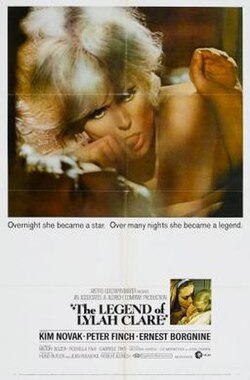
The Legend of Lylah Clare-1968

The Legend of Lylah Clare-1968

Director Robert Aldrich

Starring Kim Novak, Peter Finch

Scott’s Review #1,554
Reviewed September 27, 2026

Grade: B

Kim Novak stars in a 1968 psychological thriller named The Legend of Lylah Clare, a film on the surface similar to her legendary turn in Hitchcock’s Vertigo ten years earlier.

Like Vertigo, she plays two characters, both shrouded in ghostly mystery, as one is dead. Other characters are obsessed with the dead one.

Lylah Clare isn’t as good as Vertigo, so the parallels are limited.

The film has positives and negatives that create an uneven viewer experience. The bizarre environment raises suspicions of story changes or behind-the-scenes conflict, as something feels a bit off.

I much preferred the first half to the second, as what starts as an intriguing, mysterious promise goes off the rails and leads to more confusion than satisfaction.

A renowned German actress who died years earlier, Lylah Clare (Novak) is the subject of a film developed by volatile movie producer Barney Sheean (Ernest Borgnine).

An agent, Bart Langner (Milton Selzer), finds Elsa Brinkmann (also Novak), a beautiful woman who looks just like Lylah, and sets about getting the movie off the ground.

Lylah’s ex-husband, Lewis Zarken (Peter Finch), directs the film and begins to fall in love with Elsa as he coaches her to act just like his late wife.

Director Robert Aldrich has a vast filmography, but Lylah Clare most resembles What Ever Happened to Baby Jane? (1962) and Hush…Hush, Sweet Charlotte (1964), mostly in terms of a gothic environment and the fear of being made irrelevant.

Zarken’s looming Los Angeles mansion is the backdrop for much of the film. Its illustrious yet stuffy veneer hides dark secrets revealed through flashbacks, and the set is a main highlight.

I was immediately drawn into the story and the ‘legend’ by hints of what’s to come. Enormous portraits of Lylah adorn the estate, the most prominent being a lavish one on the steep staircase in the living room.

Shown to have been attacked by a fan who gained access to the mansion, Lylah was able to make the man fall down the staircase to his death. Afraid of heights, Lylah then fell and died after looking down at the corpse.

Is this the truth? What is Zarken hiding? Does Lylah’s acting coach, Rossella, know secrets? Did the fan have secrets?

The past is shrouded in mystery, and multiple characters’ obsessions with Lylah are very tantalizing.

Additionally, Elsa seems obsessed with Lylah even before she is cast to play her. Are they the same, like in Vertigo?

A deliciously satisfying scene is delivered at a party meant to debut Elsa’s new look as Lylah. Mean journalist Molly Luther (Coral Browne) prods and insults Elsa until Lylah emerges to put the wicked witch in her place.

It’s the first public appearance of Lylah as Elsa, and she quickly pounces on her foe in shocking form.

These elements make The Legend of Lylah Clare so compelling in the first half.

Slowly, the film began to unravel.

As Elsa begins to belt out a perfect German accent and switch into Lylah mode, summoning her wardrobe staff, or refusing to emerge onto the set, it feels terribly uneven and out of character.

I love Novak, but I’m not sure I love her in these roles. Since the characters don’t feel right, it must have been hard for the actress to play them well.

I couldn’t help but wonder whether Elsa couldn’t get into Lylah, or whether Novak couldn’t do the same.

And the obvious dubbing of Lylah’s German accent is very weird.

Zarkan’s back-and-forth personalities are too much. He goes from madly in love and smitten with Lylah to berating her on the movie set, back and forth.

In the final chapter, he basically causes Elsa’s death by coaxing her to look down from a trapeze set for no reason.

The film is billed as a satire and is assumed to examine the shark-like Hollywood world. The number of hateful characters (Molly, Zarkan, Barney) reinforces this.

A seemingly added TV commercial for dog food interrupts the film itself, suggesting that Hollywood is literally a dog-eats-dog world.

The last scene of Rossella drunkenly sitting on the couch watching the commercial and loading a gun, assumed to be to shoot Zarkan, is murky at best.

While confusing, The Legend of Lylah Clare (1968) has enough appeal to be a suggested watch.

Juliet Of The Spirits-1965

Juliet Of The Spirits-1965

Director Federico Fellini

Starring Giulietta Masina

Top 250 Films #188

Scott’s Review #725

Reviewed February 15, 2018

Grade: A

A true Fellini film in every sense, and perhaps his most personal, 1965’s Juliet of the Spirits is a colorful, masterful experience with fluid art direction and stunning sets and costumes.

As with most of his films, the story and its intricacies are odd and do not always make perfect sense, but the film is meant to be absorbed and felt, and it has more of a central plot than some of his other works.

Juliet of the Spirits is undoubtedly a must-see for fans of Fellini or any novice who wants an introduction to the great director.

In a compelling tidbit of background information, lead actress Giulietta Masina, wife and muse of director Fellini and sometimes deemed the female Charlie Chaplin, plays a true-to-life character.

In real life, the woman suffered from a philandering husband- Fellini himself!

For this reason alone, the film is fascinating as a true-to-life story, leading the audience to empathize with Giulietta and her life of doldrums and turmoil.

Giulietta Boldrini (Masina) is an affluent woman living in Italy with her successful and dashing husband, Giorgio (Mario Pisu). Despite wealth, two housekeepers, and free time to do whatever she pleases, she is dissatisfied with her life and surroundings.

This occurs mainly after she hears her husband mutter another woman’s name in his sleep. Concerned and intrigued, Giulietta hires investigators to unravel the mystery, which spawns an adventure for her.

Instead of a cookie-cutter film with a basic plot, in proper Fellini form, Giulietta embarks on a journey into a dreamlike, odd experience, tapping into her repressed desires and innermost thoughts while being exposed to her larger-than-life, sexy neighbor, Suzy (Sandra Milo).

The oversexed Suzy enlightens Giulietta to the joys of her mansion, treehouse, dazzling, weird friends, and bubbling sensuality.

Juliet of the Spirits is a joy to watch and quite a bit more linear than other complex masterpieces, such as the 1960s La Dolce Vita or 1969’s Fellini Satyricon.

The plot is spelled out presently- Giulietta is depressed and anxious for something new and exciting. Her journey into this new life, marked by her wrestling with demons and resistance, makes this film so much fun.

Styles and colors are brilliant and lavishly loud. Take the gaudy and glamorous nest that Suzy calls home. Her palace is both tawdry and sophisticated, with a built-in underground swimming pool where she bathes after lovemaking and velvety red walls and furniture.

Fellini uses gorgeous reds, greens, and blues throughout the film to create dazzle and spectacles with larger-than-life characters.

To further focus on Suzy for a minute, the blonde bombshell frequently visits her very own treehouse, complete with a swing. She flirts with handsome young men who gaze up at the scantily dressed beauty as she tosses her high-heeled shoe down to them in a suggestive manner.

When they come up to the top of the treehouse by way of a mechanical basket, presumably for sex, this is too much for the overwhelmed Giulietta, who returns to the safety of her own home.

But she is excited and scared.

The film belongs to Masina, and we cannot help but wonder if Fellini created Juliet of the Spirits for the actress because of his reported years of cheating.

Regardless, Masina plays a confident woman on the outside- insecure on the inside- flawlessly.

With her expressive eyes and a nice smile, Masina enthusiastically embraces the role, making her a perfect fit for a Fellini film.

Juliet of the Spirits mixes several film genres, including fantasy, drama, and light comedy, and contains interesting supporting characters.

Suzy’s seemingly clairvoyant mother is a great side character. When she meets Giulietta, she immediately sees that the woman is troubled. Giulietta’s father, whom we meet when she is a little girl appearing in a religious play, is boisterous and spirited.

I was fortunate enough to stay at the Grand Hotel in Rome, a lavish yet strange establishment where Fellini spent many nights as a guest. While watching Juliet of the Spirits, I fantasized that he drew inspiration for this film from the hotel.

The grand red textures that appear in both the hotel and the Fellini film could have created a truly inspiring setting.

Stalwart, creative, and masterful director Fellini once again crafts a stylish film that warrants thoughtful consideration after a solid viewing.

Too much analysis, however, will ruin the enchanting experience. Juliet of the Spirits (1965) is best enjoyed as a treat that will mesmerize you in glamorous fashion.

Oscar Nominations: Best Art Direction, Color, Best Costume Design, Color

Golden Globe Nominations: 1 win-Best Foreign Film-Foreign Language (won)