Marnie-1964
Director Alfred Hitchcock
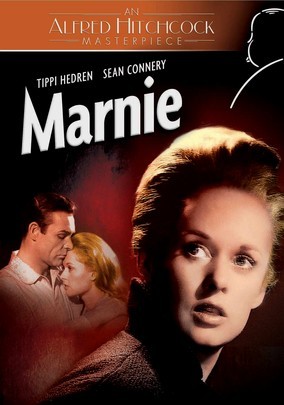
Starring Tippi Hedren, Sean Connery
Top 250 Films #45
Scott’s Review #180
Reviewed October 4, 2014
Grade: A
When evaluating Alfred Hitchcock’s many films, Marnie (1964) is one of the more complicated.
In recent years, it has earned more praise than it did at release, much like Vertigo (1958).
It features one of Hitchcock’s most complex psychological characters and is as much a character study as a psychological thriller.
Tippi Hedren stars as Marnie Edgar, a troubled young woman who travels from one financial company to another, using a false identity and her good looks to insinuate herself into a clerical job without references.
Over time, she steals thousands from the companies by gaining their trust.
Eventually, Mark Rutland, a handsome, wealthy widower and client of one of the firms, catches her, played by Sean Connery.
Infatuated with Marnie, he strikes a deal with her: She will marry him, but he will not turn her over to the police.
Marnie gives most of her stolen money to her disabled mother, Bernice, in Baltimore, played by Louise Latham.
Why Bernice is crippled, avoids affection with Marnie, and why Marnie despises most men and is terrified of the color red make up the film’s mysterious nature.
Diane Baker is compelling as Lil, Mark’s sister-in-law and somewhat of a nemesis to Marnie.
The film features three scenes I love each time I watch it.
In one scene, Marnie hides in the bathroom and waits until all the employees have gone home for the night. She carefully steals money from her employer’s safe and prepares to make her escape.
Suddenly, she notices an unaware cleaning woman with her back to Marnie, yet blocking the exit.
How will Marnie escape unnoticed? The surprise in this scene is excellent. Hitchcock plays the scene without music, which adds to the tension—brilliant.
In an emotional scene later in the film, Marnie’s horse, Forio, is injured, and a sobbing Marnie must choose between killing her beloved friend or letting him suffer until a veterinarian can be summoned.
It is a heart-wrenching scene.
The third scene takes place at a racetrack as Marnie and Mark enjoy one of their first dates. However, the date is ruined when a former employer of Marnie’s, who has been victimized, recognizes her and makes accusations.
Marnie turns from a sweet girl to an ice queen seamlessly.
A huge controversial aspect of the film is that, while not shown, it is heavily implied that Mark rapes Marnie on their honeymoon. The following day, Marnie attempts suicide but is rescued by Mark.
The scene was carefully filmed so viewers wouldn’t hate Mark. Perhaps saving Marnie the next morning lessens what he did the night before in the eyes of the audience? This is open to debate.
Hedren excels at portraying the complexities of Marnie’s character throughout the entire film and does an excellent job in a demanding role.
As excellent as Hedren is (and she is fantastic), I struggle to accept her as a poor, icy criminal, and this issue comes up each time I watch the film.
Could this be a result of having identified Hedren as the sophisticated, glamorous socialite in The Birds made a year earlier so many times? This is quite possibly so.
The set of Marnie was reportedly fraught with tension during filming.
This tension was mainly between Hedren and Hitchcock, who reportedly refused to speak to each other throughout filming. This may have added to the tension, and Hedren appears anxious.
Could this be art imitating life? As the ending nears, Marnie and Mark align and form a team as they try to avoid the police altogether; Mark, more or less, becomes an accomplice.
The final reveal seems rushed. It takes place mostly in flashbacks and wraps up quickly. Marnie has blocked much of her childhood from her memory, which seems far-fetched.
Still, Marnie (1964) is a complex, psychological classic from Hitchcock’s heyday.
