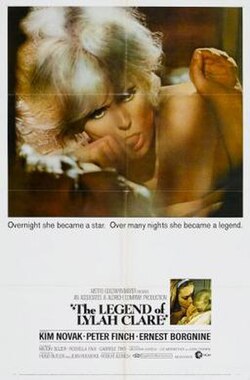
The Legend of Lylah Clare-1968
Director Robert Aldrich
Starring Kim Novak, Peter Finch
Scott’s Review #1,554
Reviewed September 27, 2026
Grade: B
Kim Novak stars in a 1968 psychological thriller named The Legend of Lylah Clare, a film on the surface similar to her legendary turn in Hitchcock’s Vertigo ten years earlier.
Like Vertigo, she plays two characters, both shrouded in ghostly mystery, as one is dead. Other characters are obsessed with the dead one.
Lylah Clare isn’t as good as Vertigo, so the parallels are limited.
The film has positives and negatives that create an uneven viewer experience. The bizarre environment raises suspicions of story changes or behind-the-scenes conflict, as something feels a bit off.
I much preferred the first half to the second, as what starts as an intriguing, mysterious promise goes off the rails and leads to more confusion than satisfaction.
A renowned German actress who died years earlier, Lylah Clare (Novak) is the subject of a film developed by volatile movie producer Barney Sheean (Ernest Borgnine).
An agent, Bart Langner (Milton Selzer), finds Elsa Brinkmann (also Novak), a beautiful woman who looks just like Lylah, and sets about getting the movie off the ground.
Lylah’s ex-husband, Lewis Zarken (Peter Finch), directs the film and begins to fall in love with Elsa as he coaches her to act just like his late wife.
Director Robert Aldrich has a vast filmography, but Lylah Clare most resembles What Ever Happened to Baby Jane? (1962) and Hush…Hush, Sweet Charlotte (1964), mostly in terms of a gothic environment and the fear of being made irrelevant.
Zarken’s looming Los Angeles mansion is the backdrop for much of the film. Its illustrious yet stuffy veneer hides dark secrets revealed through flashbacks, and the set is a main highlight.
I was immediately drawn into the story and the ‘legend’ by hints of what’s to come. Enormous portraits of Lylah adorn the estate, the most prominent being a lavish one on the steep staircase in the living room.
Shown to have been attacked by a fan who gained access to the mansion, Lylah was able to make the man fall down the staircase to his death. Afraid of heights, Lylah then fell and died after looking down at the corpse.
Is this the truth? What is Zarken hiding? Does Lylah’s acting coach, Rossella, know secrets? Did the fan have secrets?
The past is shrouded in mystery, and multiple characters’ obsessions with Lylah are very tantalizing.
Additionally, Elsa seems obsessed with Lylah even before she is cast to play her. Are they the same, like in Vertigo?
A deliciously satisfying scene is delivered at a party meant to debut Elsa’s new look as Lylah. Mean journalist Molly Luther (Coral Browne) prods and insults Elsa until Lylah emerges to put the wicked witch in her place.
It’s the first public appearance of Lylah as Elsa, and she quickly pounces on her foe in shocking form.
These elements make The Legend of Lylah Clare so compelling in the first half.
Slowly, the film began to unravel.
As Elsa begins to belt out a perfect German accent and switch into Lylah mode, summoning her wardrobe staff, or refusing to emerge onto the set, it feels terribly uneven and out of character.
I love Novak, but I’m not sure I love her in these roles. Since the characters don’t feel right, it must have been hard for the actress to play them well.
I couldn’t help but wonder whether Elsa couldn’t get into Lylah, or whether Novak couldn’t do the same.
And the obvious dubbing of Lylah’s German accent is very weird.
Zarkan’s back-and-forth personalities are too much. He goes from madly in love and smitten with Lylah to berating her on the movie set, back and forth.
In the final chapter, he basically causes Elsa’s death by coaxing her to look down from a trapeze set for no reason.
The film is billed as a satire and is assumed to examine the shark-like Hollywood world. The number of hateful characters (Molly, Zarkan, Barney) reinforces this.
A seemingly added TV commercial for dog food interrupts the film itself, suggesting that Hollywood is literally a dog-eats-dog world.
The last scene of Rossella drunkenly sitting on the couch watching the commercial and loading a gun, assumed to be to shoot Zarkan, is murky at best.
While confusing, The Legend of Lylah Clare (1968) has enough appeal to be a suggested watch.