Tag Archives: Henry Fonda

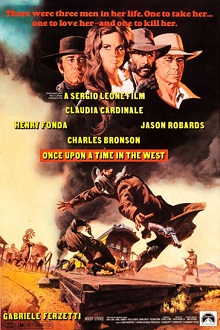
Once Upon a Time in the West-1968

Once Upon a Time in the West-1968

Director Sergio Leone

Starring Henry Fonda, Charles Bronson, Claudia Cardinale

Top 250 Films #187

Scott’s Review #886
Reviewed April 17, 2019

Grade: A

At one time dismissed as either frivolous or cartoon-like, the derogatory genre classification “spaghetti western” was originally played for laughs or featured a comical slant, often with bad lip-syncing.

Many of these films have aged tremendously well, though, and are now more widely appreciated and have become a part of the cinematic canon.

Once Upon a Time in the West (1968) is a lesson in camp art that marinates like a fine steak, drizzling with texture and a good atmosphere across a sprawling two-hour-and-forty-six-minute landscape.

In a great sequence, the film begins with a mysterious harmonica-playing gunman (Charles Bronson), dubbed “Harmonica” for reasons eventually revealed, shooting three men sent to kill him.

Meanwhile, to get his hands on prized railroad land in Sweetwater, disabled railroad baron Morton (Gabriele Ferzetti) hires killers, led by blue-eyed baddie Frank (Henry Fonda), who murders property owner Brett McBain (Frank Wolff) and his family.

The film immediately exudes intensity, with a severe revenge theme.

The story develops further, with romance mixed in a Western style, as McBain’s newly arrived bride, Jill (Claudia Cardinale), inherits the land instead.

Jill is a former prostitute who catches the eye of most of the men she encounters. Both outlaws, Cheyenne (Jason Robards) and Harmonica, take it upon themselves to look after Jill and thwart Frank’s plans to seize her land.

With standard Western flair, they are both attracted to Jill and yearn for her affection while also feeling protective of her.

Not professing to be enamored with the Western genre- the stereotypical Cowboys and Indians and token damsel in distress have their limitations- Once Upon a Time in the West is a feast for the eyes and the ears with cinematography on par with Lawrence of Arabia (1963) and a killer musical score.

While the story may have a traditional backbone, the nuances are astounding. The sweeping mountains of the western United States are heavily featured, and the tension-infused music sets up every thrilling scene with gusto and foreboding.

Hot on the heels of another similarly themed masterpiece, The Good, The Bad, and The Ugly (1966), Leone delivers the goods at every turn, most notably setting up each scene with sizzling elements that emit a clear sense of danger.

The audience knows trouble is about to transpire, but not exactly when the shit will hit the fan. The family death scene is paced astoundingly well as the family merrily goes about preparing a delicious summer meal, unaware that destruction is around the corner.

Sure, the cast is a mix of American and Italian actors with varying degrees of accents, not exactly mirroring the Wild West.

Yes, Jill wears heavy mascara and a hairstyle straight out of the 1960s, and one character has brightly dyed red hair, but these intricacies give the film character rather than turn the production into a disheveled mess.

Forever known for heroic or everyman roles, Fonda plays against type, cast as the central, sadistic villain, and the result is superlative.

Leone’s ability to cast a legendary star in production with little expectations is quite a feat, and Fonda seems to revel in role-playing him dangerously and straight.

With his piercing blue eyes and a gaze sure to make children run away in terror, his brutal villainy is fully realized only at the film’s conclusion.

Dozens of iconic comparisons to Quentin Tarantino’s modern directing style can be drawn. The director undoubtedly watched and studied this film repeatedly, as numerous qualities mirror his movies.

Viewers will delight in drawing these comparisons, including a harmonica reference, a revenge story, and the climactic reveal at the end of the film via flashback, which pulls all the pieces together.

Once Upon a Time in the West (1968) is a quality film that has finally gotten its due. Tremendous and compelling storytelling is combined with flavorful qualities and a dusty atmosphere.

The film is the sum of all its parts, and while at first underappreciated, it has finally risen to the ranks of a high-quality masterpiece.

Influencing many great directors, including Martin Scorsese, George Lucas, and Tarantino, is quite a testament to its staying power.
The Wrong Man-1956

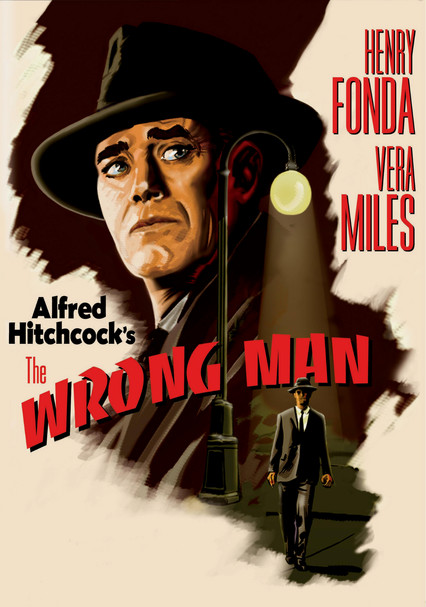
The Wrong Man-1956

Director Alfred Hitchcock

Starring Henry Fonda, Vera Miles

Top 250 Films #233

Scott’s Review #902

Reviewed May 24, 2019

Grade: A-

The Wrong Man (1956) is not an Alfred Hitchcock film typically mentioned when lists of the greatest of all the director’s works are in conversation.

Although it flies completely under the radar and is absent from most “Best of” collections, the film is a lovely gem ready to be dusted off and appreciated for its worth.

It features the legendary Henry Fonda, perfectly cast in a story point frequently used in Hitchcock films: that of the wrongly accused man.

Set in New York City, Manny Balestrero (Fonda) is a struggling musician who requires three hundred dollars for dental work that his wife Rose (Vera Miles) needs. Determined not to let his wife suffer, he decides to obtain the money by borrowing against her insurance policy.

The life insurance employees mistake Manny for another man who recently held them up. He is arrested and forced to perform a test for the police, which he fails, leading them to assume he is their man.

Attorney Frank O’Connor (Anthony Quayle) sets out to prove that Manny is not guilty since he has perfect alibis for the nights of both holdups. However, complications erupt during his trial as proper witnesses either cannot be found or have died, leaving Manny in dire straits.

Meanwhile, Rose teeters towards the brink of insanity as she suffers from severe depression.

The Wrong Man differs from many Hitchcock films in that its story is based on a real-life quandary one man faced. As such, viewers can relate to the story immensely and imagine themselves in Manny’s shoes.

I often wonder, “What would I do if this were me?” as one could find the story implausible, one could just as easily find it plausible. Mistaken identity can happen, and proving one’s innocence may not be as easy as it may seem.

Mainly set on location is another tidbit unique to many Hitchcock productions as the man cringed at the thought of any scene that studio luxuries could not manipulate. The New York City locales are splendid and provide an artistic and genuine element.

Many scenes were filmed in Jackson Heights, where Manny lived when he was accused. Most of the prison scenes were filmed among the convicts in a New York City prison in Queens. The courthouse was at the corner of Catalpa Avenue and 64th Street in Ridgewood.

Careful not to be too dissimilar to standard Hitchcock fare, the use of every man being falsely accused is every day in some of his films.

Other films like North by Northwest (1958) and The 39 Steps (1935) delivered the same elements with a man being mistakenly accused of murder. While the others were more of “chase stories” involving flight, The Wrong Man stays firmly planted in one city.

The film has some jazz elements, representing Fonda’s appearance as a musician in the nightclub scenes. These elements add sophistication to the film’s overall tone, especially as we see Manny as worldly yet kind.

He is a performer but comes home to his wife and adores her, doing anything he needs to for her comfort. The music and the black-and-white cinematography exude harshness and coldness but also good style.

Fans of either the police force or the justice system may be in for a challenging ride watching The Wrong Man, as neither group is written very sympathetically. The police are the worst offenders as they go to unethical methods to accuse a man of a crime and seem not to care who is convicted, only that someone is.

The one detraction to The Wrong Man is the chemistry between Fonda and Miles. The passion is underwhelming but not terrible, either. Instead, the main point is the false accusations instead of the romance. A bit more of the latter might have made the film more unique.

With suspenseful and dramatic elements and a charismatic leading man, The Wrong Man (1956) perhaps lacks the flair of other well-known Hitchcock films. Still, it is a solid achievement that deserves more acclaim than traditionally given.

Yes, it’s sullen, but it’s also poignant, frightening, and a terrific effort. Henry Fonda carries the film and provides compassion and realism.

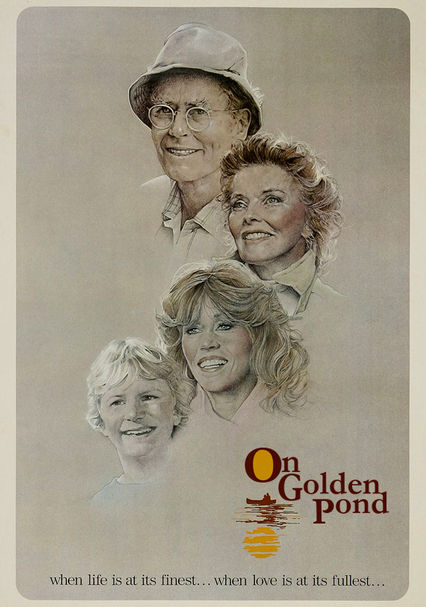
On Golden Pond-1981

On Golden Pond-1981

Director Mark Rydell

Starring Henry Fonda, Katharine Hepburn, Jane Fonda

Scott’s Review #1,297

Reviewed September 8, 2022

Grade: A

A beautiful and quiet family drama, On Golden Pond (1981) is a brilliantly acted and written story about life specifically aging and dying. It tells one lovely story arc after another, involving the relationships between its principal characters.

With heavyweights like Katharine Hepburn, Henry Fonda, and Jane Fonda signed on to star how could the film not be a success? It was not only a blockbuster in the summer of 1981 but accumulated ten Academy Award nominations and tons of other awards showing that sometimes subdued stories about human relationships win big.

The anticipation of legendary stars Fonda and Hepburn, golden icons of Hollywood, finally appearing opposite each other in a film must have made film lovers salivate back in 1981.

Norman Thayer (Fonda) is a grumpy old man trying to enjoy his golden years. He and his nurturing wife, Ethel (Hepburn), spend summers at their New England vacation home on the shores of idyllic Golden Pond.

Norman is experiencing memory problems and frets about dying while Ethel makes the most of it and enjoys the beautiful loons on the water and chats with the local mailman.

One year, their adult daughter, Chelsea (Jane Fonda), visits with her new fiancée (Dabney Coleman) and his teenage son, Billy (Doug McKeon) on their way to Europe. After leaving Billy behind to bond with Norman, Chelsea returns, attempting to repair the long-strained relationship with her aging father before it’s too late.

The greatest part of On Golden Pond is that it is believable. The tender love that Norman and Ethel share, the tensions between Norman and Chelsea, and the burgeoning friendship between Norman and Billy Jr. feel so very real and poignant.

Beautiful scenes emerge between the old man and a young man when Norman turns Billy Jr. on to literary classics like A Tale of Two Cities and Treasure Island. The viewers can easily see themselves in real-life situations like this or when Ethel and Chelsea discuss a strained relationship.

Years and years of memories and situations between the characters spring to life making the dialogue rich with flavor. Moving sequences like when Norman suffers a heart attack and is involved in a boating accident are teary and sentimental but fresh with emotion.

They do not feel manipulated.

As if the richly acted scenes are not enough, screenwriter, Ernest Thompson, who wrote the film based on his play provides credibility. He felt the passion the story would bring to the big screen and he was right.

As I grow older I appreciate the characters of Norman and Ethel. They stick together through thick and thin, sometimes quarrel, but love each other with a bond that can never be severed.

We all know and love couples like them.

The cinematography bristles with sweet nature. From the loons to the other sounds of summer, the camerawork elicits the light of late summertime. I constantly had to remind myself that I wasn’t really in the countryside but was in my living room.

A tearjerker that carefully combines heavy drama with comical moments that lighten the load, On Golden Pond (1981) is a truthful and emotional extravaganza about death that never feels sad or downtrodden. It’s much too clever for that and instead is an uproarious crowd-pleaser.

Oscar Nominations: 3 wins-Best Picture, Best Director-Mark Rydell, Best Actor-Henry Fonda (won), Best Actress-Katharine Hepburn (won), Best Supporting Actress-Jane Fonda, Best Screenplay-Based on Material from Another Medium (won), Best Cinematography, Best Film Editing, Best Original Score, Best Sound

My Darling Clementine-1946

My Darling Clementine-1946

Director John Ford

Starring Henry Fonda, Victor Mature

Scott’s Review #1,017

Reviewed April 30, 2020

Grade: A-

Esteemed director John Ford, mostly known for crafting the very best in the Western genre for four decades, creates a timeless story that is character-driven and unpredictable.

My Darling Clementine (1946) provides a superb atmosphere amid a depressing ambiance led by Henry Fonda, the appealing leading man of the day. The iconic American Western folk ballad, “Oh My Darling, Clementine,” appears during the opening and closing credits to bookend the classic.

In 1882, events began when a group of men herded cattle through the Old West en route to California. The Earp brothers (Wyatt, Morgan, Virgil, and James) encountered the sinister Clanton family, who salivated over the profit the animals could supply them.

After being rebuffed for a sale, the Clantons kill young James and steal the cattle. Wyatt (Fonda) vows revenge and settles in at Tombstone, Arizona, where he befriends the dangerous Doc Holliday (Victor Mature), Clementine Carter (Cathy Downs), the ravishing Chihuahua (Linda Darnell), and Mac, the local bartender.

The film is based on real-life Western figures and events. Wyatt Earp was a lawman and gambler, while Doc Holliday was a gambler, gunslinger, and dentist. Both men participate in the famous and bloody gunfight at the OK Corral, the thirty-second shootout between law enforcement officers and outlaws, regarded as the most well-known battle in the American Wild West.

This makes the film both historical and fun for viewers anticipating some truth. The rest is a created story.

During My Darling Clementine, one can delve into other avenues of enjoyment besides the action on screen. The rich surroundings are glorious and plentiful.

Much of the action takes place outdoors, which is a treat. The spacious and wide-open exteriors are a marvel to watch. The exquisite clouds and sprawling lands are evident, as is the black-and-white cinematography, which adds a measure that color film would have ruined.

Unlike other Westerns, there is surprisingly little racism to be found. Commonly, American Indians are classified as the enemy and subsequently mistreated. Other than one quick scene where an unnamed Indian is booted out of town, a racist moment can be found.

Quite a few Mexican characters appear, most prominently Chihuahua, the apple of every man’s eye. To see Mexican culture represented and celebrated with dancing and country colors is a nice addition.

The pacing is also superior, with little lag or drag time. The short running time of one hour and thirty-six minutes is beneficial, as events get dirty quickly. The saloon scenes, which are simply a must in this genre, are excellent, with their combustible energy.

So much transpires within each scene as the patrons eat, drink, dance, sing, and fight. Interesting characters like the bartender and Granville Thorndyke, a stage actor who performs Shakespeare, make the film very fleshed out from a character perspective.

A minor demerit that must be aimed at the film is the awkward decision to write a perplexing ending that sours the wrap-up. When the big shootout concludes, Wyatt decides to depart Tombstone, bidding adieu to a confused Clementine at the schoolhouse, wistfully promising that he will look her up if he returns.

This is weak and unsatisfying, considering she moved to the West from the East to be with Doc, who dies. Why would she decide to stay, and why would he leave, considering the pair were drawn to each other as the film escalated? I was expecting a “happily ever after” moment.

My Darling Clementine (1946) is an elite treasure in a genre that is commonly one-note and riddled with stereotypes and inadequate treatment of those who are not white, masculine men. Sure, the whiskey flows heavily as the guns are cocked and loaded at a moment’s notice.

But, with arguably two main heroes (Wyatt and Doc), well-crafted supporting characters, and a stoic final fight, this film has it all, providing depth and freshness to an often-stale cinematic genre.

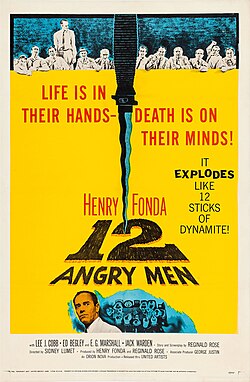
12 Angry Men-1957

12 Angry Men-1957

Director Sidney Lumet

Starring Henry Fonda, Lee J. Cobb

Scott’s Review #910

Reviewed June 14, 2019

Grade: A

A fond memory of Junior High School was reading the play and then being treated to a viewing of the film version of 12 Angry Men (1957), a bristling and suffocating film that infuses progressive thought and thinking for oneself in animosity.

A valuable lesson for a teenager to learn, or anyone else, the film is essential, providing life lessons and tremendous drama, holding up well and still brimming with texture.

The film begins as the audience is introduced to twelve men as they deliberate the conviction or acquittal of a defendant based on reasonable doubt. The defendant is an eighteen-year-old Puerto Rican male living in a poor neighborhood, accused of fatally stabbing his father.

The witnesses are an older man and a lady who lives across the street. The juror’s instructions are evident; if there is any reasonable doubt, they return a verdict of not guilty. If found guilty, the accused will receive a death sentence.

Henry Fonda plays Juror # Eight, who initially is the only juror to vote “not guilty” when the others assuredly vote “guilty.” He adamantly questions how reliable the two witnesses are and disagrees with the argument that the knife used in the death is an obscure brand as he produces an identical knife of his own.

Juror # Eight can convince one juror to change his vote, allowing discussions and analysis to reconvene, much to the chagrin of a few men, especially Juror # 3 (Lee J. Cobb), the main antagonist.

Director Sidney Lumet provides a dynamic atmosphere in his debut film with astounding results. The black and white cinematography is brilliantly mixed with the humidity of a scorching New York summer day as the one set used is claustrophobic, bringing the audience into the action and suffocating along with the men.

As tensions mount and one juror attempts to kill another juror out of rage, a thunderstorm erupts outside, breaking the heat and changing the momentum in the jury room as the tide slowly turns in a different direction.

The story is wonderfully written as each juror’s backstory is slowly revealed, providing insight into why each man may think the way he does or perhaps have preconceived notions about the accused instead of giving him a fair shake.

Juror #3 is a bully estranged from his son, while Juror # 7 mistrusts “foreigners.” Some of the others “go with the flow,” intimidated by conflicts, and afraid to ruffle feathers.

12 Angry Men teaches the utmost importance of the power of change against all odds. By standing by his convictions, Juror # 8 influenced the other jurors to see what they were either unable to see or refused to see.

He forces them to question their morals and values.

By the time the film has concluded, the audience is smacked across the face with tremendous impact, perhaps questioning their views.

This is an example of the power of cinema.

Like the stage version, the plot requires the audience to think and determine along with the characters, the power of reason, and intense dialogue.

The fact that all the jurors are white males is never lost on me, but neither does it detract from my enjoyment. This is how things were done decades ago.

Fonda is charismatic and brilliant in the lead role.

12 Angry Men (1957) is a timeless story told and retold wonderfully on the live stage. Lumet brings the production to the big screen powerfully and effectively by using cinematic elements to produce the proper emotions from his audience.

The film holds up very well as, sadly, many of the stereotypes and beliefs that the jurors possess are still held by many Americans.

On the more positive scale, people with strong and empathetic wills, like Juror # 8, also exist and unquestionably influence more than they lose.

Oscar Nominations: Best Motion Picture, Best Director-Sidney Lumet, Best Screenplay Based on Material from Another Medium

The Grapes of Wrath-1940

The Grapes of Wrath-1940

Director John Ford

Starring Henry Fonda, Jane Darwell

Scott’s Review #828

Reviewed November 8, 2018

Grade: A

Based on the famous novel written by John Steinbeck and released only one year before the film, The Grapes of Wrath (1940) is a superlative offering by director John Ford, known chiefly for Westerns.

The work accurately depicts life for the struggling American family during the Great Depression of the 1930s.

With gorgeous cinematography and a sad yet poignant story, the film is a must-see and a timeless depiction of the perils of life for working-class people in the United States.

Set on the vast plains of Oklahoma, the Joad family has run a successful farm and lived as a thriving family unit for decades- an extended group enjoying their lives.

When the United States suffers from Depression, the Joads’ lives are turned upside down, and they are forced to sell their farm. They decide to traverse the countryside in hopes of the promise of profitable jobs and wealth in faraway California. The Grapes of Wrath depicts the family’s journey as hardship and deaths occur.

When the film was released in 1940, many studios were not interested in bringing the story to the big screen, as some aspects were deemed too left-leaning for conservatives.

The social issues the film delves into are still incredibly relevant today, and Ford wisely dissects not only the poverty that the Joad family suffers but also the psychological trauma and ruination they must endure. What a devastating effect this must have had on families.

The casting is spot-on. A young Henry Fonda was merely an upstart actor in 1940 and successfully exuded a rich, passionate performance as Tom.

Plenty of close-up shots reveal the young man’s quiet pain and desperation and the humiliation of having lost his livelihood. Fonda shares poignant chemistry with the preacher character, Jim Casy (John Carradine), who once was filled with glory but has now lost his spirit and belief in goodness.

Jane Darwell, a famous character-actress, gives a treasured performance as the family matriarch, Ma Joad. The actress won the Academy Award for Best Supporting Actress, deservedly so, as she relays a haggard woman wanting only the best for her family and attempting to hold them together.

Her determined final speech at the film’s conclusion is teary and meaningful. She says, “We’re the people… We’ll go on forever.” Speaking of Oscars, Ford also won Best Director.

The film sees no age but endures as a timeless journey alongside the Joad family. Although it stays very close to Steinbeck’s novel, the story is modified significantly. Perhaps to please studio financiers or provide a more hopeful message, the Joads are left with a positive future thanks to a government-run camp where they finally live.

In the novel, they reside at the camp first but are later reduced to starvation wages.

A monumental scene is when the family drives their battered vehicle to a squatter’s camp for needed shelter. The scene is shot documentary style, with the camera focusing both on the Joads and on the faces of the occupants of the run-down and filthy shacks that they are forced to live in.

We wonder with sadness what the lives of these unfortunate people were like before the Depression.

The Grapes of Wrath (1940) was a humanistic cinematic masterpiece. As a terrible war and otherworldly problems plagued the new decade, the film reminisced about a previous decade fraught with different issues.

The film is one for the ages and should be appreciated by all.

Oscar Nominations: 2 wins-Outstanding Production, Best Director-John Ford (won), Best Actor-Henry Ford, Best Supporting Actress-Jane Darwell (won), Best Screenplay, Best Sound Recording, Best Film Editing

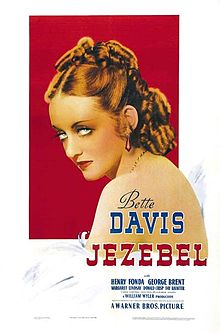
Jezebel-1938

Jezebel-1938

Director William Wyler

Starring Bette Davis

Scott’s Review #236

220px-Jesebel_movieposter

Reviewed April 18, 2015

Grade: B+

An excellent showcase for the young and lovely Bette Davis, Jezebel (1938) is a very early film role for Davis. It is similar to Gone with the Wind, a film Davis reportedly lost to Vivian Leigh.

One wonders how she would have made the character of Scarlett O’Hara her own, and Jezebel is on a journey exploring that possibility.

Acclaimed director William Wyler directed Jezebel, set in New Orleans in 1852 (pre-Civil War). Davis plays spoiled southern belle Julie Marsden, who is engaged to wealthy banker Preston Dillard, played by Henry Fonda.

After a dispute in which Julie selfishly feels her needs are unmet, she shockingly wears a red dress to a sophisticated ball where unmarried women are expected to wear white. This causes a scandal that results in Preston dumping Julie and leaving town.

Cocky Julie expects Preston to return to town and grovel for her forgiveness, but when he does return with a life-changing twist, the drama unfolds. Circumstances include a savage duel, longing for love, and atonement.

Fans of Davis will love Jezebel for the sheer excellence that she brings to the screen. Mesmerizing with those soulful, big eyes and excellent mannerisms, she exudes confidence and sophistication. Admittedly, this is my earliest Davis experience, and she shimmers on-screen.

Bette Davis is perfectly cast. Interesting to note are the innocent qualities early Davis possessed. Later afflicted with a hoarse, deep voice and ravaged beauty after years of alcohol and cigarette abuse, Davis in Jezebel is virginal and debutante-looking.

I find Julie’s wardrobe choices interesting. Her horseback riding outfit, the vixen-like red dress, the virginal white dress, and the dark raven cape at the climax of the film, as well as the various lighting techniques Wyler used to showcase Davis’s face, almost look like candlelight.

The film is similar to Gone with the Wind (preceded by a year). Julie, like Scarlett, is a rich, selfish girl who likes to manipulate men. Both films feature a love triangle prevalent in the story and broken hearts. The enslaved people in both films resemble each other, though they are a bit more glamorous in Jezebel.

The introduction of the yellow fever storyline and the sick and weak lying around in droves is similar to the wounded and dying soldier scene in Gone with the Wind, where the ill and dying lie in pain. The periods, triangle, and southern charms all heavily play in both. It is impossible not to compare the two films.

Melodrama did very well; Jezebel (1938) is to be admired as it is a film featuring a strong female character, something lacking in the film then (1938) and shamefully still lacking in cinema today! Jezebel is an actual “ambitious woman’s movie.”

Oscar Nominations: 2 wins- Outstanding Production, Best Actress-Bette Davis (won), Best Supporting Actress-Fay Bainter (won), Best Scoring, Best Cinematography