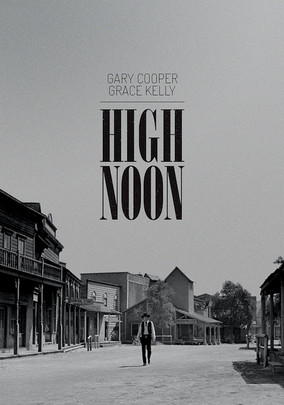
High Noon-1952
Director Fred Zinneman
Starring Gary Cooper, Grace Kelly
Top 250 Films #150
Scott’s Review #638
Reviewed April 28, 2017
Grade: A
Billed as a standard Western but much more complex than a traditional, basic Western, High Noon accomplished what no other Western did in 1952- adding complexities from different genres, such as suspense and drama, to a film form.
Additionally, High Noon challenged typical Western themes, such as male-driven fights and chases, in favor of a moral and emotional approach, and oh, is the film ever character-driven.
The results are astounding, and to understand and appreciate all its elements, the film should be studied in film school.
High Noon heartily breaks the mold. It was released when mainstream Western was quite popular in the film, adding enormous risk, and the results paid off in spades.
Marshal Will Kane (Gary Cooper) has just wed his beloved bride, Amy (Grace Kelly), in a small ceremony in a tiny New Mexican town. He plans to turn over his badge and retire to the prairie land with his new wife.
Suddenly, the town receives word that a dastardly villain, Frank Miller, whom Kane once sent away, has been released from a Texas prison and plans to exact revenge on Kane.
Miller is to arrive on the noon train as his three accomplices await his arrival, much to the chagrin of the rest of the town, who become panicked with each passing moment.
The film begins at approximately ten-thirty in the morning and ends shortly after Noon.
High Noon has subtle political themes and clear examples of McCarthyism. However, some dispute that McCarthyism was a campaign launched by Senator Joseph McCarthy, which ended up blacklisting many artists suspected of communism.
The central theme is how people become frightened and blame one another for the attack out of that fear.
Our main protagonist (Kane) faces the daunting task of confronting four angry gunmen, with revenge on their minds, alone, as an entire town chooses not to get involved.
It’s brilliant that High Noon more or less takes place in real-time.
The inclusion of clocks in the film, specifically pendulums swaying back and forth, creates a distinct sense of tension as character after character nervously glances at the time.
They know full well that with each passing minute, they inch closer and closer to a fantastic and deadly showdown- much blood will be shed.
Cooper, old enough to be Kelly’s grandfather, is noticeable if one chooses to be nitpicky, but the couple works well together, and I bought the happily wedded couple as genuine.
I adore the character of Helen Ramirez, played by actress Katy Jurado. A Mexican character, Ramirez, is a prominent businesswoman in the small town who owns a saloon.
She is empowered and confident, a character to admire regardless of gender.
A strong female character of Mexican heritage in a 1952 film was relatively uncommon, considering the film is set in the Wild West.
Equally impressive and completely backward for the time, the events of Amy coming to the rescue of Kane, instead of the standard, gender-specific “man rescues woman,” challenge the norm.
Further, Amy is groundbreaking: she is written as a Quaker woman, not a traditional Christian woman, nor is she skittish or silly.
Western stereotypes are entirely turned upside down, which is arguably way ahead of its time.
Eerie yet highly effective is the use of a “theme song” either sung or in another form (musical score or background music) throughout the film—the song is “Do Not Forsake Me, My Darling,” which became a hit for Texas Ritter.
It is worth noting that the success of this added “theme song” encouraged subsequent Westerners to include similar songs in their films.
Challenging the standard in many ways, High Noon sets a very high bar for its thoughtfulness, message, and conflict.
The film exemplifies people who take the world and turn it upside down with fantastic and inspiring results.
Oscar Nominations: 4 wins-Best Motion Picture, Best Director-Fred Zinnemann, Best Actor-Gary Cooper (won), Best Screenplay, Best Scoring of a Dramatic or Comedy Picture (won), Best Song-“The Ballad of High Noon (“Do Not Forsake Me, O My Darlin”)” (won), Best Film Editing (won)
Golden Globe Nominations: 4 wins-Best Motion Picture-Drama, Best Performance by an Actor in a Motion Picture-Drama-Gary Cooper (won), Best Performance by an Actress in a Supporting Role in any Motion Picture-Katy Jurado (won), New Star of the Year-Actress-Katy Jurado, Best Screenplay-Motion Picture, Cinematography-Black and White (won), Best Original Score-Motion Picture (won)