Tag Archives: Keenan Wynn

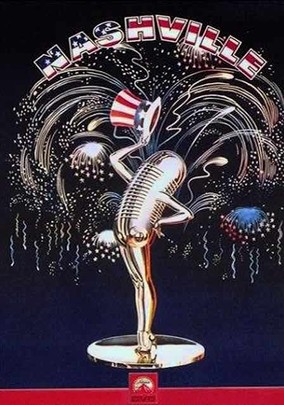
Nashville-1975

Nashville-1975

Director Robert Altman

Starring Lily Tomlin, Keith Carradine, Karen Black

Top 250 Films #3

Scott’s Review #47

60001541

Reviewed June 19, 2014

Grade: A

Nashville (1975)  is a brilliant film.

I have found that with each subsequent viewing, it creeps higher and higher on my list of favorite movies of all time.

The style is unique (largely improvised) and epitomizes creative freedom in the film during the 1970s.

Director Robert Altman lets his actors express themselves, even allowing them to write their songs; the dialogue overlaps at times, which results in a natural feeling as the viewer watches the cast of twenty-four principals intersect over five days at a political rally/country music festival.

It is pure Robert Altman at his finest.

Nashville is a satire of the political arena of the early 1970s, particularly the Vietnam conflict and its politicians.

The film certainly questions and challenges the government with an ironic patriotic setting (Nashville).

The country music industry was in uproar upon the film’s initial release. It is a layered film that can be discussed and appreciated, and every character is cared about.

I cannot adequately describe the multitude of nuances in each scene that are noticed over time.

Each character, even those with limited screen time, is vital to the story, as are the political elements —the questions of war, policies, and so on.

The chaotic bits and individual storylines come together at the end, and many background happenings are exciting to watch and take note of throughout each viewing.

With each experience, the audience will notice more and more. I certainly do.

Lily Tomlin, for example, plays Linnea, a haggard mother of deaf children with a supportive husband, a woman who, on the surface, is heroic; yet, she is a complex character. She is bored with her life and falls in love with a young musician despite the guilt and repercussions.

The musician in question is Tom Frank, played by Keith Carradine. Handsome and self-absorbed, he arrives in Nashville to dump his bandmates in hopes of a solo career and beds many willing females.

He also lashes out at a soldier at the airport, saying, “Kill anyone lately?”

Despite his unlikable character, Carradine gives one of the most beautiful performances in the film when he sings “I’m Easy”.

Several of the female characters assume he is singing the song for them, but who is he truly singing it for — if anyone?

Another character to analyze is Barbara Jean, played by Ronee Blakley. A frail yet very successful country singer, she is in and out of hospitals as she frets about her replacement singer stealing her thunder.

Her insecurities rise to the surface.

Insecurity is a common theme among the characters. Many of them are unsure, afraid, or lack confidence in their musical talent, relationships, or themselves.

These are only three examples of the twenty-four richly layered characters- some ambitious, some falling apart, others meandering through life.

Many songs throughout were written and performed by the actors themselves.

Nashville (1975) is storytelling and filmmaking at its best. A creation by Altman that is deservedly admired, revered, and heralded as a significant influence.

It is studied in film schools as it should be.

Oscar Nominations: 1 win-Best Picture, Best Director-Robert Altman, Best Supporting Actress-Ronee Blakley, Lily Tomlin, Best Original Song-“I’m Easy” (won)

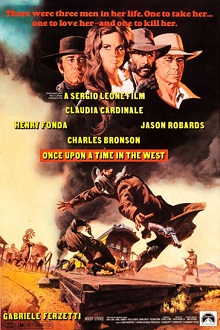
Once Upon a Time in the West-1968

Once Upon a Time in the West-1968

Director Sergio Leone

Starring Henry Fonda, Charles Bronson, Claudia Cardinale

Top 250 Films #187

Scott’s Review #886

Reviewed April 17, 2019

Grade: A

At one time dismissed as either frivolous or cartoon-like, the derogatory genre classification “spaghetti western” was originally played for laughs or featured a comical slant, often with bad lip-syncing.

Many of these films have aged tremendously well, though, and are now more widely appreciated and have become a part of the cinematic canon.

Once Upon a Time in the West (1968) is a lesson in camp art that marinates like a fine steak, drizzling with texture and a good atmosphere across a sprawling two-hour-and-forty-six-minute landscape.

In a great sequence, the film begins with a mysterious harmonica-playing gunman (Charles Bronson), dubbed “Harmonica” for reasons eventually revealed, shooting three men sent to kill him.

Meanwhile, to get his hands on prized railroad land in Sweetwater, disabled railroad baron Morton (Gabriele Ferzetti) hires killers, led by blue-eyed baddie Frank (Henry Fonda), who murders property owner Brett McBain (Frank Wolff) and his family.

The film immediately exudes intensity, with a severe revenge theme.

The story develops further, with romance mixed in a Western style, as McBain’s newly arrived bride, Jill (Claudia Cardinale), inherits the land instead.

Jill is a former prostitute who catches the eye of most of the men she encounters. Both outlaws, Cheyenne (Jason Robards) and Harmonica, take it upon themselves to look after Jill and thwart Frank’s plans to seize her land.

With standard Western flair, they are both attracted to Jill and yearn for her affection while also feeling protective of her.

Not professing to be enamored with the Western genre- the stereotypical Cowboys and Indians and token damsel in distress have their limitations- Once Upon a Time in the West is a feast for the eyes and the ears with cinematography on par with Lawrence of Arabia (1963) and a killer musical score.

While the story may have a traditional backbone, the nuances are astounding. The sweeping mountains of the western United States are heavily featured, and the tension-infused music sets up every thrilling scene with gusto and foreboding.

Hot on the heels of another similarly themed masterpiece, The Good, The Bad, and The Ugly (1966), Leone delivers the goods at every turn, most notably setting up each scene with sizzling elements that emit a clear sense of danger.

The audience knows trouble is about to transpire, but not exactly when the shit will hit the fan. The family death scene is paced astoundingly well as the family merrily goes about preparing a delicious summer meal, unaware that destruction is around the corner.

Sure, the cast is a mix of American and Italian actors with varying degrees of accents, not exactly mirroring the Wild West.

Yes, Jill wears heavy mascara and a hairstyle straight out of the 1960s, and one character has brightly dyed red hair, but these intricacies give the film character rather than turn the production into a disheveled mess.

Forever known for heroic or everyman roles, Fonda plays against type, cast as the central, sadistic villain, and the result is superlative.

Leone’s ability to cast a legendary star in production with little expectations is quite a feat, and Fonda seems to revel in role-playing him dangerously and straight.

With his piercing blue eyes and a gaze sure to make children run away in terror, his brutal villainy is fully realized only at the film’s conclusion.

Dozens of iconic comparisons to Quentin Tarantino’s modern directing style can be drawn. The director undoubtedly watched and studied this film repeatedly, as numerous qualities mirror his movies.

Viewers will delight in drawing these comparisons, including a harmonica reference, a revenge story, and the climactic reveal at the end of the film via flashback, which pulls all the pieces together.

Once Upon a Time in the West (1968) is a quality film that has finally gotten its due. Tremendous and compelling storytelling is combined with flavorful qualities and a dusty atmosphere.

The film is the sum of all its parts, and while at first underappreciated, it has finally risen to the ranks of a high-quality masterpiece.

Influencing many great directors, including Martin Scorsese, George Lucas, and Tarantino, is quite a testament to its staying power.

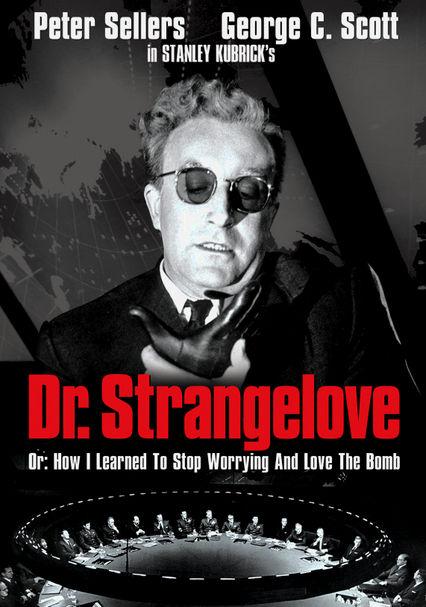
Dr. Strangelove-1964

Dr. Strangelove-1964

Director Stanley Kubrick

Starring Peter Sellers, George C. Scott

Top 250 Films #242

Scott’s Review #958

Reviewed November 13, 2019

Grade: A

Dr. Strangelove, or How I Learned to Stop Worrying and Love the Bomb, more commonly known simply as Dr. Strangelove, is a 1964 political satire black comedy film that satirizes the Cold War and fears of a nuclear conflict between the Soviet Union and the United States.

The film, timely in the 1960s, is as relevant decades later amid the chaos during the 2016 United States Presidential election and the following tumultuous years.

The film is powerful, brave, and essential.

The story centers around an unhinged United States Air Force general (Sterling Hayden) who orders a first-strike nuclear attack on the Soviet Union.

The plot follows the President of the United States (Peter Sellers), the Joint Chiefs of Staff, and a Royal Air Force (RAF) officer as they try to recall the bombers to prevent a nuclear apocalypse.

The film also follows the crew of one B-52 bomber as they try to deliver their payload.

The Cuban Missile Crisis was fresh in viewers’ minds when this film was released, and President John F. Kennedy was recently assassinated. The United States and the Soviet Union were hardly best buddies.

The film was a robust offering because its political satire was fresh. The ironic controversy between the two leaders, nearly sixty years after the film was released, is unintentionally clever.

The acting is excellent. Peter Sellers plays three prominent roles. Each is quite different from the others. Group Captain Lionel Mandrake, a British RAF exchange officer, President Merkin Muffley (what a name!), the President of the United States, and Dr. Strangelove, the wheelchair-using nuclear war expert and former Nazi.

Each glistens with goodness as the actor chomps at the bit, making them precise and unique, careful never to stray too far overboard into ridiculousness.

Director Stanley Kubrick wisely chooses black-and-white cinematography with stellar results and prominent filmmaking techniques.

As creative and progressive as many 1960s films started to become as the decade blossomed, it feels like it could have been made in the 1940s.

Kubrick, well known for masterpieces such as The Shining (1980) and 2001: A Space Odyssey (1968), delivers perhaps the oddest film in his catalog with Dr. Strangelove.

The story does not feel dated, and the dialogue remains crisp and razor-sharp in its delivery and meaning. With fast dialogue delivery and a monotone vocal style, the film is entertaining and humorous. It does not take itself too seriously yet brings a poignant and vital idea to life.

The film keeps gnawing at the viewers that as far-fetched as events seem, the possibility they could become real is more than a bit scary.

Who can forget the final sequence of the looming nightmare of the mushroom clouds, set to Vera Lynn’s hopeful We’ll Meet Again?

Since the film has a 1940s cinema style, the rude awakening that the 1960s produced in nuclear weapons and insecurity hits home in this sequence.

Dr. Strangelove (1964) is pure satire but frightening in its realism and uncertainty about how one crazy leader could lead an entire nation to detrimental results.

The film highly influenced later satires and unique filmmaking styles—Wes Anderson’s creations immediately spring to mind.

One can wonder about the different possibilities offered—in a way, the situation’s absurdity and the unthinkable way it could quickly become a reality.

Oscar Nominations: Best Picture, Best Director-Stanley Kubrick, Best Actor-Peter Sellers, Best Screenplay Based on Material from Another Medium

Touch of Evil-1958

Touch of Evil-1958

Director Orson Welles

Starring Charlton Heston, Janet Leigh

Scott’s Review #914

Reviewed July 2, 2019

Grade: A

Touch of Evil (1958) is a film noir directed by the legendary influential Hollywood director Orson Welles.

The film contains suspense, drama, and mystery but is to be mainly praised for visual treats to enhance the cinematic experience. The dark and foreboding thriller was revolutionary for the time of release and influenced many films of similar ilk in the years to come.

Robust and fraught with tension, the experience is marvelous and worthy of study for its many nuances.

Welles directs the work, stars in, and writes the screenplay, so his entire being is invested in the production and execution.

Known mainly for the legendary Citizen Kane (1940), a film that arguably changed the course of cinema with its direction and cinematography, Touch of Evil explores a different genre entirely. However, it keeps the excellent aspects of Welles’s loftier film intact, including the black-and-white element, resulting in a grand and dangerous crime-infused classic.

The screenplay was loosely based on the novel Badge of Evil by Whit Masterson.

The tension is ample from the onset as the humidity-drenched Mexico-United States border is the focal point. A car driven by a young couple is laced with a bomb and detonates as soon as they cross into U.S. territory.

In a hint of irony, Newlyweds Miguel “Mike” Vargas (Charlton Heston), a drug enforcement official in the Mexican government, and his wife Susie (Janet Leigh) pass the car several times on foot before the explosion.

An investigation ensues with the introduction of other characters, including Police Chief Pete Gould (Harry Shannon), District Attorney Adair (Ray Collins), and police captain Hank Quinlan (Welles), with a prime suspect being Sanchez, a young Mexican secretly married to the victim’s daughter.

Typical in the film noir genre, events are not what they seem like as layers of the plot slowly unravel. The heavyset and disheveled Captain nostalgically visits a brothel run by Tanya (Marlene Dietrich), who barely recognizes him because he’s gained so much weight since their last meeting.

Vargas forsakes his bride to spearhead the investigation but soon locks horns with corpulent Quinlan, and the duo begins to feud. Could Quinlan or Vargas have something to do with the car bombing, or could other supporting characters be behind or involved in the shenanigans?

This is an excellent part of Touch of Evil, as the film leaves the viewer guessing.

Heston and Leigh are the lead couple, and their chemistry is apparent from the first scene in which they appear together. Sexy and mysterious, she hunkers down in a dump fraught with peril while he attempts to solve the crime and keep his girl safe.

Outside factors play a significant role in keeping the lovers apart. Although Heston’s portrayal of a Mexican man is quite the stretch, the audience will nestle comfortably into the events as they reveal deeper layers.

Once a handsome man, Wells is not afraid to let it all hang out as the fat and racist Quinlan becomes one of the greatest and most complicated screen villains as his true colors emerge.

As the film’s title boldly suggests, does his character contain complexities that make him evil and keep some sympathies, or does he wreak havoc on all he touches with his devious nature only the tip of the iceberg?

Viewers await the final act to have several questions answered as motivations are finally revealed.

Touch of Evil (1958) provided delicious and pulsating material for filmmakers clever enough to study its intricacies, notably Roman Polanski for Chinatown (1974).

Nuggets were also thrown the way of Alfred Hitchcock, who got the idea for Leigh to appear in Psycho (1960) two years later, catapulting her character alone in a hotel peril and mixing in a weird hotel clerk.

The power the film had to hatch other great films from its ingenuity is the most fun part of watching it repeatedly.

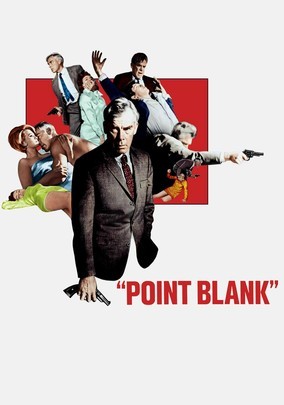
Point Blank-1967

Point Blank-1967

Director John Boorman

Starring Lee Marvin, Angie Dickinson

Scott’s Review #263

70033963

Reviewed August 8, 2015

Grade: B+

Directed by John Boorman, (later made famous for the masterpiece Deliverance in 1972), and based on the novel The Hunter, by Donald E. Westlake, Point Blank (1967) is a tense crime drama starring Lee Marvin as a man seeking revenge on those who have wronged him.

A criminal himself and involved in the mob world of deals and drugs, he is double-crossed by his partner, who takes off with his wife.

A relatively obscure film, Point Blank features obvious influences from the classics it preceded (The Getaway, 1972; Chinatown, 1974; The French Connection, 1971; and Dirty Harry, 1971) and contains some dynamic camera work and art direction.

In its day, it must have been quite a groundbreaking film.

The film begins muddled a confusing, catching the viewer off guard. We know nothing about any of the characters, who are suddenly introduced via flashbacks, interlaced with present and future scenes, so that chaos and tension fill the story immediately.

We know that someone has stabbed someone in the back, but we do not understand why or who the players are.

The film is set partly on deserted Alcatraz Island (the meeting point for a money drop, which we later learn), then moves to Los Angeles. Early on, we realize that Marvin’s character (Walker) has been tricked, shot, and left for dead by his partner Mal (John Vernon), who takes off with Walker’s share of cash…and his troubled wife Lynne.

Hell-bent on seeking revenge (and his money) on Mal and his wife (Lynne), he attempts to track the duo down using any means necessary, leading to the introduction of pivotal and mysterious characters such as Lynne’s sister Chris (played by Angie Dickinson), and Crime Organization leaders Carter and Brewster (played by Lloyd Bochner and Carroll O’Connor, respectively).

With little blood or overt violence, the film instead uses tense action scenes and a great style, and is told in a non-linear way.

One favorite scene involves Walker taking a new car for a test drive and interrogating the salesman for information. As he terrorizes the salesman, he repeatedly slams the vehicle into a pole using the car’s reverse and drive gears, increasing in intensity with each attempt by the salesman to avoid answering Walker’s questions.

Two other scenes that stand out and deserve mention are as follows: when a naked villain is nonchalantly tossed from a penthouse apartment to his death on the street, and subsequently becomes wedged under a passing car, the scene is as startling as it is well shot, especially considering the year was 1967.

In another scene, Lynne is at the beauty salon having her makeup and hair done by a stylist. Her face is captured in the mirror, and the camera shows a dozen or so images of the mirror layered on top of one another.

This looks great, inventive, and is a good example of some superlative camera shots that occur throughout the film.

A few interesting tidbits that I pondered following the film. Was the elevator scene containing Angie Dickinson (almost meaningless to Point Blank) the inspiration for the famous elevator scene from the 1980s Dressed to Kill?

Only Dressed to Kill’s director, Brian De Palma, would know the answer to that question.

How interesting to see Carroll O’Connor (later universally famous for portraying TV’s “Archie Bunker”) as a crime lord. Even though Point Blank was made before All in the Family premiered, it was tough to find him believable in this role.

Finally, I loved the scenes set high atop Los Angeles, in a gorgeous high-rise apartment- the sophisticated living room furniture arrangement and colors are great visual treats.

Taut, intense, and engaging, though admittedly a plot not always made crystal clear nor easy to follow, the film came along at a time when edgier, more experimental films were beginning to be released, which makes Point Blank (1967) a groundbreaking and influential film that undoubtedly helped bring about other crime dramas to follow.