Tag Archives: Woody Strode

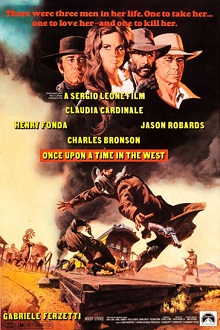
Once Upon a Time in the West-1968

Once Upon a Time in the West-1968

Director Sergio Leone

Starring Henry Fonda, Claudia Cardinale

Top 250 Films #187

Scott’s Review #886
Reviewed April 17, 2019

Grade: A

At one time dismissed as either frivolous or cartoon-like, the derogatory genre classification “spaghetti western” was originally played for laughs or featured a comical slant, often with bad lip-syncing.

Many of these films have aged tremendously well, though, and are now more widely appreciated and have become a part of the cinematic canon.

Once Upon a Time in the West (1968) is a lesson in camp art that marinates like a fine steak, drizzling with texture and a good atmosphere across a sprawling two-hour-and-forty-six-minute landscape.

In a great sequence, the film begins with a mysterious harmonica-playing gunman (Charles Bronson), dubbed “Harmonica” for reasons eventually revealed, shooting three men sent to kill him.

Meanwhile, to get his hands on prized railroad land in Sweetwater, disabled railroad baron Morton (Gabriele Ferzetti) hires killers, led by blue-eyed baddie Frank (Henry Fonda), who murders property owner Brett McBain (Frank Wolff) and his family.

The film immediately exudes intensity, with a severe revenge theme.

The story develops further, with romance mixed in a Western style, as McBain’s newly arrived bride, Jill (Claudia Cardinale), inherits the land instead.

Jill is a former prostitute who catches the eye of most of the men she encounters. Both outlaws, Cheyenne (Jason Robards) and Harmonica, take it upon themselves to look after Jill and thwart Frank’s plans to seize her land.

With standard Western flair, they are both attracted to Jill and yearn for her affection while also feeling protective of her.

Not professing to be enamored with the Western genre- the stereotypical Cowboys and Indians and token damsel in distress have their limitations- Once Upon a Time in the West is a feast for the eyes and the ears with cinematography on par with Lawrence of Arabia (1963) and a killer musical score.

While the story may have a traditional backbone, the nuances are astounding. The sweeping mountains of the western United States are heavily featured, and the tension-infused music sets up every thrilling scene with gusto and foreboding.

Hot on the heels of another similarly themed masterpiece, The Good, The Bad, and The Ugly (1966), Leone delivers the goods at every turn, most notably setting up each scene with sizzling elements that emit a clear sense of danger.

The audience knows trouble is about to transpire, but not exactly when the shit will hit the fan. The family death scene is paced astoundingly well as the family merrily goes about preparing a delicious summer meal, unaware that destruction is around the corner.

Sure, the cast is a mix of American and Italian actors with varying degrees of accents, not exactly mirroring the Wild West.

Yes, Jill wears heavy mascara and a hairstyle straight out of the 1960s, and one character has brightly dyed red hair, but these intricacies give the film character rather than turn the production into a disheveled mess.

Forever known for heroic or everyman roles, Fonda plays against type, cast as the central, sadistic villain, and the result is superlative.

Leone’s ability to cast a legendary star in a production with little expectation is quite a feat, and Fonda seems to revel in role-playing him both dangerously and straight.

With his piercing blue eyes and a gaze sure to make children run away in terror, his brutal villainy is fully realized only at the film’s conclusion.

Dozens of iconic comparisons to Quentin Tarantino’s modern directing style can be drawn. The director undoubtedly watched and studied this film repeatedly, as numerous qualities of it mirror his own movies.

Viewers will delight in drawing these comparisons, including a harmonica reference, a revenge story, and the climactic reveal at the end of the film, presented as a flashback that pulls all the pieces together.

Once Upon a Time in the West (1968) is a quality film that has finally gotten its due. Tremendous and compelling storytelling is combined with flavorful qualities and a dusty atmosphere.

The film is the sum of its parts, and while it was initially underappreciated, it has finally risen to the rank of a high-quality masterpiece.

Influencing many great directors, including Martin Scorsese, George Lucas, and Tarantino, is quite a testament to its staying power.
Spartacus-1960

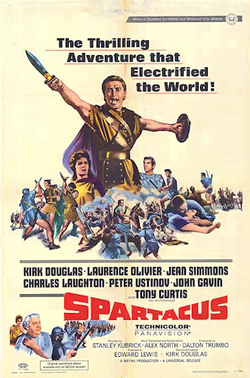
Spartacus-1960

Director Stanley Kubrick

Starring Kirk Douglas

Top 250 Films #247

Scott’s Review #1,250

Reviewed April 30, 2022

Grade: A

Typically, when influential director Stanley Kubrick’s name is uttered, films such as The Shining (1980), 2001: A Space Odyssey (1968), and Barry Lyndon (1975) are immediately thought of, and for obvious reasons.

The haunting, moody musical score, the long camera shots, the dark humor, and the clever camera tricks are easy to pinpoint.

1960, the director was hired to direct the gorgeous epic Spartacus after Hollywood star Kirk Russell unceremoniously fired the first director.

None of the previously mentioned elements are easy for me to notice and are more or less absent, but a grand battle scene in a luscious green field is very reminiscent of Barry Lyndon.

This is likely because Spartacus was not Kubrick’s film entirely; instead, it belonged to others with more clout.

Spartacus is a brilliant film for many reasons. Some epics suffer from a hokey, cliched feel and can be overwrought, predictable, and tired.

The rebellious Thracian Spartacus (Russell), born and raised an enslaved person, is sold to Gladiator trainer Batiatus (Ustinov). After training to kill for the arena, Spartacus turns on his owners and leads the other enslaved people in rebellion.

As the rebels move from town to town, their numbers increase as escaped slaves join their ranks. Under the leadership of Spartacus, they make their way to southern Italy, where they intend to cross the sea and return to their homes.

Spartacus is grand, sweeping, cinematically significant, and everything else you’d expect from a 1960s Hollywood epic with enormous stars of its day.

Looking beneath the surface, the film is riddled with interesting tidbits like bisexuality, homoeroticism, and violence, more in tune with an art film or modern war film than the safety of a movie made during this time.

Particularly noteworthy is that Dalton Trumbo wrote the screenplay. One of the Hollywood Ten, he refused to testify before the House Un-American Activities Committee in 1947 during the committee’s investigation of alleged Communist influences in the motion picture industry.

After the release of Spartacus, it marked the beginning of the end of the Hollywood Blacklist for Trumbo and other affected screenwriters.

Thank goodness.

In a famous scene, recaptured enslaved people are asked to identify Spartacus in exchange for leniency; instead, each enslaved person proclaims himself to be Spartacus, thus sharing his fate.

The suggestion is that this scene was meant to dramatize the solidarity of those accused of being Communist sympathizers during the McCarthy era.

Besides the political importance, Spartacus showcases a beautiful romance between Spartacus (Russell) and Varinia (Jean Simmons), a gorgeous slave girl.

The tenderness and authenticity are palpable as many of their early scenes involve no dialogue but only longing and expression through both actors’ eyes.

I celebrated the connection between the actors at the forefront of much romance. Russell carries the film with calm masculinity, quickly making him heroic and likable.

He is the charismatic, good guy who has been wronged and ill-fated.

A sequence oozing with machismo and homoeroticism occurs when evil Crassus (Olivier) is bathed by his slave boy Antoninus (Tony Curtis).

He seductively explains that while sometimes he prefers snails, he also likes oysters. The implication is that he is bisexual, brazenly so, and expects the youngster to become his sex slave.

The warmth of the bathtub and the luxurious atmosphere contrast with the proximity and touch of both male characters.

In 1960, this scene was way ahead of its time.

The conclusion of Spartacus is melancholy and surprising. Having bested Rome’s cruelty, one might have expected to see Spartacus and Varinia happily ride off into the sunset.

This doesn’t happen, and the film is richer for it. There is pain and despair as there was in real life. Wisely sparing complete doom and gloom, the ending is satisfying as one central character escapes a deadly demise and moves ahead.

Spartacus (1960) is one of the greats. It has muscle and texture, and many below-the-surface nuances are ripe for discussion. For these reasons, it’s a must-see.

Oscar Nominations: 4 wins-Best Supporting Actor-Peter Ustinov (won), Best Art Direction-Color (won), Best Cinematography-Color (won), Best Costume Design-Color (won), Best Film Editing, Best Music Score of a Dramatic or Comedy Picture

Golden Globe Nominations: 1 win-Best Motion Picture-Drama (won), Best Director-Motion Picture-Stanley Kubrick, Best Performance by an Actor in a Motion Picture-Drama-Laurence Olivier, Best Performance by an Actor in a Supporting Role in any Motion Picture-Peter Ustinov, Woody Strode, Best Original Score-Motion Picture