Tag Archives: Richard Fleischer

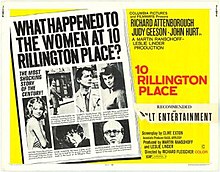
10 Rillington Place-1971

10 Rillington Place-1971

Director Richard Fleischer

Starring Richard Attenborough, Judy Geeson, John Hurt

Scott’s Review #1,424
Reviewed March 22, 2024

Grade: A

Richard Fleischer has directed films such as Dr. Doolittle (1967) and Soylent Green (1973) that are remembered better than 10 Rillington Place (1971).

That’s a shame, because the film is one I hadn’t seen or heard of, yet it’s chilling, macabre, and masterful in its bleakness and atmosphere.

It’s also wonderfully acted.

One can’t help but notice the stark similarities to Frenzy, an equally disturbing and great 1972 film by Alfred Hitchcock.  Did this film influence the master of suspense to create that one? Only he knows the answer to that question.

Primarily set in one dreary apartment building in London named 10 Rillington Place, it tells the true story of the British serial killer John Christie (Richard Attenborough), who committed many of his crimes in the tall terraced house, and the miscarriage of justice involving his neighbor, the simple-minded Timothy Evans (John Hurt).

John used Timothy as a scapegoat for the murders.

John is a seemingly model citizen but a killer, as the audience witnesses in the first scene. He poses as a kindly doctor who convinces naive women that he can cure whatever ails them, whether it’s aches and pains or a pesky pregnancy.

He usually strangles them to death and buries them in a makeshift graveyard in the pretty garden in front of his residence.

The main story in 10 Rillington Place follows John as he cons a pregnant bride (Judy Geeson) who is struggling financially to use his help and medical methods. John’s dutiful, clueless wife, Ethel (Pat Heywood), slowly discovers her husband’s shenanigans, but will she fall victim as his next target?

Of course, Richard Attenborough steals the show as the demented killer with a calm, cool, and collected exterior. As an average-looking Joe type, he can use his trusting appearance to his advantage.

I’d trust him.

Attenborough became an Academy Award-winning director for 1982’s Gandhi, so he knows his craft well. He also directed Cry Freedom in 1987 and Chaplin in 1992.

In actor mode, he is phenomenal as a crazed killer. His most excellent skill is his demeanor. Thoughtful and pondering, he never plays the psycho or the nut. He is careful, but that’s part of his creepiness. With every noise, he peers out the window, drawing the living room curtain ever so slightly, revealing his face.

Hurt and Geeson are terrific as the young couple with the cards stacked against them. They are simply looking for tranquility and the means to raise their child.

Simplicity is a winning formula, and most of the film is subdued thanks to Fleischer’s laid-back direction techniques.

The look of 10 Rillington Place is perfection. The colors are muted and faded, giving a dank and depressing look. Even a bright red velvet sofa appears dark and dreary.

As Timothy and Beryl agree to lease the top-floor flat, it will not bode well for them, and we can sense it.

Towards the end of the film, it is almost too much to bear with the knowledge that John strangles a toddler to death and unceremoniously stuffs the child, wrapped in a blanket, in a washroom.

Brilliantly, the murders rarely happen on screen and involve none of the principal characters. That’s what’s so haunting about the film and reminds me of Hitchcock’s Frenzy.

Remember the scene where the necktie killer lures a female victim upstairs to her death? There is silence and a shot of the staircase for seemingly an eternity until the killer descends the stairs.

We know what’s happened.

What we don’t see is sometimes much more frightening than what we do see.

The ghastly reveal at the end of 10 Rillington Place that the story is based on real-life events packed a punch since I didn’t have this knowledge going into the film.

Thankfully, 10 Rillington Place (1971) has received its just desserts in recent years, with praise and recognition. This proves that great films are like cream and rise to the top…..eventually.
Soylent Green-1973

Soylent Green-1973

Director Richard Fleischer

Starring Charlton Heston, Leigh Taylor-Young, Edward G. Robinson

Scott’s Review #943

Reviewed October 8, 2019

Grade: B

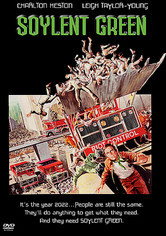
Soylent Green (1973) is a rather obscure offering starring the big-named star Charlton Heston in a dystopian science-fiction film.

The story is futuristic and eerily reminiscent of Planet of the Apes (1968), though not nearly as compelling nor as layered.

The result is admirable for its progressive message, cool colors, and sets, but it feels dated and of its time and treats female characters more like props than characters, leaving an uneven result.

It’s a one-and-done sort of film.

The year is 2022, and because of the Industrial Revolution, 40 million people live in New York City, suffering year-round from extreme humidity due to the greenhouse effect and from shortages of water, food, and housing.

Only the wealthy are afforded necessities, and residents of the rich (mostly female) are referred to as “furniture” and enslaved.

Detective Frank Thorn (Heston) is tasked with investigating the murder of an affluent and prominent man, which leads him to dire details surrounding Soylent Industries and the food they produce.

The film seems like someone’s visionary idea that turned into a Hollywood movie.

Loosely based on a 1966 novel entitled “Make Room! Make Room!” by Harry Harrison, Heston is cast as the lead while his career was slowly declining, but he is still the star and quite hunky for an older gentleman.

He plays a role similar to George Taylor in Planet of the Apes, especially during the final climactic reveal, which will make viewers question what is in their dinner.

Heston carries the film well and mixes wonderfully with character actor Edward G. Robinson, who plays Sol Roth in his final role. The old character decides to “return to the home of God” and seeks assisted suicide at a government clinic.

The final scene between the actors is poignant and heartfelt as they say goodbye. Eagle-eyed viewers will spot a young Dick Van Patten in a tiny role during this scene.

Any romantic chemistry is lacking in Soylent Green as a potential love match between Frank and Shirl (Leigh Taylor-Young) strikes out. Mismatched and with little thunder together, the couple does not look good.

Making matters worse is that Shirl is mere “furniture,” limiting the character’s potential. She is reduced to assisting with Frank’s investigation.

The main detraction is that the film does not feel very futuristic or authentic. The characters look like actors from the 1970s dressed up to look like they are from the future, always with a tint of Hollywood thrown in.

The story loses its way halfway through and teeters between pure science fiction and a standard detective story, seen nightly at that time on network television.

Still, the film does contain a robust amount of potential but does not reach it. The progressive slant and social commentary are admirable, and the bright green, nutritious, synthetic canned food is almost a character in its own right.

The final scene will shock the viewer with horror, and I wish more jaw-dropping scenes existed throughout the experience, not just at the end.

A film that attempts to do something different or provide a provocative message is worthy of a certain amount of praise.

Soylent Green (1973) offers a bit of thought-provoking provocation but seems more relevant to the 1970s than to much interest decades later.

Heston is dazzling as the main character, and the trimmings are impressive, but Invasion of the Body Snatchers (1956) or The Day the Earth Stood Still (1951) resonate more as similar genre films.

Mandingo-1975

Mandingo-1975

Director Richard Fleischer

Starring James Mason, Susan George

Scott’s Review #53

70094784

Reviewed June 21, 2014

Grade: B+

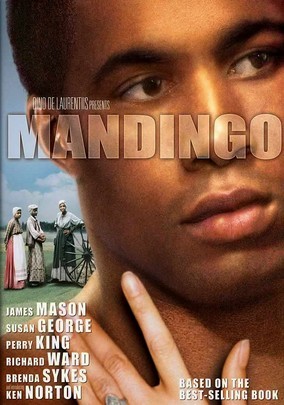
Mandingo is quite a controversial 1975 film and is inspirational to Quentin Tarantino’s Django Unchained (2012) and to 12 Years a Slave (2013), as it is very similar to the latter.

It centers on a family of southern slave owners who eventually have physical relations and even romantic, loving relationships with their slaves.

There is also a sub-plot involving bare-knuckle fights to the death among the enslaved men that is disturbing to witness.

The entire film is extreme and difficult at times, but also has a mystical, dreamlike element to it and is in no way an exploitation film.

The sticky, hot, deep southern setting adds a wonderful atmosphere. The romances are an interesting facet of the film, which I have never seen in similarly themed movies.

There is one sympathetic enslaver, but happily, the others get their comeuppance, one by one, which is delightful to watch.

Mandingo (1975) is an interesting film because it inspires others to follow in its footsteps and shows how far we have come as a society.