Tag Archives: Dick Warlock

Halloween II-1981

Halloween II-1981

Director Rick Rosenthal

Starring Jamie Lee Curtis, Donald Pleasence

Top 250 Films #135

Top 40 Horror Films #23

Scott’s Review #505
569099

Reviewed October 31, 2016

Grade: A

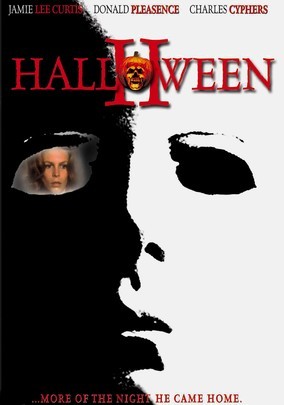
The follow-up to the surprise 1978 cult classic, independently made Halloween- directed by legend John Carpenter,  Halloween II (1981) was made in 1981.

In real life, it is three years later. Still, the film picks up immediately where the original left off in a chronological sense- the infamous night Michael Myers came home to brutalize the town where he killed his sister years earlier.

This is an excellent plot point that makes the film successful, as it immediately takes the viewer back to that infamous night.

Halloween II is one of my favorite film sequels.

Despite not directing Halloween II, John Carpenter, along with Debra Hill, both wrote the script, so they are, thankfully, heavily involved in the production, giving it authenticity and familiarity.

So much so that Halloween and Halloween II can be watched back-to-back, like one long film.

Michael Myers’s path of destruction continues in the sleepy, suburban town of Haddonfield, Illinois. This point looms large in this fantastic sequel, and we are treated to a direct transition from the original to the sequel.

The events switch from babysitter territory to the community hospital as new characters- mostly doctors, nurses, and ambulance people are introduced to the story, Laurie’s friends are sadly deceased.

Laurie Strode (Jamie Lee Curtis) and Doctor Loomis (Donald Pleasence) are the main stars of the film, and by the climax, they take center stage.

As a recap, the determined Loomis shot Michael Myers several times as he tumbled off a balcony to his presumed death. Spectacularly, the original Halloween brilliantly set the stage for a sequel, as Myers survives and disappears into the night, whereabouts unknown.

Now hours later, Laurie is transported to Haddonfield Hospital for treatment.  While there, the hospital staff do their best to protect her but are subsequently offed one by one by the crazed killer, who finds his way into the (conveniently!) deserted hospital.

The great quality of Halloween II is that it is gorier than its predecessor. More characters are sliced and diced in an unceremonious, brutal fashion.

One has her blood drained, and another is stabbed in the eye with a syringe. Yet another is repeatedly dunked into scalding water. And then there is the traditional knife in the back.

In contrast to many other slasher films, the supporting cast of characters is quite likable, and they are given little backstories of their own- a great touch.

Bud- the wise-cracking ambulance driver is dating Nurse Karen. Jimmy, a handsome orderly, takes a shine to Laurie.

Mixed in with the heavy horror are nice comic moments, such as when Nurse Janet ineptly tries to assist the hospital security guard, the bumbling Mr. Garrett, with a walkie-talkie, or when Head Nurse Mrs. Alves scolds the staff for being tardy.

We grow to care for these characters, in their little night-shift family, so that their inevitable demises hit home.

The chilling music- so instrumental to the success of the original- is slightly modernized into more of a keyboard-style sound. This gives a slicker, more commercial appeal.

Not to take away from the brilliance of the original score, but it is nice to hear a change, giving a fresher, more contemporary sound, rather than simply copying the same music.

Admittedly, Halloween II (1981) is not quite on par with Halloween, but that is asking the impossible. Halloween is a masterpiece, but Halloween II holds its own and is more than adequate as a sequel, having large shoes to fill.

Thanks to many of the same creators involved, it has not lost its edge or relevance all these years later.
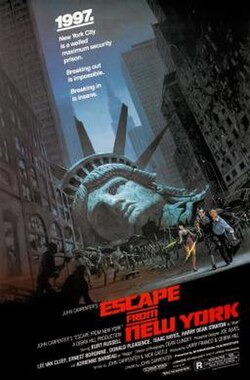
Escape from New York-1981

Escape from New York-1981

Director John Carpenter

Starring Kurt Russell, Lee Van Cleef

Top 250 Films #141

Scott’s Review #344

Reviewed January 9, 2016

Grade: A

Escape from New York (1981) epitomizes a great action film to me.

Too often, action films are filled with run-of-the-mill characters, are plot-driven, and are mediocre stories that lack creativity. I adore Escape from New York, however.

The creativity and amazing direction by John Carpenter allow the film to soar high above what is typical for this genre.

The unique premise sets things off immediately as we follow the mission of ex-con Snake Plissken (Kurt Russell) to save an important figure in peril.

In futuristic 1997, we learn that due to skyrocketing crime throughout the United States, New York City has been fenced off and turned into a maximum-security prison.

All of the most hardened and demonic criminals have been isolated on Manhattan Island to fend for themselves- free to kill or be killed as they like.

The rest of the country is presumably crime-free- though we never see the rest of the country.

The President of the United States (Donald Pleasence) is taken hostage when Air Force One crashes on Manhattan Island. Snake is injected with a poison that will kill him in twenty-four hours unless he successfully rescues the president and returns him alive and well.

I love this film because it is strictly Carpenter’s vision.

Due to the success of 1978’s Halloween, he was given creative freedom and a big budget to film in St. Louis (doubling for New York).

The film features eerie synthesizer music (reminiscent of Halloween and Halloween II) that sets the tone exceptionally well. The dark and abandoned sets are wonderful and capture a futuristic world oh so well.

The audience will undoubtedly become enraptured as Snake’s mission is to do or die- if he does not save the president, he dies. As Snake arrives atop the World Trade Center via glider, now, post-9/11, the scene takes on a haunting quality.

Snake then immerses himself in the gloomy world of Manhattan, facing all sorts of dangers along the way. Punk rock-looking creatures scurry around the city- many insane, and Snake meets odd character after odd character in his quest to save the president.

His main ally is Cabbie, played by Ernest Borgnine.

The villain of the story is Duke, not well cast nor well developed, but this can be overlooked because of his super rad Cadillac and his two fascinating accomplices- Maggie (Barbeau) and Brain (Harry Dean Stanton).

The lavish sets include the New York Public Library and Grand Central Station- I love that there are so many iconic New York City locales featured- but the fact that they are not shot in the genuine areas does not bother me.

The art direction is done so well that I was fooled.

Escapism fare, but a unique entry in the action genre. Thanks to fantastic direction and a likable star, Escape from New York (1981) succeeds.

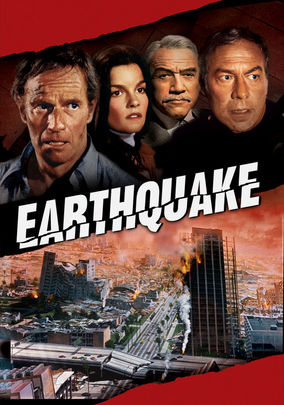
Earthquake-1974

Earthquake-1974

Director Mark Robson

Starring Charlton Heston, Ava Gardner, Geneviève Bujold

Top 250 Films #144

Scott’s Review #407

60030175

Reviewed June 2, 2016

Grade: B+

One of the several disaster films to populate film screens in the early to mid-1970s, Earthquake is one of the “main four” blockbusters (The Poseidon Adventure, 1972, The Towering Inferno, 1974, and Airport, 1970, being the others) that still resonate with viewers in modern times and are nostalgic to watch.

One might argue that the aforementioned few largely influenced Earthquake since it was the last of the group to be filmed.

Certainly, the influence is apparent.

Earthquake is a classic, traditional disaster film containing many stock characters (or types). It is an ensemble piece- as disaster films always are- frequently containing stars of yesteryear attempting exposure in the modern cinema.

The gender roles in Earthquake are quite mainstream for the day, as the females are all clearly “damsels in distress” types, and the men are portrayed as the heroes.

The action begins as we witness a Los Angeles-based middle-aged couple (the central couple, if you will) engaging in a dispute.

Charlton Heston and Ava Gardner play Stewart and Remy Graff, an affluent couple, a former football star, she a boozy socialite. Her father is the wealthy Sam Royce, played by Lorne Greene. Stewart is having an affair with a young actress, Denise Marshall, creating a soap-opera-style romantic triangle that adds drama to the film.

We meet other characters who round out the characters’ stories- LAPD Sgt. Slade (George Kennedy) shares a flirtation with Rosa (Victoria Principal), while drunkard Walter Matthau and evil kineval character Richard Roundtree provide comic relief.

These stories are merely filler until the inevitable earthquake arrives to ‘shake’ things up.

The earthquake is the main character in the film, just like the tidal wave, the fire, and the airline peril are in other films in the same genre.

The character’s trivial relationships soon take a back seat to the action as the earthquake shatters the city in subsequent onsets and aftershocks, destroying buildings and resulting in many deaths.

The very lengthy main earthquake sequence is second to none, hovering around the twenty-minute mark. We see many characters in peril. The scene goes on and on but is hardly redundant.

The scene is masterful and well done. The effects, cinematography, and visuals alone hold up well today and must have been breathtaking circa 1974.

In one particularly thrilling scene, a group of office workers on the thirtieth floor of a skyscraper desperately scrambles to the elevator as the building shakes and shimmies.

One businessman shoves a secretary aside and selfishly steps into the crowded elevator as others desperately pound on the door to escape.

Things do not end well for the folks on the elevator as bolts loosen and the car crashes to the ground. An animated blood splat fills the screen in a lighthearted, comical way.

The film wisely does not take itself too seriously.

As fantastic as the destruction sequence is, Earthquake is not a film without a few flaws, mostly from a character standpoint.

Unbelievable is Heston playing Greene’s son-in-law, and Gardner is assumed to be young enough to be his daughter- they appear to be around the same age.

A strange character, Jody, a store clerk, suddenly dresses as a soldier, wearing a wig, following the destruction, and is assumed to be gay by thugs, who tease him, which prompts him to shoot them with a machine gun. He subsequently becomes obsessed with and nearly rapes Rosa.

The sub-plot seems uneven and very unnecessary.

With spectacular special effects, Earthquake (1974) is a must-see disaster film with a slightly downcast, hopeless tone. It does its job well- it entertains, thrills, and features an all-star cast of former Hollywood elite and a few rising stars.

A fun time will be had.

Oscar Nominations: 1 win-Best Sound (won), Best Art Direction, Best Cinematography, Best Film Editing

Body Double-1984

Body Double-1984

Director Brian De Palma

Starring Craig Wasson, Gregg Henry, Melanie Griffith

Scott’s Review #1,475

Reviewed April 5, 2025

Grade: A-

Brian De Palma is one of my favorite directors. His stylistic body of work in the psychological thriller/horror genre is masterful, with treats such as Carrie (1976) and Dressed to Kill (1980) as my favorite films.

Body Double (1984) allowed De Palma much creative freedom because of the success of these films and the underwhelming but successful Scarface (1983).

It is a fly-under-the-radar type of film that pays direct homage to 1950s Alfred Hitchcock films, most notably Vertigo (1958) and Rear Window (1954).

I get triple pleasure from watching Body Double. I compare scenes to the above-mentioned Hitchcock films and scenes to De Palma’s own films, especially Dressed to Kill. Plus, it stars Melanie Griffith, daughter of Hitchcock star Tippi Hedren.

The setting is Los Angeles, with B-movie film sets, posh Hollywood mansions, and hilly views of the vast City of Angels landscape. I am fascinated by the city and its mixture of glitzy glamour and dark subtext, which is a perfect recipe for watching this film.

While not De Palma’s very best work it is pretty damned good and somehow isn’t as revered as other films.

Craig Wasson plays Jake Scully, a struggling actor who loses his acting role and his girlfriend, Carol (Barbara Crampton), on the same day. While taking a Method acting class, his friend Sam (Gregg Henry) offers him a gig house-sitting an ultra-modern home that overlooks mansions.

While peering through the beautiful home’s telescope one night, he spies a gorgeous blonde, Gloria (Deborah Shelton), dancing in her window. Becoming obsessed with her, it leads to a vicious crime and into the world of adult entertainment along with porn star Holly Body (Melanie Griffith).

Fans of De Palma will undoubtedly love Body Double because it feels like a De Palma film. At other times, he veered too far away from his brand for my tastes, but the sultry and glossy voyeurism is fully displayed.

Who won’t instantly think of the museum scene in Dressed to Kill during the mall scene in Body Double? It’s a titillating cat-and-mouse chase scene with Jake following Gloria through a parking garage, a Fredericks of Hollywood-type store, and ultimately watching her try on panties, which he steals.

The panties serve as a version of the glove in Dressed to Kill, while the final shower scene in Body Double made me think of the steamy shower scene in Dressed to Kill.

I often thought of Rear Window and Vertigo, but De Palma honors them instead of stealing from the treasures. Jake is obsessed with Gloria yet knows nothing of her. Is she who she appears to be? Is she in danger? Is Jake being set up like Scottie was in Vertigo?

The telescope that Jake peers through is a modern version of the one from Rear Window. In both films, a murder is attempted while the protagonist helplessly watches from afar.

Anyone who enjoys acting will be satisfied with a dose of a method acting class being showcased, as well as nifty low-budget sets and set pieces reminiscent of a Hammer Horror set.

Finally, the overarching theme of a ‘body double’ frequently used in films when the ‘star’ is replaced by a stand-in, usually for nude scenes, is cleverly referenced in the final scene when a girl with perfect breasts is used while filming a shower scene.

The trickery of filmmaking is celebrated.

The camera work and musical score are a large part of the appeal. The eroticism smolders while Jake and the audience watch Gloria and Holly dance amid moody, electronic 1980s dance beats. The camera captures the moment perfectly.

The glossy, sensual elements forever link De Palma with Hitchcock, 1980s style.

1980s films are often dismissed as cheesy or mainstream affairs, but Body Double’s look is 1980s in the best possible ways. The expensive cars, the big hair, the cocaine, and the L.A. porn world all mesh together fabulously. Incorporating the monster hit, ‘Relax’ and the band Frankie Goes to Hollywood is a significant win.

With Body Double (1984), De Palma provides slick entertainment and thrilling sensuality and helped launch the career of Melanie Griffith, a star of the 1980s and 1990s.

Jaws-1975

Jaws-1975

Director Steven Spielberg

Starring Roy Scheider, Richard Dreyfuss, Robert Shaw

Scott’s Review #1,240

Reviewed March 28, 2022

Grade: A

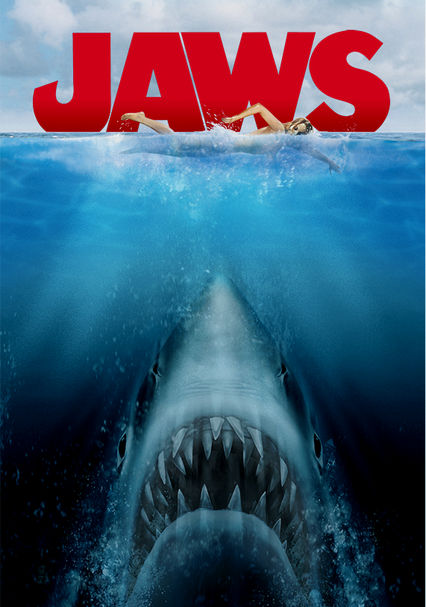
The directorial breakthrough by the iconic Steven Spielberg is Jaws (1975).

The film is such a legendary and familiar project that even stating the name to pretty much any human being immediately conjures images of a man-eating great white shark and the unforgettable ‘duh-duh, duh-duh’ musical score.

It’s the film that famously made people afraid to go into the water, just as Hitchcock’s 1960 masterpiece, Psycho, made people afraid to take a shower. When I have to be near the ocean, I always think of this film.

Jaws is a hybrid horror/thriller/adventure/action film, whereas the subsequent sequels were all straight-ahead horror films that cast more teenagers, and some better than others.

Spielberg teaches a valuable lesson that much can come from very little and that a small budget can create greatness. What he accomplishes with Jaws is admirable, to say the least.

With Jaws, the story is more about the attempts of three men to destroy a killer shark and their relationship with the shark itself. The scary aspect, always terrific in horror, is that we do not know what the shark’s motivation is.

Why does it kill?

It’s a brilliant film that holds up well decades later, despite the shark feeling less authentic over time. But the time a film is made must always be kept in mind.

When one summer day, a young woman is killed by a shark while skinny-dipping near the New England tourist town of Amity Island, police chief Martin Brody (Roy Scheider) wants to close the beaches.

He comes into conflict with the mayor, Larry Vaughn (Murray Hamilton), who overrules him, fearing that the loss of tourist revenue will negatively affect the town during its summer season.

Dismissed as a mere boating accident, the great white shark then kills a young boy in full view of a beach crowd, resulting in panic and mayhem. It’s as if the shark is determined to be taken seriously.

Oceanographer Matt Hooper (Richard Dreyfuss) and grizzled ship captain Quint (Robert Shaw) offer to help Brody capture the killer shark, and the trio engages in an epic battle with the beast.

Jaws is a film that can be viewed multiple times and provides sheer pleasure each time. Forgetting the horror elements, the film provides adventure and heart-pounding thrills per minute once the men dare to try and foil the shark.

The fun, as in any film of this kind, is not knowing when or where danger will strike, only that it inevitably will come.

Scheider excels in his household name-making role as the determined police chief. He cares deeply about the townspeople and is therefore a likable hero. During frequent scenes, he gazes out to the water, a troubled look on his face, pained and feeling responsible for the deaths.

The audience empathizes with him.

Lorraine Gary, who would later play a lead role in poorly received films, is terrific as the supportive yet challenging wife, Ellen. She is the yin to his yang, and it comes across on-screen.

The best scenes of the film are the very first one, when the girl is eaten by the shark, and the later one, when Brody yells at everyone on a crowded beach to flee the water. Munching on the first victim, this is the scene where the dreaded music makes its debut.

From this point, the audience knows that hearing this music means the shark is nearby.

In the other scene, the panic caused is breathtaking and palpable, and sympathy is felt for Brody. He obediently takes the blame for the chaos and the deaths and makes it personal when his son is victimized. The scene sets the tone for the scramble and mayhem.

Jaws (1975) has it all: adventure, thrills, horror, action, a hero, and blood. The technical aspects are astounding, with underwater sequences and effects that remain viable.

It arguably created what has come to be known as the summer blockbuster.

Oscar Nominations: 3 wins-Best Picture, Best Film Editing (won), Best Original Dramatic Score (won), Best Sound (won)

The Abyss-1989

The Abyss-1989

Director James Cameron

Starring Ed Harris, Mary Elizabeth Mastrantonio

Scott’s Review #1,210

Reviewed December 19, 2021

Grade: B+

Well before he created Titanic (1997) and Avatar (2009) and became a household name, director James Cameron made the gorgeous, special effects-laden film The Abyss (1989).

The film followed hits like Terminator (1984) and Aliens (1986).

These films undoubtedly allowed him to make a film that he wanted to make with the necessary freedoms.

The Abyss is completely visual and the interesting cast of characters with possibilities for development are never allowed to shine through instead feeling stale. They are usurped by the constant flow of underwater lush worldly spectacles that utterly encompass the film.

Even when the central characters get a moment to dig deeper into their backstories Cameron never goes for the emotional jugular instead encouraging the viewers to focus on the extraterrestrial and science fiction elements rather than his characters.

That’s the type of director Cameron is and recommended watching The Abyss on the big screen, or the biggest screen possible. I did not and recognize the sheer bombast that a cinema watching would render.

I missed out.

The film, and specifically Cameron, must be heralded for the vast loveliness of the art direction, visual effects, and cinematography.

Forget the convoluted plot entirely and sit back and enjoy the spectacle.

Ed Harris and Mary Elizabeth Mastrantonio portray Bud and Dr. Lindsey Brigman formerly married petroleum engineers who still have some issues to work out. When an American submarine sinks in the Caribbean, a US search and recovery team works with an oil platform crew, racing against Soviet vessels to recover the boat.

Deep in the ocean, they encounter something unexpected and the American team is determined to find out what. Is it the Russians or a deadly and intelligent extraterrestrial force?

The story is overly complicated and riddled with stereotypical plot points. As the team becomes submersed in their submarine they experience the standard trouble- a hurricane, a rogue team leader, a flooded rig, and freezing temperatures.

Harris and Mastrantonio have pretty good chemistry here but we never fully grasp their marital problems or why there is a distance between them. Thrown together on this mission they predictably face peril and come close to losing each other.

When they embrace in the final scene it is a wrapped up like a tight bow sort of ending that underwhelms.

But, man are the visuals amazing. When the team drops at the alien city in the deepest trenches of the ocean floor the beautiful underwater camera shots take center stage. The technical consistencies are simply breathtaking and become the focal point of the film.

I daresay The Abyss (1989) features the greatest underwater sequences ever seen on film to this date but somehow decades later the film feels forgotten or overshadowed by Cameron’s other works.

Perhaps the dated Cold War plotline and the traditional romance have not served the film well in the long run.

Oscar Nominations: 1 win-Best Art Direction, Best Cinematography, Best Visual Effects (won), Best Sound

Soylent Green-1973

Soylent Green-1973

Director Richard Fleischer

Starring Charlton Heston, Leigh Taylor-Young, Edward G. Robinson

Scott’s Review #943

Reviewed October 8, 2019

Grade: B

Soylent Green (1973) is a rather obscure offering starring the big-named star Charlton Heston in a dystopian science-fiction film.

The story is futuristic and eerily reminiscent of Planet of the Apes (1968), though not nearly as compelling nor as layered.

The result is admirable for its progressive message, cool colors, and sets, but it feels dated and of its time and treats female characters more like props than characters, leaving an uneven result.

It’s a one-and-done sort of film.

The year is 2022, and because of the Industrial Revolution, 40 million people live in New York City, suffering year-round from extreme humidity due to the greenhouse effect and from shortages of water, food, and housing.

Only the wealthy are afforded necessities, and residents of the rich (mostly female) are referred to as “furniture” and enslaved.

Detective Frank Thorn (Heston) is tasked with investigating the murder of an affluent and prominent man, which leads him to dire details surrounding Soylent Industries and the food they produce.

The film seems like someone’s visionary idea that turned into a Hollywood movie.

Loosely based on a 1966 novel entitled “Make Room! Make Room!” by Harry Harrison, Heston is cast as the lead while his career was slowly declining, but he is still the star and quite hunky for an older gentleman.

He plays a role similar to George Taylor in Planet of the Apes, especially during the final climactic reveal, which will make viewers question what is in their dinner.

Heston carries the film well and mixes wonderfully with character actor Edward G. Robinson, who plays Sol Roth in his final role. The old character decides to “return to the home of God” and seeks assisted suicide at a government clinic.

The final scene between the actors is poignant and heartfelt as they say goodbye. Eagle-eyed viewers will spot a young Dick Van Patten in a tiny role during this scene.

Any romantic chemistry is lacking in Soylent Green as a potential love match between Frank and Shirl (Leigh Taylor-Young) strikes out. Mismatched and with little thunder together, the couple does not look good.

Making matters worse is that Shirl is mere “furniture,” limiting the character’s potential. She is reduced to assisting with Frank’s investigation.

The main detraction is that the film does not feel very futuristic or authentic. The characters look like actors from the 1970s dressed up to look like they are from the future, always with a tint of Hollywood thrown in.

The story loses its way halfway through and teeters between pure science fiction and a standard detective story, seen nightly at that time on network television.

Still, the film does contain a robust amount of potential but does not reach it. The progressive slant and social commentary are admirable, and the bright green, nutritious, synthetic canned food is almost a character in its own right.

The final scene will shock the viewer with horror, and I wish more jaw-dropping scenes existed throughout the experience, not just at the end.

A film that attempts to do something different or provide a provocative message is worthy of a certain amount of praise.

Soylent Green (1973) offers a bit of thought-provoking provocation but seems more relevant to the 1970s than to much interest decades later.

Heston is dazzling as the main character, and the trimmings are impressive, but Invasion of the Body Snatchers (1956) or The Day the Earth Stood Still (1951) resonate more as similar genre films.

Halloween III: Season of the Witch-1982

Halloween III: Season of the Witch-1982

Director Tommy Lee Wallace

Starring Tom Atkins, Stacey Nelkins

Scott’s Review #506

569108

Reviewed November 1, 2016

Grade: B

Halloween III: Season of the Witch was met with much disdain when it was released in 1982- a mere one year following the very successful Halloween II- the sequel to the iconic Halloween (1978).

Fans (and critics) expecting a third chapter in the maniac-wielding Michael Myers saga were sorely disappointed and perplexed at what they were “treated” to.

After all, the title is billed as “III”. Therefore, the film was met with disapproval.

This film is not even in the slasher genre although I’ll categorize it as such for name recognition alone- more of a science fiction meets Twilight Zone.

Years later, this film would be heralded as a not-so-bad offering from a stand-alone film perspective. A different title might have been wise but at the risk of being a forgotten film.

I agree with the sentiment-it’s not a fantastic film- the plot is far from its strong suit, but a brave film and one that has aged well.

The franchise creators (John Carpenter and Debra Hill) had hoped to create an anthology-type film series with different chapters all surrounding the holiday of Halloween. This was not to be and Michael Myers would return for the fourth installment.

Director Tommy Lee Wallace was also affiliated with the original Halloween.

The story begins a week before Halloween (reaching a crescendo on Halloween) as shop owner, Harry Grimbridge runs along a highway in northern California, panicked and fleeing from corporate-looking men in business suits- he clutches a Halloween mask.

Finally rushed to the hospital by a stranger, he is killed by one of the businessmen, who then sets himself on fire.

Grimbridge manages to tell Dr. Dan Challis that “They’re going to kill us.” Challis and Grimbridge’s daughter, Ellie, mount an investigation to solve the mystery of her father’s demise.

Naturally, a romance ensues between the pair.

The film, while not a stinker, does have some issues. The corporate greed that we realize exists by the villain, Cochran, the founder of a company producing Halloween masks and responsible for the prosperity of a town is silly.

Even more perplexing are his motivations- he plans to sacrifice children wearing the masks to honor some ancient witchcraft- huh?

He creates androids as his henchmen and airs creepy television commercials to release a signal- and there are strange bugs that emerge from the masks, thereby killing the mask wearers.

The story is ludicrous.

Other gripes involve no chemistry between leads Tom Atkins and Stacey Nelkin, and the shameful waste of actress Nancy Loomis’s (Annie Brackett from Halloween) time and talents as she is reduced to a one-scene appearance as nagging and haggard-looking, ex-wife of Challis.

She deserved better and would have been perfect in the lead female role. The fact that Loomis was married to director Wallace makes this even more surprising- they were later divorced.

The negative attributes listed above would make one think that I detested this film, but somehow it is compelling in its own right.

The musical score is one highlight of Halloween III. Techie and new-wave-ish, it does wonders at portraying peril and creepiness- especially where the male androids are concerned.

And the sing-along jingle to the tune of the classic children’s song, “London Bridge is Falling”, encouraging children to buy the masks, is superb.

Though the story does not work- the subject does contain a throwback to science fiction films of yesteryear- most notably, highly resembling Invasion of the Body Snatchers in its eeriness and mystique, which renders the film appealing.

In the end, a character we do not suspect is revealed to be an android spinning the plot into a fun finale.

Halloween III: Season of the Witch (1982) is flawed, but becomes a bit of an acquired taste- appreciated a bit more over the years- if for no other reason than going against the grain and trying to be something different and creative.

The story fails, but other little nuances succeed immeasurably.

Friday the 13th: Part V: A New Beginning-1985

Friday the 13th: Part V: A New Beginning-1985

Director Danny Steinmann

Starring Melanie Kinnaman, John Sheperd

Scott’s Review #118

60020915

Reviewed July 17, 2014

Grade: B

The fifth installment of the seemingly never-ending Friday the 13th franchise, Part V (1985) offers viewers a twist, one that sadly did not go over well with horror audiences.

Hardly high art, and hated by myself initially, I have grown a fondness for this film over the years after repeated viewings.

Originally, I was not crazy about the twist at the end of the film, but I now recognize, for this type of film, an appreciation for trying something different.

The lighting is brighter and more modern than its predecessor, Part IV, despite being made only a year later.

There is greater comedy in this one- the hillbillies are laugh-out-loud funny and the waitress scene is howlingly awful in the acting department most of the acting is atrocious and can be laughed at, but a much-needed change of setting away from Camp Crystal Lake works and seems refreshing.

The final victim is, for a change, not a teenager, but a mature, intelligent young woman.

Released smack dab in the middle of the 1980s, the film has a jarring dated look to it, which doesn’t do the film any favors in the longevity department.

The film cannot compare to the original or even the first three installments (the best in my opinion), but more experimental than any of the others, which deserves some credit.