Tag Archives: Ronald Fraser

The Killing of Sister George-1968

The Killing of Sister George-1968

Director Robert Aldrich

Starring Beryl Reid, Susannah York

Top 250 Films #210

Scott’s Review #228
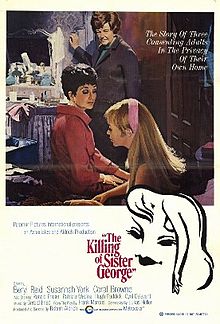
220px-Original_movie_poster_for_the_film_The_Killing_of_Sister_George

Reviewed March 13, 2015

Grade: A-

The Killing of Sister George is a British film drama, adapted from a 1964 stage production that was a risky subject matter to tackle for the times- lesbianism- in the late 1960s.

Directed by Robert Aldrich, well known for Whatever Happened to Baby Jane, The Killing of Sister George is a similarly dark tale of loneliness, desperation, and an actress who falls from former grace and success into despair, confusion, and anguish.

It also has witty, crackling comedic moments that keep it from being a true downer.

Sister George is a successful, well-regarded actress on a popular soap opera named Applehurst. Her character is the wholesome presence in a town fraught with manipulation and drama. She is the show’s moral focal point.

In real life, however, George (interestingly called by her character’s name) is troubled.

She is bitter, angry, and an alcoholic, and she frequently berates and even abuses her partner, Childie, played by Susannah York.

A third central character is TV Producer Mercy Croft, who is powerful and confused about her sexuality.

When the soap opera powers-that-be decide to kill off the beloved Sister George, the real George’s life begins to spiral out of control.

As enjoyable a film as it is and certainly featuring the competent talents of Beryl Reid in the title role, I cannot help but ponder and fantasize how wonderful the casting of Bette Davis- reportedly considered for the role and inexplicably not cast- would have been.

Davis, famous for playing grizzled, mean, unsympathetic characters, would have knocked this role out of the park, and sadly, she didn’t get the chance.

At its core, the film is a sad character study of one woman’s pain and anguish at being discarded. Presumably unable to be hired anywhere else, her soap opera character is her life.

She loves Childie but is not entirely fulfilled by her, either, and the vibrant, polished Mercy threatens that relationship.

This is an interesting triangle as George does not always treat Childie well, but loves her all the same. Childie is a simple character, childlike, and needs a strong mate to counter-balance the way she is- someone to take care of her.

Without a job or prospects, this would be difficult for George. Does Childie love George, or does she want a meal ticket?

The film is understandably rated X for content, presumably for a very explicit sex scene between Mercy and Childie, and when a drunken George molests two nuns in the back seat of a London taxi cab.

These scenes are both cutting-edge and admirable in their risk-taking.

The scene set at the real-life London lesbian club (the Gateway Club) and featuring mostly real-life lesbians is excellent. It provides a real-life glimpse into the gay/lesbian world and lifestyle during the period.

A brave, groundbreaking, risk-taking film with bravura direction from Aldrich, The Killing of Sister George (1968) is a forgotten gem that film fans everywhere need to rediscover and an early journey into gay and lesbian cinema.

Golden Globe Nominations: Best Actress- Drama- Beryl Reid
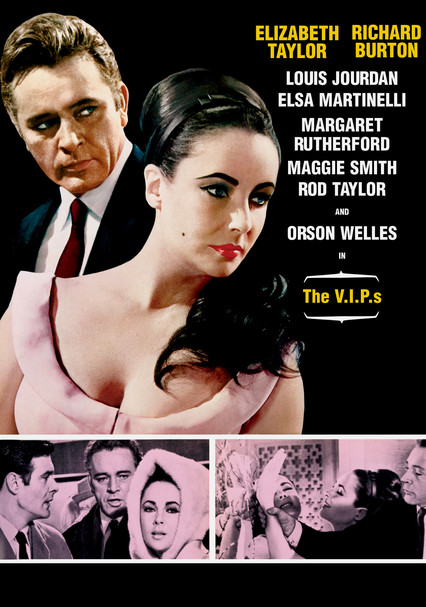
The V.I.P’s-1963

The V.I.P’s-1963

Director Anthony Asquith

Starring Elizabeth Taylor, Richard Burton

Scott’s Review #1,263

Reviewed June 4, 2022

Grade: B+

The V.I.P.’s (1963) is a sweeping drama set against a foggy London airport.

It’s a good film but hardly a masterpiece, as the trials and tribulations of the stranded passengers are explored and sometimes intersect in standard ways.

The film is formulaic and offers little surprise, but I enjoyed it and was entertained by the parade of stars shuffling through the vast airport.

Some stories are more interesting than others, and the film is in a soap-opera style with glamorous, rich characters.

One wonders if The V.I.P. influenced the creation of the film Airport (1970) seven years later. The film is patterned after 1932’s Grand Hotel, both of which were distributed by Metro-Goldwyn-Mayer.

Real-life couple and Hollywood A-listers Elizabeth Taylor and Richard Burton star and are the film’s main draws.

The all-star cast also features Louis Jourdan, Maggie Smith, Rod Taylor, Orson Welles, and the scene-stealing Margaret Rutherford.

Inclement weather has delayed a flight from London’s fabulous Heathrow Airport to New York City. A cross-section of elite passengers (V.I.P.s) impatiently wait to board the plane as they experience various life crises in the airport.

The main storyline revolves around Frances (Taylor), a gorgeous woman fleeing a loveless marriage to her millionaire husband, Paul (Richard Burton), and in love with the dashing Marc Champselle (Jourdan).

Supporting stories feature a dotty duchess (Rutherford) who has fallen on hard times and a handsome businessman (Rod Taylor) trying to thwart a hostile takeover.

At the same time, his secretary (Smith) lusts after him, and Gloria (Elsa Martinelli), an aspiring actress, and her money-grubbing producer, Max (Welles).

Despite the heavy-sounding plots, the film is not overly severe and provides comical moments in small doses, which secures the pacing and offsets too much doom and gloom.

Liz and Richard have big, soapy moments, and writer Terence Rattigan was reportedly inspired to write the screenplay by a real-life situation.

Actress Vivien Leigh was planning to leave her husband Laurence Olivier for another man but was delayed at Heathrow Airport.

How scandalous!

Nonetheless, Taylor stoically gives an acceptable performance as a conflicted actress in love with a man other than her husband.

The setup plays out as tired as it sounds, except for the juicy reality that Taylor and Burton were married, providing the only interest.

Taylor and Burton have terrific chemistry, though she also does with Jourdan. Still, there is something uncompelling and unsatisfying about the story.

Shockingly, they are all upstaged by Rutherford, who steals the entire film, resulting in her surprising Best Supporting Actress victory.

She may have won because of the Academy’s tendency to sometimes award an older actor with the prize for a lifetime body of work.

Her riveting story is my favorite as she desperately seeks a way to save her historic home.

The actress hits a home run, providing much-needed comic relief and the liveliest of performances. Her peril offsets her cleverness, and her performance is filled with heart.

Many critics hastily insisted that Rutherford was the only reason to see The V.I.P.s. Personally, the combination of an airport, peril, and big stars was more than enough to have me hooked.

The only addition that might have made the film better was an enormous fire or a hijacking crisis.

The V.I.P.’s (1963) will only appeal to fans of Taylor and Burton or those seeking something sudsy. Otherwise, the film is not too well remembered.

Oscar Nominations: 1 win-Best Supporting Actress-Margaret Rutherford (won)

Golden Globe Nominations: 1 win-Best Performance by an Actress in a Supporting Role in any Motion Picture-Margaret Rutherford (won), New Star of the Year-Actress-Maggie Smith