Soylent Green-1973
Director Richard Fleischer
Starring Charlton Heston
Scott’s Review #943
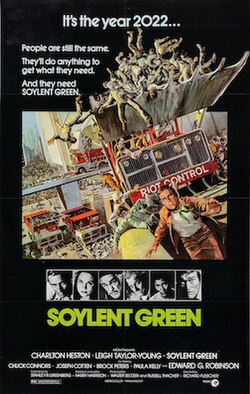
Reviewed October 8, 2019
Grade: B
Soylent Green (1973) is a rather obscure offering starring the big-name star Charlton Heston in a dystopian science-fiction film.
The story is futuristic and eerily reminiscent of Planet of the Apes (1968), though not nearly as compelling or as layered.
The result is admirable for its progressive message, cool colors, and sets, but it feels dated and of its time and treats female characters more like props than characters, leaving an uneven result.
It’s a one-and-done sort of film.
The year is 2022, and because of the Industrial Revolution, 40 million people live in New York City, suffering year-round from extreme humidity due to the greenhouse effect and from shortages of water, food, and housing.
Only the wealthy are afforded necessities, and residents of the rich (mostly female) are referred to as “furniture” and enslaved.
Detective Frank Thorn (Heston) is tasked with investigating the murder of an affluent and prominent man, which leads him to dire details surrounding Soylent Industries and the food they produce.
The film feels like a visionary idea that became a Hollywood movie.
Loosely based on a 1966 novel entitled “Make Room! Make Room!” by Harry Harrison, Heston is cast as the lead while his career was slowly declining, but he is still the star and quite hunky for an older gentleman.
He plays a role similar to George Taylor in Planet of the Apes, especially during the final climactic reveal, which will make viewers question what is in their dinner.
Heston carries the film well and mixes wonderfully with character actor Edward G. Robinson, who plays Sol Roth in his final role. The old character decides to “return to the home of God” and seeks assisted suicide at a government clinic.
The final scene between the actors is poignant and heartfelt as they say goodbye. Eagle-eyed viewers will spot a young Dick Van Patten in a tiny role during this scene.
Any romantic chemistry is lacking in Soylent Green as a potential love match between Frank and Shirl (Leigh Taylor-Young) strikes out. Mismatched and with little thunder together, the couple does not look good.
Worse, Shirl is mere “furniture,” limiting the character’s potential. She is reduced to assisting with Frank’s investigation.
The main detraction is that the film does not feel very futuristic or authentic. The characters look like 1970s actors dressed up to look futuristic, with a clear Hollywood tint.
The story loses its way halfway through and teeters between pure science fiction and a standard detective story you saw nightly on network television at the time.
Still, the film has a lot of potential but doesn’t reach it. The progressive slant and social commentary are admirable, and the bright green, nutritious, synthetic canned food is almost a character in its own right.
The final scene shocks the viewer with horror, and I wish more jaw-dropping moments existed throughout the experience, not just at the end.
A film that attempts to do something different or provide a provocative message is worthy of a certain amount of praise.
Soylent Green (1973) offers a bit of thought-provoking provocation but seems more relevant to the 1970s than to many decades later.
Heston is dazzling as the main character, and the trimmings are impressive, but Invasion of the Body Snatchers (1956) or The Day the Earth Stood Still (1951) resonate more as similar genre films.