Amarcord-1974
Director Federico Fellini
Starring Bruno Zanin
Top 250 Films #78
Scott’s Review #357
Reviewed January 9, 2016
Grade: A
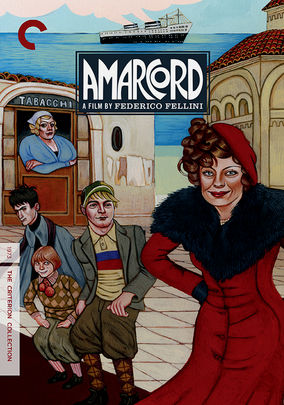
Federico Fellini’s Amarcord, winner of the Best Foreign Language Oscar and Golden Globe in 1974, is a semi-autobiographical film based on the director’s own childhood.
Set in the small Italian village of Borgo San Giuliano, the film features a diverse array of quirky, eccentric characters.
The plot centers around young Titta (Bruno Zanin) and his coming-of-age development as he blossoms into a young man; his sexual desires and fantasies are heavily explored in this zany film.
Set in the 1930s, when Fascism, led by the tyrannical Mussolini, was rearing its ugly head, Amarcord isn’t all light-hearted fun and games; despite its surface appearance, the film carries a serious undertone.
Still, the film lacks any story that can be dissected very well, which both pleases and frustrates- the film is to be “experienced”. It can leave you spinning, scratching your head, or disliking the film.
That is not to say that I take issue with or take offense at Amarcord. I adore the film, but it is not an easy watch. Scenes meander about in a dream-like fashion as we follow Titta through his sexual blossoming.
In one memorable scene, Titta has a titillating experience with a buxom older female who lives in the village.
Some of the other characters we meet are giddy with peculiarities: a blind accordion player and a female nymphomaniac, to name but a couple.
Titta and his family are featured prominently as they eat, fight, and live together. One day, when the family treks to visit their Uncle Teo, who is confined to an insane asylum, they take him out for a day in the country, where he climbs a tree and refuses to come down.
A dwarf nun and two orderlies finally arrive and coax him down- he obediently returns to the asylum. It is a bizarre sequence, but one that sums up Amarcord perfectly.
Amarcord contains one wacky scene after another, but many of them are not just there to showcase outlandish behavior, nor are they fluff.
Fellini has a distinct message in the film, and several scenes mock Christianity or Mussolini’s crazy political ideas.
The film is larger than life but also laced with the fear of 1930s Fascism and the fear Italians felt during this time.
The film is also sweet, and Fellini successfully adds a nostalgic feel to it- everyone feels cozy in a large, sprawling town with unique characters, shenanigans, and a celebratory theme, but seriousness lurks beneath.
Amarcord (1974) is a zest for life throughout a tumultuous time, and Fellini successfully creates a hybrid of the two, resulting in one fantastic film.
Oscar Nominations: 1 win-Best Foreign Language Film (won), Best Director-Federico Fellini
Golden Globe Nominations: Best Foreign Film