Tag Archives: Leland Orser

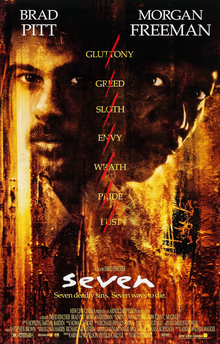
Seven-1995

Seven-1995

Director David Fincher

Starring Brad Pitt, Morgan Freeman

Top 250 Films #230

Scott’s Review #780
Reviewed June 29, 2018

Grade: A-

Many films containing a similar theme as Seven (1995) have come along over the years- some good, most mediocre.

The mixture of homicidal detectives tracking crazed killers has been done ad nauseam and more often than not, done with either poor writing or a predictable outcome, or both.

Instead of being a run-of-the-mill film, Seven serves as a blueprint for the tautness and unpredictability achievable with a familiar yet compelling concept, provided there is good writing and direction.

The film is incredibly brutal and riveting.

Respected director David Fincher assembles an all-star cast of Hollywood heavies, including Brad Pitt, Morgan Freeman, Kevin Spacey, and Gwyneth Paltrow, all of whom lend their talents to the well-crafted script.

It also raises the talent level to a respectable level, and, as great as the story is, with weaker actors, the stakes would not have been as high, and the film might even have been ruined.

A serial killer is on the loose in Los Angeles- detective duo William Somerset (a very good Freeman) is set to retire and is tasked with finding the killer. He is partnered with David Mills (Pitt), a young, hot-tempered man who has just moved to the city with his wife, Tracy (Paltrow).

Unbeknownst to David, Tracy is pregnant and unsure whether to keep the child- this point factors in heavily as events unfold.

The killer is using the seven deadly sins: greed, gluttony, sloth, lust, pride, envy, and wrath, as his motivation for the creative slayings.

In retrospect, Seven is very similar to the still-to-come Fincher work, 2007’s Zodiac, so much so that both films could be watched in sequence- one being a true story, the other pure fiction.

Both focus on the serial-killer element with a message; each has marvelous psychological intrigue and purpose. There are cat-and-mouse scenes aplenty for fans to enjoy.

At the risk of this point being a total stretch, I’d also argue that 1971’s Dirty Harry influenced Zodiac, Seven, and The Silence of the Lambs (1991).

A heinous killer shrouded in intelligence, danger, and motivation is a commonality of all of the aforementioned films, and numerous studies of each of the killers could be dissected if time permits.

Each killer is calculating and manipulative.

On that note, Kevin Spacey gives a tremendous performance as the cold and villainous John Doe. Clever and inventive, his victims are intended to suffer and suffer greatly.

Some of the kills could be included in the best of the torture-horror franchise, Saw (2004), as they are very twisted and brutal.

A supermodel is disfigured after being given a choice to call for help or overdose on pills, representing pride. A man is forced to consume food until his stomach ruptures, representing gluttony.

Spacey portrays his role as calm, cool, and collected, eliciting a terrifying response from audiences, especially as he toys with the detectives.

Still coming into his own as an actor in 1995, Pitt proves he can almost measure up (though not quite) with big-boy acting talents Spacey and Freeman.

Playing an ambitious man eager to prove himself in “the big city” with his pretty wife in tow, Pitt’s David is wholesome and family-oriented, yet has an edge.

All around the likable hero, Pitt is perfectly cast in the role and a large part of the film’s success.

The frightening final sequence still resonates with me after all of these years since Seven was released. In a classic standoff between Doe and the detectives, as is typical in these films, the climax is twisted, psychological, and gruesome.

I did not see this shocker coming, as it culminates in lives being forever changed. The expressions and actions of Freeman, Pitt, and Spacey are superlative.

Seven (1995) is a film basking in riches. On par with the best of the best in serial killer films, it is powerfully directed by Fincher. The film is fraught with grisly symbolism and its share of suspenseful sequences.

With powerful performances, it is a film that remains relevant and watchable decades after its original release.

Perhaps not quite on the level as Dirty Harry or The Silence of the Lambs, but pretty damned close, and that is impressive in itself.

Oscar Nominations: Best Film Editing
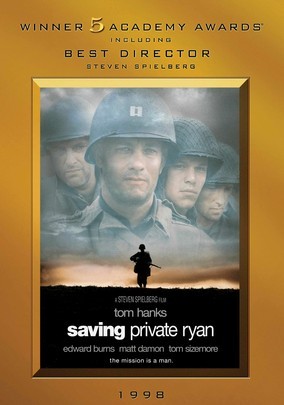
Saving Private Ryan-1998

Saving Private Ryan-1998

Director Steven Spielberg

Starring Tom Hanks

Scott’s Review #778

Reviewed June 26, 2018

Grade: A

Famed director Steven Spielberg does not always get the respect he deserves. This is usually because, for better or worse, he has become synonymous with the “blockbuster” film, drawing comparisons to either lightweight fare or films of “lesser” artistic merit.

His 1980’s works- Raiders of the Lost Ark (1981), E.T. the Extra-Terrestrial (1982), and Indiana Jones and the Temple of Doom (1984)- were enormous commercial successes, though I enjoyed all of the films.

During the 1990s, Spielberg continued to direct “popcorn flicks” such as Hook (1991) and Jurassic Park (1993) with large studio budgets but somewhat less critical acclaim.

Finally, he was able to change many opinions with 1993’s Schindler’s List and the war film to end all war films, Saving Private Ryan (1998), an epic, profound experience.

Both received numerous Oscar nominations and achieved box-office success.

The film is a tremendous treat, thanks to the riveting opening sequence alone (more on that later).

If that is not enough to impress, Saving Private Ryan is known for infusing a very graphic element into the war film, with no let-up from the brutality. Spielberg does not water down this picture; instead shows the pain and angst of war.

The film is helped tremendously by the casting of Hollywood superstar Tom Hanks, who leads an enormous cast of mainly young men.

Saving Private Ryan opens with a prologue: in the present, a veteran brings his family to visit an American cemetery in Normandy.

Flashbacks then take the audience back to the Omaha Beach debacle in 1944, where American troops faced deadly German artillery attacks in France.

After the horrific three-day D-Day, it is learned that three of the four Ryan sons have died in the events. Captain Miller (Hanks) is ordered to bring a team of men to Normandy and bring the fourth Ryan son (Matt Damon) to safety.

Spielberg’s opening D-Day sequence is just astounding and propels the film to unforgettable status. With a running time of twenty-four minutes, the riveting and horrific slaughter of American soldiers is intensely brought to the screen.

Audiences undoubtedly sat open-mouthed (I know I did!) as bullets riddled the beach and left soldiers killed or with limbs torn off. The camera work is brilliant, as the use of a shaky technique, almost a documentary style, is used for effect.

This sequence successfully promotes anti-war sentiment without glorifying combat at all. The scene will stay with its audience for years to come.

Saving Private Ryan can be compared to the decades-later Dunkirk (2017) in that each film took the war genre and turned it on its head.

The similarities between the films start with the obvious: the main events in both films occur during World War II, in the same week, and in the French beach settings, making the films perfect companion pieces.

Both films feature a gray, rainy setting with many horrific moments of death and suffering. The war film is a common genre that has historically teetered on the brink of predictability and oversaturation. Still, both films do something completely different and unexpected, yet mirror each other in style.

To counter-balance the violence in the opening sequence, a quiet scene is created and remains one of my favorites. The scene contains almost no dialogue throughout the seven-minute duration and is pivotal to the entire film.

As a typist realizes that three letters of death are to be delivered to the same family, a woman on a mid-west farm quietly washes dishes and is calmly horrified when she sees a government car approaching.

What else can this mean but that one of her sons is dead? The poor Mrs. Ryan will be told that she has lost not one, but three sons.

How utterly unimaginable, and the scene is incredibly touching!

The best part of Saving Private Ryan is that Spielberg combines a deeply sentimental vision with the terrible atrocities of war. He portrays not only the violent effects of the battles on the soldiers but also on the surviving families.

This is not always done in war films, at least not to the level that Spielberg chooses to.

With a film as startling as Saving Private Ryan, Spielberg turned the war film genre inside out. Breaking barriers with a no-holds-barred gusto, Spielberg influenced war films for years to come- Black Hawk Down and Enemy at the Gates (2001) are prime examples, and received acclaim from fellow directors for his interesting techniques.

Saving Private Ryan (1998) was an enormous financial winner at the box office, proving that great films don’t have to be watered down to find an audience.

Oscar Nominations: 5 wins-Best Picture, Best Director-Steven Spielberg (won), Best Actor-Tom Hanks, Best Screenplay Written Directly for the Screen, Best Original Dramatic Score, Best Sound Effects Editing (won), Best Sound (won), Best Art Direction, Best Cinematography (won), Best Makeup, Best Film Editing (won)

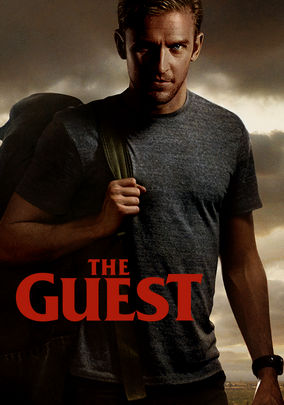
The Guest-2014

The Guest-2014

Director Adam Wingard

Starring Dan Stevens, Maika Monroe

Scott’s Review #220

70300664

Reviewed February 7, 2015

Grade: C-

The Guest is a 2014 thriller that can perhaps be classified under the adage “it’s so bad that it’s good,” though as I pondered writing this review, that might be a bit of a stretch.

As poor as the film is, I still enjoyed something about it.

The premise is simple. A Midwestern family, the Petersons, is suddenly visited by a veteran soldier named David, who claims to be a friend of the parents’ deceased son, Caleb.

David easily insinuates himself into their lives, and the Petersons invite him to stay a few days to rehash details about Caleb.

The family is middle-class yet struggling financially, and it consists of a mother and father, a college-aged daughter named Anna, an actress eerily resembling a young Gwen Stefani, and a bullied, timid, high school-aged son named Luke.

From the get-go, something feels off about David, but his motives remain unclear to the audience.

The film has plenty of issues.

For starters, the acting is rather poor. The most notable actors are Dan Stevens (Downton Abbey), Sheila Kelley (L.A. Law), and a collection of unknowns.

Stevens and Kelley give better performances, and I found Stevens particularly believable in a role opposite his Downton Abbey alter ego.

The rest of the cast is wooden and uncompelling.

The weakest parts of The Guest are the inane plot points and the 1980s-style soundtrack. Were the filmmakers going for a retro throwback? The film is set in present times, so this aspect remains a mystery.

The story starts interestingly. Is it a Fatal Attraction (1987) type of film? What is David’s motive? What was his relationship with the deceased Caleb? Does he intend to help or harm the family?

The reveal towards the end of the film is implausible, ridiculous, and disappointing. Without giving too much away, the government plays a major role in the film, but it does little to provoke sympathy for any of the characters, only eliciting more confusion.

The attempted (and botched) love story between David and Anna does not work. They have little chemistry, and the rooting value is not there, especially as he picks up her drunken best friend at a party.

Is the audience supposed to root for David and Anna, or is it merely a weak sub-plot to the thrill aspect of the film? I suspect the latter.

Despite all these negatives, I didn’t despise the film as it trucked along; rather, I found it more of a mess than anything else.

It is not a good film, but there is something slightly appealing about it. Some of the death scenes are well done, and the budding friendship between David and the bullied son is rather sweet.

The son is enamored with the strong, masculine David, and David, in turn, serves as a protector, humiliating the bullies who gave the kid a black eye.

The film doesn’t delve into a sexual angle, but it is a bond that is cheerful to see. It has a nice, warm element.

Another impressive point of The Guest is that it ends with a surprise that leaves room for a sequel. However, because the film didn’t achieve success, I doubt a sequel will ever see the light of day.

A poorly written, weakly acted film, The Guest (2014) has moments of interest but fails miserably as a viewing experience.

By the end, I still had no idea what the main character was motivated by, which is a huge problem.

Confusing and convoluted are the adjectives best to describe this film.

Independent Spirit Award Nominations: Best Editing