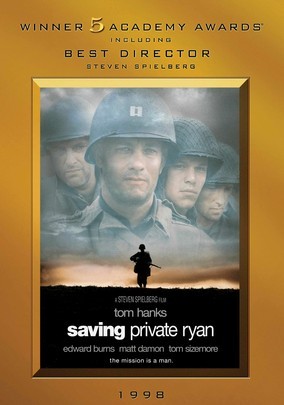
Saving Private Ryan-1998
Director Steven Spielberg
Starring Tom Hanks
Scott’s Review #778
Reviewed June 26, 2018
Grade: A
Famed director Steven Spielberg does not always get the respect he deserves. This is usually because, for better or worse, he has become synonymous with the “blockbuster” film, drawing comparisons to either lightweight fare or films of “lesser” artistic merit.
His 1980’s works- Raiders of the Lost Ark (1981), E.T. the Extra-Terrestrial (1982), and Indiana Jones and the Temple of Doom (1984)- were enormous commercial successes, though I enjoyed all of the films.
During the 1990s, Spielberg continued to direct “popcorn flicks” such as Hook (1991) and Jurassic Park (1993) with large studio budgets but somewhat less critical acclaim.
Finally, he was able to change many opinions with 1993’s Schindler’s List and the war film to end all war films, Saving Private Ryan (1998), an epic, profound experience.
Both received numerous Oscar nominations and achieved box-office success.
The film is a tremendous treat, thanks to the riveting opening sequence alone (more on that later).
If that is not enough to impress, Saving Private Ryan is known for infusing a very graphic element into the war film, with no let-up from the brutality. Spielberg does not water down this picture; instead shows the pain and angst of war.
The film is helped tremendously by the casting of Hollywood superstar Tom Hanks, who leads an enormous cast of mainly young men.
Saving Private Ryan opens with a prologue: in the present, a veteran brings his family to visit an American cemetery in Normandy.
Flashbacks then take the audience back to the Omaha Beach debacle in 1944, where American troops faced deadly German artillery attacks in France.
After the horrific three-day D-Day, it is learned that three of the four Ryan sons have died in the events. Captain Miller (Hanks) is ordered to bring a team of men to Normandy and bring the fourth Ryan son (Matt Damon) to safety.
Spielberg’s opening D-Day sequence is just astounding and propels the film to unforgettable status. With a running time of twenty-four minutes, the riveting and horrific slaughter of American soldiers is intensely brought to the screen.
Audiences undoubtedly sat open-mouthed (I know I did!) as bullets riddled the beach and left soldiers killed or with limbs torn off. The camera work is brilliant, as the use of a shaky technique, almost a documentary style, is used for effect.
This sequence successfully promotes anti-war sentiment without glorifying combat at all. The scene will stay with its audience for years to come.
Saving Private Ryan can be compared to the decades-later Dunkirk (2017) in that each film took the war genre and turned it on its head.
The similarities between the films start with the obvious: the main events in both films occur during World War II, in the same week, and in the French beach settings, making the films perfect companion pieces.
Both films feature a gray, rainy setting with many horrific moments of death and suffering. The war film is a common genre that has historically teetered on the brink of predictability and oversaturation. Still, both films do something completely different and unexpected, yet mirror each other in style.
To counter-balance the violence in the opening sequence, a quiet scene is created and remains one of my favorites. The scene contains almost no dialogue throughout the seven-minute duration and is pivotal to the entire film.
As a typist realizes that three letters of death are to be delivered to the same family, a woman on a mid-west farm quietly washes dishes and is calmly horrified when she sees a government car approaching.
What else can this mean but that one of her sons is dead? The poor Mrs. Ryan will be told that she has lost not one, but three sons.
How utterly unimaginable, and the scene is incredibly touching!
The best part of Saving Private Ryan is that Spielberg combines a deeply sentimental vision with the terrible atrocities of war. He portrays not only the violent effects of the battles on the soldiers but also on the surviving families.
This is not always done in war films, at least not to the level that Spielberg chooses to.
With a film as startling as Saving Private Ryan, Spielberg turned the war film genre inside out. Breaking barriers with a no-holds-barred gusto, Spielberg influenced war films for years to come- Black Hawk Down and Enemy at the Gates (2001) are prime examples, and received acclaim from fellow directors for his interesting techniques.
Saving Private Ryan (1998) was an enormous financial winner at the box office, proving that great films don’t have to be watered down to find an audience.
Oscar Nominations: 5 wins-Best Picture, Best Director-Steven Spielberg (won), Best Actor-Tom Hanks, Best Screenplay Written Directly for the Screen, Best Original Dramatic Score, Best Sound Effects Editing (won), Best Sound (won), Best Art Direction, Best Cinematography (won), Best Makeup, Best Film Editing (won)