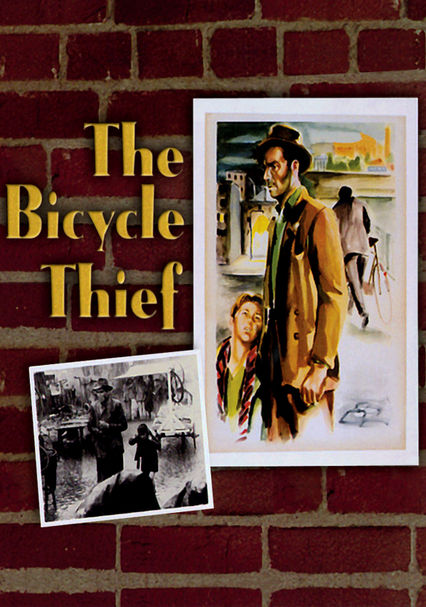
The Bicycle Thief-1948
Director Vittorio De Sica
Starring Lamberto Maggiorani, Enzo Staiola
Scott’s Review #867
Reviewed February 16, 2019
Grade: A
The Bicycle Thief (1948), whose English title is a translation of the original Italian Bicycle Thieves (Ladri di biciclette), is an essential and cherished film that delivers a powerful message through a compelling story.
The emotional film focuses on a robust relationship between a father and his son and their determination to retrieve what is rightfully theirs.
Made after World War II, it has a socialist theme and a hallmark neorealist style centered around working-class people.
The film is an example of cinema as art, not merely entertainment.
The film deservedly was awarded a special Academy Award for “Most Outstanding Foreign Language Film” before the historic Best Foreign Language Film award existed.
This is a testament to the power and humanism that the film envelops as the sad and occasionally incredible story unfolds. Professional actors and non-actors make the film a strong and authentic watch in a quick one-hour and twenty-nine-minute running time.
In the late 1940s, Rome Antonio Ricci (Lamberto Maggiorani) struggles to find decent work to support himself and his family.
When an opportunity presents itself but requires a bicycle, Antonio’s wife, Maria (Lianella Carell), selflessly sells family heirlooms to acquire his pawned bicycle.
Things look great for the family as Antonio begins his new job. On his first day, a thief steals his bicycle. Antonio sits atop a ladder, helplessly witnessing the theft.
Determined to track the thief down and retrieve his stolen bike, he and his son Bruno (Enzo Staiola) traverse the city in desperation.
The Bicycle Thief is a simple story that enraptures readers with a range of emotions: anger at the thief, empathy for Antonio and Bruno, inspiration from the humanity of some characters, and rage at the actions of others.
Antonio strives to be a good role model for his son and a provider for Maria. By the end, he has become a more complex character, resorting to drastic measures to solve his problems.
Antonio is desperate, guilt-ridden, and ashamed, yet also a highly inspirational character.
Fans of the gorgeous and historic European city of Rome are in for a treat. The Bicycle Thief is peppered with enchanting shots of the famous town and focuses on the events of everyday people as they go to work and spend their days on a mission.
Director Vittorio de Sica’s bright, sunny lighting portrays Rome as a hot, bustling epicenter. The atmosphere is foreboding, as we know something dire will soon occur amid the warm and cheery metropolis.
The acting is central to The Bicycle Thief’s success, with inspired performances by Maggiorani and Staiola as father and son.
Staiola is masterful as a young boy who needs a father figure and hangs on his father’s every move.
In many scenes, his soulful, expressive eyes hold both sadness and hope as he yearns and prays for his father to be happy again and for himself to feel safe.
In comparison, Maggiorani possesses an ability to portray strength and angst interchangeably. His finest scene is pivotal as he realizes he has become no better than the thief he despises early in the film and is buried in shame.
The Bicycle Thief (1948) is a powerful and memorable film because of its simplicity and humanistic sensibilities. The plot is basic and explores one man’s quest for justice and the right to live his life and care for his family.
His journey is complex and fraught with tense moments, making the film palpable and heart-racing as his adventure unfolds before us.
Thanks to gorgeous cinematography and a dose of pathos, those who watch this film will be in store for a treasure of powerful cinematic storytelling.
Oscar Nominations: Best Screenplay
Golden Globe Nominations: 1 win-Best Motion Picture-Non-English Language (won)