Tag Archives: John Dall

Rope-1948

Rope-1948

Director Alfred Hitchcock

Starring Farley Granger, John Dall, James Stewart

Top 250 Films #26

Scott’s Review #323

60020558

Reviewed January 5, 2016

Grade: A

Rope (1948) is one of my favorite Alfred Hitchcock films and a film that flies under the radar amongst his catalog of gems. Made in 1948, the movie, set as a play (and based on a 1929 play), uses one set only and appears to be one long take, making it an understated film.

The action takes place inside a luxurious Manhattan apartment with a stunning panoramic skyline. Intelligent with subtle nuances that in current viewings are not as subtle, the tiny (nine) cast is fantastic at eliciting a fine story that never seems dated.

Starring Hitchcock stalwart Jimmy Stewart, the film features Farley Granger (Strangers On A Train, 1951) and John Dall.

Granger and Dall portray Phillip and Brandon, two college students who strangle a fellow student as an experiment to create the perfect murder. Immediately after the murder, they host a dinner party for friends, including the father, aunt, and fiancée of the victim, all in attendance.

Stewart plays Brandon and Phillip’s prep school housemaster,  Rupert Cadell, who is suspicious of the duo.

To further the thrill, the dead body is hidden inside a large antique wooden chest in the center of their living room, as their housekeeper unwittingly serves dinner atop the dead body.

The film is macabre, clever, and quite experimental.

The very first scene is of Phillip strangling the victim, David, with a piece of kitchen rope, which is an unusual way to start a film. Typically, there would be more buildup and then the climax of the murder, but Hitchcock is far too intelligent to follow the rulebook.

Ironically, Phillip is the weak and submissive one, despite having committed the crime. Brandon is dominant and keeps Phillip in check by coaxing him to be calm and in control.

The fact that many of the guests have a relationship with the deceased, munching on their dinner while wondering why David is not attending the party, is gleeful irony. Plenty of drinks are served, and as Phillip gets drunker and drunker, he becomes more unhinged.

The film reminds me of some aspects of Who’s Afraid of Virginia Woolf, also based on a play and primarily featuring one set – both dinner parties with alcoholic consumption, secrets, and accusations becoming more prevalent as the evening progresses.

The plot unfolds chillingly throughout one evening as Rupert slowly figures out that what he had previously taught Brandon and Phillip in an intellectual, hypothetical classroom discussion has been taken morbidly seriously by the two.

The homosexual context is hard to miss in this day and age, but remarkably, it was over the heads of the 1948 Production Code censors, who had no idea of what they were witnessing.

Phillip and Brandon are a gay couple who live together, and Hitchcock has admitted to this in later years. If watched closely, one will notice that in any shot where Brandon and Phillip are speaking to one another, their faces are dangerously close, so we can easily imagine them kissing.

This is purely intentional by Hitchcock.

Rope (1948) is a daring achievement in innovative filmmaking. It should be viewed by any aspiring filmmaker or anyone who enjoys robust and clever camera angles and stories, seeking an extraordinary adventure in a calm, subtle, and engaging narrative.
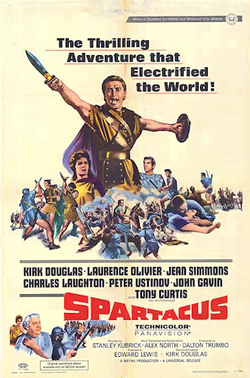
Spartacus-1960

Spartacus-1960

Director Stanley Kubrick

Starring Kirk Douglas

Top 250 Films #247

Scott’s Review #1,250

Reviewed April 30, 2022

Grade: A

Typically, when influential director Stanley Kubrick’s name is uttered, films such as The Shining (1980), 2001: A Space Odyssey (1968), and Barry Lyndon (1975) are immediately thought of, and for obvious reasons.

The haunting, moody musical score, the long camera shots, the dark humor, and the clever camera tricks are easy to pinpoint.

1960, the director was hired to direct the gorgeous epic Spartacus after Hollywood star Kirk Russell unceremoniously fired the first director.

None of the previously mentioned elements are easy for me to notice and are more or less absent, but a grand battle scene in a luscious green field is very reminiscent of Barry Lyndon.

This is likely because Spartacus was not Kubrick’s film entirely; instead, it belonged to others with more clout.

Spartacus is a brilliant film for many reasons. Some epics suffer from a hokey, cliched feel and can be overwrought, predictable, and tired.

The rebellious Thracian Spartacus (Russell), born and raised an enslaved person, is sold to Gladiator trainer Batiatus (Ustinov). After training to kill for the arena, Spartacus turns on his owners and leads the other enslaved people in rebellion.

As the rebels move from town to town, their numbers increase as escaped slaves join their ranks. Under the leadership of Spartacus, they make their way to southern Italy, where they intend to cross the sea and return to their homes.

Spartacus is grand, sweeping, cinematically significant, and everything else you’d expect from a 1960s Hollywood epic with enormous stars of its day.

Looking beneath the surface, the film is riddled with interesting tidbits like bisexuality, homoeroticism, and violence, more in tune with an art film or modern war film than the safety of a movie made during this time.

Particularly noteworthy is that Dalton Trumbo wrote the screenplay. One of the Hollywood Ten, he refused to testify before the House Un-American Activities Committee in 1947 during the committee’s investigation of alleged Communist influences in the motion picture industry.

After the release of Spartacus, it marked the beginning of the end of the Hollywood Blacklist for Trumbo and other affected screenwriters.

Thank goodness.

In a famous scene, recaptured enslaved people are asked to identify Spartacus in exchange for leniency; instead, each enslaved person proclaims himself to be Spartacus, thus sharing his fate.

The suggestion is that this scene was meant to dramatize the solidarity of those accused of being Communist sympathizers during the McCarthy era.

Besides the political importance, Spartacus showcases a beautiful romance between Spartacus (Russell) and Varinia (Jean Simmons), a gorgeous slave girl.

The tenderness and authenticity are palpable as many of their early scenes involve no dialogue but only longing and expression through both actors’ eyes.

I celebrated the connection between the actors at the forefront of much romance. Russell carries the film with calm masculinity, quickly making him heroic and likable.

He is the charismatic, good guy who has been wronged and ill-fated.

A sequence oozing with machismo and homoeroticism occurs when evil Crassus (Olivier) is bathed by his slave boy Antoninus (Tony Curtis).

He seductively explains that while sometimes he prefers snails, he also likes oysters. The implication is that he is bisexual, brazenly so, and expects the youngster to become his sex slave.

The warmth of the bathtub and the luxurious atmosphere contrast with the proximity and touch of both male characters.

In 1960, this scene was way ahead of its time.

The conclusion of Spartacus is melancholy and surprising. Having bested Rome’s cruelty, one might have expected to see Spartacus and Varinia happily ride off into the sunset.

This doesn’t happen, and the film is richer for it. There is pain and despair as there was in real life. Wisely sparing complete doom and gloom, the ending is satisfying as one central character escapes a deadly demise and moves ahead.

Spartacus (1960) is one of the greats. It has muscle and texture, and many below-the-surface nuances are ripe for discussion. For these reasons, it’s a must-see.

Oscar Nominations: 4 wins-Best Supporting Actor-Peter Ustinov (won), Best Art Direction-Color (won), Best Cinematography-Color (won), Best Costume Design-Color (won), Best Film Editing, Best Music Score of a Dramatic or Comedy Picture

Golden Globe Nominations: 1 win-Best Motion Picture-Drama (won), Best Director-Motion Picture-Stanley Kubrick, Best Performance by an Actor in a Motion Picture-Drama-Laurence Olivier, Best Performance by an Actor in a Supporting Role in any Motion Picture-Peter Ustinov, Woody Strode, Best Original Score-Motion Picture