Tag Archives: Kathleen Freeman

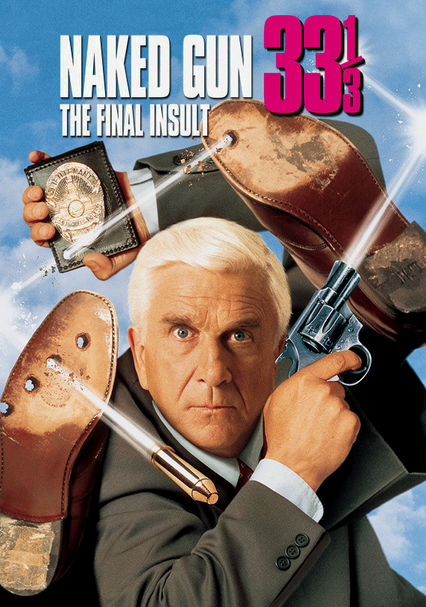
Naked Gun 33 1/3: The Final Insult-1994

Naked Gun 33 1/3: The Final Insult-1994

Director Peter Segal

Starring Leslie Nielsen

Scott’s Review #1,104

Reviewed January 26, 2021

Grade: B-

Despite being the third and final installment in the popular Naked Gun (1988-1994) franchise, Naked Gun 33 1/3: The Final Insult (1994) is my favorite of the trio, despite having a silly title.

The title of “33 1/3” is a reference to the resolutions per minute of an LP playing on a phonograph, a point that has nothing to do with the actual film.

It was also inexplicably decided to omit the “The” from the title, leaving “Naked Gun” instead of “The Naked Gun.”

Why is anyone’s guess? Nor does it matter.

Don’t get me wrong. It’s not a great film, but it’s better than the other two, which is shocking in a spoof/screwball comedy going for the standard gags.

But, as dumb as the film is, it’s also kind of fun and lightweight.

It’s like a needed chuckle that requires little thought after a rough day at the office.

A familiar formula is followed, and this time the events culminate at the glorious Hollywood Oscar celebration, the apple in the eye of all Los Angeles, undoubtedly the main reason this effort is marginally enjoyable.

For unfamiliar viewers, the Naked Gun films are a combination of Airplane! (1980-1982) and the over-exhausted Police Academy (1984-1994) franchises.

The films were out of gas by 1994.

The franchise is based on the short-lived television series Police Squad! (1982), a procedural comedy about bumbling police personnel and the situations they get themselves into to showcase their ineptness.

The Naked Gun 33 1/3: The Final Insult was O.J. Simpson’s final role before he was damned for all eternity for his presumed role in the murder of his wife and her friend in a ritzy area of California.

Leslie Nielsen returns as Frank Drebin, retired and living with his wife Jane (Priscilla Presley).

Bored with life, they experience marital problems and seek counseling. Six months after Frank’s retirement, he is visited by Captain Ed Hocken (George Kennedy) and Officer Nordberg (Simpson), who ask for Frank’s help with an investigation.

Police Squad has caught wind that mischievous bomber Rocco Dillon (Fred Ward), who is currently incarcerated, has been hired by terrorists to conduct a major bombing against the United States.

As Frank tries to keep Jane from discovering that he is dabbling in detective work again, he jokes that he is having an affair to throw her off the scent.

When she begins to suspect he is having an affair, it leads to a silly series of misunderstandings and gags, which, as is always the case in films like this, are naturally wrapped up.

Nielsen is the main draw, and he does what he does best and what makes him the king of spoof films. A serious actor before Airplane!, he became a typecast but had lots of successes ahead of him.

He embraces his role, which adds freshness. He doesn’t take himself so seriously that audiences can sit back and relax and enjoy the entertainment.

The lavish awards ceremony and the ingenious idea of planting the bomb within the coveted Best Picture Oscar-sealed envelope are delicious, especially when the bomb is set to detonate when the card is pulled from the envelope, and the winner is crowned.

This creates a good sense of suspense as the award show moves toward the big finale.

George Kennedy has little to do, but it’s the inclusion of stars like Vanna White, Weird Al Yankovic, and Pia Zadora that add zest to the production.

Director Peter Segal, famous for lightweight comedies with heart, is wise to keep the running time at a quick one hour and twenty-two minutes. If longer, any momentum the film musters would have disintegrated.

This was his feature-length directorial debut.

The Naked Gun 33 1/3: The Final Insult (1994) may be the best of the trio, but that says little, given it’s based on funnier, fresher endeavors.

I champion the early Police Academy films for a needed dose of police incompetence and hilarity done up in a fun way. If one must watch a Naked Gun film and is partial to the Academy Awards, this one is begrudgingly suggested.

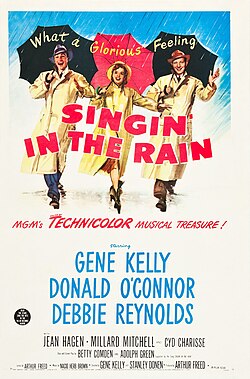
Singin’ in the Rain-1952

Singin’ in the Rain-1952

Director Stanley Donen, Gene Kelly

Starring Gene Kelly, Debbie Reynolds

Scott’s Review #874

Reviewed March 4, 2019

Grade: A-

Singin’ in the Rain (1952) is most closely associated with the entertainment industry in the oversaturated field of musicals released during the mid-twentieth century.

The battle between the transition of silent pictures to “talkies” is the basis of the story, giving the film an important, along with fun, subject matter.

Likable stars and sing-along tunes make the film memorable and decidedly All-American, though perhaps not the greatest in the crowded musical field.

During the late 1920s, Don Lockwood (Gene Kelly) was a famous and well-regarded silent film star. His co-star and studio-created romantic attachment is Lina Lamont (Jean Hagen), an annoying and shallow leading lady with a harsh singing voice.

As more successful “talkies” (films with sound) are produced, Don finds himself smitten with musical chorus girl Kathy Selden (Debbie Reynolds). The plot to dub Lina’s voice with Kathy’s leads to comical chaos and an idea to create a new musical amid a blossoming romance between Don and Kathy.

The fun and frolicking Singin’ in the Rain is lightweight but never silly nor superfluous, thanks to the overriding message of the change in Hollywood priorities.

Critically acclaimed from the get-go, this is unsurprising since Hollywood loves stories about Hollywood, especially since the film was made only slightly more than two decades since sound-laden films overtook the world.

Furthermore, in 1952, television was making its debut to legions of fans, and the accessibility presented a serious threat to the cinema, making the subject matter even more relevant.

Kelly and Reynolds make a nice enough pair, but I never thought they completely knocked it out of the park from a chemistry perspective.

One slight flaw is the lack of hurdles preventing the couple from an inevitable union. Lina is the transparent foil and ultimately played for laughs, so she is not a serious threat.

The plot-driven conflict involving Kathy’s initial dislike of Don because she values stage over film is cute, but ultimately revealed to be a sham since she has been a fan of his all along.

The musical is a comedy, but better hurdles might have made for a more interesting story.

Nonetheless, Singin’ in the Rain is a pleasure and a largely non-threatening experience. The hi-jinks involved as the characters strive and struggle to put on their production are comical, and Lina’s New York accent and shrill singing voice threaten to steal the show from the more grounded central characters.

The musical numbers are a dream, and I especially like favorites like “Make ‘Em Laugh,” “Good Morning,” and the epic title song.

Through no fault of the film’s title number, “Singin’ in the Rain” will forever not be associated with this film for me but rather with the dark and cerebral A Clockwork Orange (1971). As the villain beats and rapes his victim by cheerily singing this tune, the song will forever hold a much darker association for me.

The dramatic final act is the highlight as a lavish premiere of The Dancing Cavalier is unveiled to a live theater audience hungry for something good.

When the crowd chomps at the bit for Lina to perform live, the big reveal of Kathy being the truly talented singer is displayed as the wizard in The Wizard of Oz style as Don and Kathy kiss and ride off into the sunset together in a grand show biz fashion.

In the crowded genre of the 1950s and 1960s musical productions that ravaged American cinema at the time, I mainly chose to watch West Side Story (1961), Gypsy (1962), The Sound of Music (1965), and Oklahoma! (1955) for pleasure, but Singin’ in the Rain (1952), an earlier gem, is worthy of value, especially for the memorable musical soundtrack it offers.

The story is light but also relevant and, most importantly, highly entertaining.

Oscar Nominations: Best Supporting Actress-Jean Hagen, Best Scoring of a Musical Picture

The Seven Year Itch-1955

The Seven Year Itch-1955

Director Billy Wilder

Starring Marilyn Monroe, Tom Ewell

Scott’s Review #302

60004542

Reviewed December 18, 2015

Grade: B

Following a string of successful hits by director Billy Wilder (primarily famous for films in the 1940s and 1950s), The Seven Year Itch features Marilyn Monroe in her prime and at her finest.

It is a cute film made charming by the likable legend. While not high art, it is a fun experience in classic romantic comedy cinema, and its innocence is undoubtedly lost in today’s genre.

Playing a familiar character to what she was known for (sexy, flirty, sweet blondes), it is arguably Monroe’s best role (though Some Like it Hot still wins out for me as her best film role).

Richard Sherman, a successful New York publisher, finds himself alone for the summer when his wife and son leave for a vacation in the country. Middle-aged and bored, he immediately is enamored with his gorgeous new upstairs neighbor, known as The Girl, played by Marilyn Monroe.

The Girl is a commercial actress and former model and is quite friendly and bubbly. She is conveniently staying in New York City while filming a new television ad for toothpaste. Richard finds himself awkwardly tempted by the curvaceous Girl in one situation after another.

The Seven Year Itch is pure innocence and fantasy. The Girl has no designs on Richard, and his flirtation with her is harmless and juvenile. Richard is nerdy and socially awkward, not to mention fearful of his wife’s stern nature if she discovers that he is even spending a moment with The Girl.

Much of the film includes scenes where Richard imagines conversations with his wife or imagines her with another man, justifying his attraction for The Girl. These scenes are done hilariously as he imagines conversations with his wife, and his thoughts are exaggerated.

Humorous scenes transpire, such as the “champagne scene,” in which The Girl and Richard attempt to open a champagne bottle while cooling off with Richard’s new state-of-the-art air conditioner.  The Girl keeps her underpants in a freezer to cool off.

The Girl appearing in her toothpaste commercial, comically, is also a treat. And who can forget Marilyn Monroe’s famous scene in which she stands over a subway grate, clad in a sexy white dress and high heels, the wind from the subway blowing her dress in the air, is one of the most memorable in film history and priceless.

Some would argue that The Seven Year Itch (1955) is nothing but fluff, and they essentially are correct. Still, in an age of crude and obnoxious films disguised as romantic comedies, with cheesy jokes and canned humor, it is refreshing to look back to the 1950s culture, primarily an innocent era, and enjoy a fun film romp with one of cinema’s forever stars.

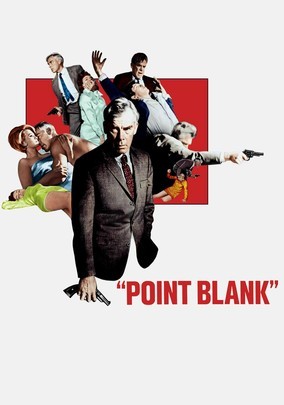
Point Blank-1967

Point Blank-1967

Director John Boorman

Starring Lee Marvin, Angie Dickinson

Scott’s Review #263

70033963

Reviewed August 8, 2015

Grade: B+

Directed by John Boorman, (later made famous for the masterpiece Deliverance in 1972), and based on the novel The Hunter, by Donald E. Westlake, Point Blank (1967) is a tense crime drama starring Lee Marvin as a man seeking revenge on those who have wronged him.

A criminal himself and involved in the mob world of deals and drugs, he is double-crossed by his partner, who takes off with his wife.

A relatively obscure film, Point Blank features obvious influences from the classics it preceded (The Getaway, 1972; Chinatown, 1974; The French Connection, 1971; and Dirty Harry, 1971) and contains some dynamic camera work and art direction.

In its day, it must have been quite a groundbreaking film.

The film begins muddled a confusing, catching the viewer off guard. We know nothing about any of the characters, who are suddenly introduced via flashbacks, interlaced with present and future scenes, so that chaos and tension fill the story immediately.

We know that someone has stabbed someone in the back, but we do not understand why or who the players are.

The film is set partly on deserted Alcatraz Island (the meeting point for a money drop, which we later learn), then moves to Los Angeles. Early on, we realize that Marvin’s character (Walker) has been tricked, shot, and left for dead by his partner Mal (John Vernon), who takes off with Walker’s share of cash…and his troubled wife Lynne.

Hell-bent on seeking revenge (and his money) on Mal and his wife (Lynne), he attempts to track the duo down using any means necessary, leading to the introduction of pivotal and mysterious characters such as Lynne’s sister Chris (played by Angie Dickinson), and Crime Organization leaders Carter and Brewster (played by Lloyd Bochner and Carroll O’Connor, respectively).

With little blood or overt violence, the film instead uses tense action scenes and a great style, and is told in a non-linear way.

One favorite scene involves Walker taking a new car for a test drive and interrogating the salesman for information. As he terrorizes the salesman, he repeatedly slams the vehicle into a pole using the car’s reverse and drive gears, increasing in intensity with each attempt by the salesman to avoid answering Walker’s questions.

Two other scenes that stand out and deserve mention are as follows: when a naked villain is nonchalantly tossed from a penthouse apartment to his death on the street, and subsequently becomes wedged under a passing car, the scene is as startling as it is well shot, especially considering the year was 1967.

In another scene, Lynne is at the beauty salon having her makeup and hair done by a stylist. Her face is captured in the mirror, and the camera shows a dozen or so images of the mirror layered on top of one another.

This looks great, inventive, and is a good example of some superlative camera shots that occur throughout the film.

A few interesting tidbits that I pondered following the film. Was the elevator scene containing Angie Dickinson (almost meaningless to Point Blank) the inspiration for the famous elevator scene from the 1980s Dressed to Kill?

Only Dressed to Kill’s director, Brian De Palma, would know the answer to that question.

How interesting to see Carroll O’Connor (later universally famous for portraying TV’s “Archie Bunker”) as a crime lord. Even though Point Blank was made before All in the Family premiered, it was tough to find him believable in this role.

Finally, I loved the scenes set high atop Los Angeles, in a gorgeous high-rise apartment- the sophisticated living room furniture arrangement and colors are great visual treats.

Taut, intense, and engaging, though admittedly a plot not always made crystal clear nor easy to follow, the film came along at a time when edgier, more experimental films were beginning to be released, which makes Point Blank (1967) a groundbreaking and influential film that undoubtedly helped bring about other crime dramas to follow.

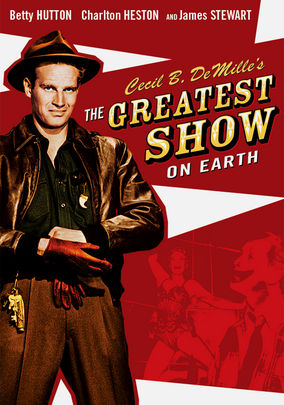
The Greatest Show on Earth-1952

The Greatest Show on Earth-1952

Director Cecil B. DeMille

Starring Charlton Heston, Betty Hutton, James Stewart

Scott’s Review #204

60034703

Reviewed December 14, 2014

Grade: B+

Considered by some critics to be one of the worst Best Picture winners of all time, The Greatest Show on Earth (1952) is quite an impressive Hollywood spectacle and tells the story of the world’s largest railroad circus as they launch a tour and travel throughout the United States, with plenty of drama to experience throughout the film.

The film stars Charlton Heston, Betty Hutton, and James Stewart as the general manager, acrobat, and clown of the show, respectively.

The film used over 1,400 real Ringling Bros. and Barnum & Bailey employees and hundreds of animals in its production, giving it an authentic circus feel.

Unfortunately, the film also has a schmaltzy quality and lacks the best acting, which surprisingly does not bother me and, strangely enough, works in a way.

Various characters have affairs with each other or fall in and out of love rather quickly- it makes for good drama, anyway.

Of course, the main appeal is the extravagant show. While the drama sometimes takes center stage, the lavish production and actual circus events shine through.

My favorite character, and arguably the only interesting character with any depth, in The Greatest Show on Earth is Buttons the Clown, played by James Stewart.

Buttons wears his clown costume, complete with full makeup, at all times. He is kind and mysterious. We learn that he “mercy killed” his dying wife and has joined the circus for protection from the police.

A wonderful human being, he was once a Doctor and tends to anyone in the circus troupe who needs assistance. Later in the film, he plays a vital role after a tragic accident.

His heartbreaking, tender conversation with his elderly mother, whom he only sees secretly once a year for seconds as she tearfully and discreetly visits him in the audience, is painfully sad to watch and is such a sweet scene.

The Greatest Show on Earth’s best scene by far still impresses today is the massive train wreck close to the conclusion.

Made in 1952, the special effects and direction of Cecil B. DeMille are brilliant. The train derails one night in a perfect way—it crashes into an approaching train and derails, highly effective in its enormity.

The scene does not look silly.

The way that all of the drama comes together in this scene—Harry, the crooked midway concessionaire and vicious elephant trainer, Klaus, who is responsible for the accident, Button’s true identity being revealed, and a significant character in peril—makes this scene top-notch and a satisfying conclusion to the film.

The stories involving Brad, Holly, Sebastian, and Angel are soapy and melodramatic and are the film’s weakest point. As a viewer, I couldn’t care less which character lusted after which or who wound up in bed together, but the movie itself is a spectacle, which is my main enjoyment.

The brightness, the revelry, and the circus performances are all wonderful.

Oscar Nominations: 2 wins-Best Motion Picture (won), Best Director-Cecil B. DeMille, Best Story (won), Best Costume Design, Color, Best Film Editing