Tag Archives: Rita Moreno

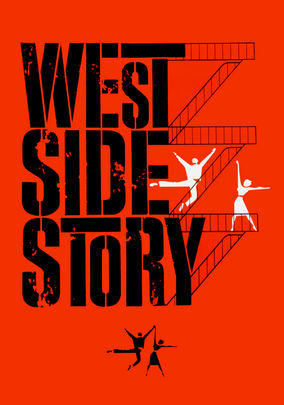
West Side Story-1961

West Side Story-1961

Director Robert Wise, Jerome Robbins

Starring Richard Beymer, Natalie Wood

Top 250 Films #12

Scott’s Review #188
1111583

Reviewed November 3, 2014

Grade: A

West Side Story is a musical from 1961 (based on the Broadway stage production from the 1950s), during a period in Hollywood where every other film released seemed to be a version of an enchanting musical.

This particular film version is much darker than most of its contemporaries within this genre. The dreary ending, fantastic and compelling in its dramatic elements, does not detract from the rest of the musical and its hum-along tunes.

West Side Story was crowned the 1961 Academy Award winner for Best Picture.

West Side Story is undoubtedly based on the Shakespearean tragedy of Romeo and Juliet- the Capulets and Montagues becoming rival teen street gangs of the Puerto Rican “Sharks” and the Polish”Jets,” with the lovesick teens Tony and Maria serving as Romeo and Juliet.

And yes, spoiler alert, the story does not end happily ever after.

Loads of suspension of disbelief must be taken- How many gangs sing and dance to each other, snapping their fingers in unison to perfectly choreographed beats?

Additionally, some gang characters do not look authentic, with clearly dyed hair, bronzed skin, or some other phony-looking get-up.

The film is a cherished friend, and these can be overlooked for my enjoyment of the film.

The story, set in 1950s New York City, pits the Sharks (a gang led by Bernardo) against the Jets (led by Riff), who have been bitter rivals for the turf of the rough streets of Manhattan’s west side for many years.

The gang’s girlfriends and one female, “Anybodys,” are in tow. She longs for the day when she can join the Jets and fight alongside the boys.

The other supporting characters primarily include various policemen (Lieutenant Schrank and Officer Krupke) who attempt to keep the gangs apart. They also include a local shopkeeper, Doc, who is the story’s moral compass. Doc encourages the gangs to get along and questions the logic of gang fights.

After a scuffle, the gangs decide to fight after an upcoming dance, and the Jets elect Tony to face Bernardo.

The story is surprisingly dark, especially in the inevitable final act. Amid all this darkness, however, lies a musical with cheery, catchy numbers (I Feel Pretty, Jet Song) and love-struck tunes (Maria and Somewhere).

A musical about diversity and rivalry, the story centers on lovesick Maria and Tony, a la Romeo and Juliet, and their struggle to be together despite adversity from their friends and family due to their significantly different backgrounds.

Throughout the film, we get to know other characters well- Anita, the girlfriend of Bernardo, for example, played by Rita Moreno, is the stubborn yet likable best friend of Maria, who thinks that Maria and Tony are wrong for each other and that things just are not supposed to be that way when you mix cultural diversity.

The film moves along quickly, featuring standoffs, fights, and plots to eliminate the other gang, a failed attempt at a dance to bring the two groups together, and Tony and Maria sneaking off to meet.

The lack of chemistry between Natalie Wood (Maria) and Richard Beymer (Tony) is noticeable, primarily upon multiple viewings. Still, decades later, it is also challenging to imagine anyone else in either role—so ingrained is the duo in film culture.

The cultural diversity of much of the cast (Rita Moreno was the only Puerto Rican) is fascinating, as is the fact that most of the singing was dubbed by other singers.

Yet, the film still manages to work very well.

Oscar Nominations: 10 wins-Best Motion Picture (won), Best Director-Robert Wise and Jerome Robbins (won), Best Supporting Actor-George Chakiris (won), Best Supporting Actress-Rita Moreno (won), Best Screenplay Based on Material from Another Medium, Best Scoring of a Musical Picture (won), Best Sound (won), Best Art Direction, Color (won), Best Cinematography, Color (won), Best Costume Design, Color (won), Best Film Editing (won)

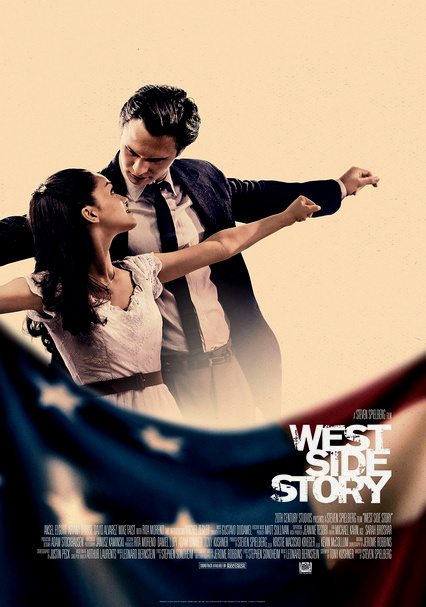
West Side Story-2021

West Side Story-2021

Director Steven Spielberg

Starring Ansel Elgort, Rachel Zegler, Ariana DeBose

Scott’s Review #1,207

Reviewed December 12, 2021

Grade: A

I salivated when the news broke that a reboot of the brilliant 1961 film West Side Story, itself based on a Broadway musical, was being planned.

I was cautiously optimistic when I heard Steven Spielberg would direct the production. Nothing personal against Mr. Spielberg, but there have been some misses with musical adaptations over the years.

Does anyone remember Cats (2019)? I know, we are all trying to forget it.

Nonetheless, my anticipation was temporarily sidelined due to the dreaded COVID-19 pandemic. Still, art always perseveres, and the release of the new West Side Story was pushed back from December 2020 to December 2021.

Finally, the moment had arrived, and I was even fortunate enough to score members-only sneak preview tickets to an early screening at my local art theater.

Hooray!

West Side Story (2021) is a brilliant adaptation that does not disappoint in the least, offering entertainment and authenticity in abundance. It’s bombastic and enthralling, mixing romance with some quite brutal fight scenes.

The delightful songs “Maria”, “America”, “Tonight”, “I Feel Pretty”, and my personal favorite “Somewhere” are all included and are like new gifts for fans to unwrap greedily.

This may be Spielberg’s best effort yet (I never thought he’d top 1993’s Schindler’s List), as he recreates a musical spectacle that will surely entice viewers back to the cinema.

The reboot has life, artistry, and expressionism, breathing fresh energy into the production. In some ways, it surpasses the 1961 version.

Despite being created in the late 1950s, a remains timely. Racism sadly still exists in America, and we have much work to do to unite as one if we ever do. This may feel hopeless, but the film’s message is one of love and unity, offering hints of hopefulness.

How timely and how much we need this film.

The film has a more profound sentiment in light of the recent death of Stephen Sondheim, the masterful composer and lyricist who revolutionized the American musical. He worked in tandem with Leonard Bernstein on most of these songs.

For those unfamiliar, let me briefly summarize the film’s plot.

Love, at first sight, strikes when young Tony (Ansel Elgort) spots Maria (Rachel Zegler) at a high school dance in 1957 New York City. Forbidden from having anything to do with each other except to hate each other, their immediate romance helps fuel the fire between the warring Jets and Sharks —two rival gangs vying for control of the streets.

Things go from tense to terrible when street fights between the gangs lead to mayhem, misunderstandings, and death.

The film is crafted exceptionally well from a visual and cinematic perspective. From the opening sequence, when the gangs stumble amongst the ruins of a decrepit west side lot, there are intriguing shadows and shapes, and high camera shots.

These moments continue throughout the film, as the flawless choreography of the dance scene takes center stage.

Speilberg corrects missteps that the 1961 version made, which brought a broad smile to my face. The Puerto Rican characters, which make up half the cast, are played by Hispanic actors. The big mistake the original film made was casting Caucasian actors who passed for Puerto Rican.

The chemistry between Richard Baymer (original Tony) and Natalie Wood (original Maria) was lacking, but it explodes off the screen from the first moment that Elgort and Zegler appear together.

Rita Morena, familiar to West Side Story fans with her portrayal of Anita in the 1961 version, returns in the role of Valentina, who runs Doc’s general store and is assumed to be the widow of Doc.

It is explained that Valentina, a Puerto Rican, married a white man. Morena’s role is much bigger than I thought, and she performs a magnificent, tear-jerking version of “Somewhere”.

The casting is flawless. Standouts are Elgort (Tony), Ziegler (Maria), Ariana DeBose (Anita), David Alvarez (Bernardo), and Mike Faist (Riff), but the entire company performs flawlessly and effortlessly.

The character of Anybodys, a tomboy in the original, is cast with a transgender actor, Iris Menas, which provides rich diversity and inclusion.

West Side Story (2021) is an instant classic that I eagerly anticipate seeing again and again. I’ll never waver in my love and devotion to the original version.

Still, the new version is an exceptional achievement in authenticity, style, and pizazz that will assuredly remind viewers why they love the cinema so much.

It certainly reminded me.

Oscar Nominations: 1 win-Best Picture, Best Director-Steven Spielberg, Best Supporting Actress-Ariana DeBose (won), Best Cinematography, Best Production Design, Best Costume Design, Best Sound

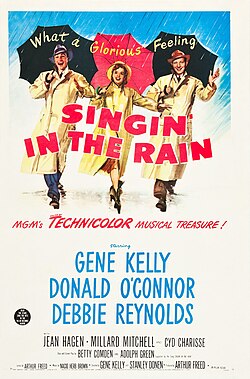
Singin’ in the Rain-1952

Singin’ in the Rain-1952

Director Stanley Donen, Gene Kelly

Starring Gene Kelly, Debbie Reynolds

Scott’s Review #874

Reviewed March 4, 2019

Grade: A-

Singin’ in the Rain (1952) is most closely associated with the entertainment industry in the oversaturated field of musicals released during the mid-twentieth century.

The battle between the transition of silent pictures to “talkies” is the basis of the story, giving the film an important, along with fun, subject matter.

Likable stars and sing-along tunes make the film memorable and decidedly All-American, though perhaps not the greatest in the crowded musical field.

During the late 1920s, Don Lockwood (Gene Kelly) was a famous and well-regarded silent film star. His co-star and studio-created romantic attachment is Lina Lamont (Jean Hagen), an annoying and shallow leading lady with a harsh singing voice.

As more successful “talkies” (films with sound) are produced, Don finds himself smitten with musical chorus girl Kathy Selden (Debbie Reynolds). The plot to dub Lina’s voice with Kathy’s leads to comical chaos and an idea to create a new musical amid a blossoming romance between Don and Kathy.

The fun and frolicking Singin’ in the Rain is lightweight but never silly nor superfluous, thanks to the overriding message of the change in Hollywood priorities.

Critically acclaimed from the get-go, this is unsurprising since Hollywood loves stories about Hollywood, especially since the film was made only slightly more than two decades since sound-laden films overtook the world.

Furthermore, in 1952, television was making its debut to legions of fans, and the accessibility presented a serious threat to the cinema, making the subject matter even more relevant.

Kelly and Reynolds make a nice enough pair, but I never thought they completely knocked it out of the park from a chemistry perspective.

One slight flaw is the lack of hurdles preventing the couple from an inevitable union. Lina is the transparent foil and ultimately played for laughs, so she is not a serious threat.

The plot-driven conflict involving Kathy’s initial dislike of Don because she values stage over film is cute, but ultimately revealed to be a sham since she has been a fan of his all along.

The musical is a comedy, but better hurdles might have made for a more interesting story.

Nonetheless, Singin’ in the Rain is a pleasure and a largely non-threatening experience. The hi-jinks involved as the characters strive and struggle to put on their production are comical, and Lina’s New York accent and shrill singing voice threaten to steal the show from the more grounded central characters.

The musical numbers are a dream, and I especially like favorites like “Make ‘Em Laugh,” “Good Morning,” and the epic title song.

Through no fault of the film’s title number, “Singin’ in the Rain” will forever not be associated with this film for me but rather with the dark and cerebral A Clockwork Orange (1971). As the villain beats and rapes his victim by cheerily singing this tune, the song will forever hold a much darker association for me.

The dramatic final act is the highlight as a lavish premiere of The Dancing Cavalier is unveiled to a live theater audience hungry for something good.

When the crowd chomps at the bit for Lina to perform live, the big reveal of Kathy being the truly talented singer is displayed as the wizard in The Wizard of Oz style as Don and Kathy kiss and ride off into the sunset together in a grand show biz fashion.

In the crowded genre of the 1950s and 1960s musical productions that ravaged American cinema at the time, I mainly chose to watch West Side Story (1961), Gypsy (1962), The Sound of Music (1965), and Oklahoma! (1955) for pleasure, but Singin’ in the Rain (1952), an earlier gem, is worthy of value, especially for the memorable musical soundtrack it offers.

The story is light but also relevant and, most importantly, highly entertaining.

Oscar Nominations: Best Supporting Actress-Jean Hagen, Best Scoring of a Musical Picture

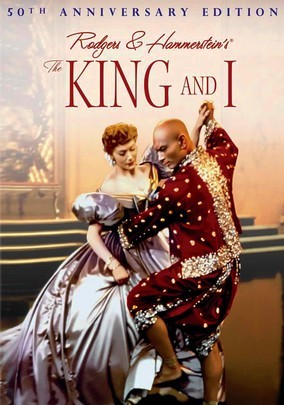
The King and I-1956

The King and I-1956

Director Walter Lang

Starring Yul Brynner, Deborah Kerr

Scott’s Review #26

671936

Reviewed June 17, 2014

Grade: B

The King and I (1956) is another of the many Rodgers and Hammerstein musicals that dominated the 1950s and 1960s film era.

Having seen the stage version, the film contained two gigantic stars of the period (Yul Brynner and Deborah Kerr), Brynner having made this role his legacy.

The story is similar to The Sound of Music, as the teacher takes on the children of the King, but it is not quite as gripping, and the chemistry among the leads is not entirely there.

The Bangkok palace set, and the costumes are stylish and fantastic in design.

As a whole, the songs are not as memorable as some other similar musicals, but that is compared to magnificence.

Much of the cast is not Asian, a characteristic of the stage version that is often overlooked and accepted. This is not a criticism, merely a notice.

It’s a lovely musical, but not as enjoyable as others, but still worth watching.

Oscar Nominations: 5 wins-Best Motion Picture, Best Director-Walter Lang, Best Actor-Yul Brynner (won), Best Actress-Deborah Kerr, Best Scoring of a Musical Picture (won), Best Sound Recording (won), Best Art Direction-Color (won), Best Cinematography, Color, Best Costume Design, Color (won)