Tag Archives: Lawrence Tierney

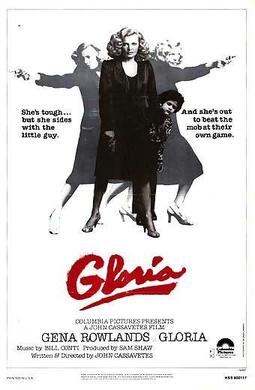
Gloria-1980

Gloria-1980

Director John Cassavetes

Starring Gena Rowlands

Top 250 Films #32

Scott’s Review #166
Reviewed September 9, 2014

Grade: A

Gloria (1980) is an action/thriller film that features the standard action-crime thriller elements, including shoot-em-ups, guns blazing, and clichéd fare.

It also contains an interesting and appealing leading character, a gritty atmosphere, and witty dialogue.

It is a significantly better film than most indistinguishable action films.

Directed and written by independent film master, John Cassavetes, who wanted to make a more conventional, mainstream film than was typical for him- think the very left of center, brilliant A Woman Under the Influence, also starring Gena Rowlands.

Gloria was the perfect film for him to create with Rowlands as the focal point.

Made in 1980, Gloria perfectly captures New York City of that era.

New York City was gritty, dirty, rough, crime-infested, violent, and chaotic, and the film frequently travels throughout Manhattan, the Bronx, and New Jersey, with many scenes shot directly on the streets of New York.

Several other scenes are set in dingy apartments, hotels, seedy bars, and rundown streets, and are highly effective in portraying a gloomy atmosphere.

The cinematography in the film is perfect.

The heart of the film lies with Rowlands (Cassavetes’s wife), who gives a mesmerizing performance as a former mob girlfriend who, by circumstance, must protect a young Hispanic boy from execution by the mob because of an informant’s book he clings to for dear life.

No other actress could have played this role of a tough-talking, brash New Yorker as well as Rowlands does.

The boy’s father, played by Buck Henry, is a scared accountant with ties to a company fronted by the mob.

He fears his entire family will be murdered and hands his kid over to Gloria. Julie Carmen gives a brief but effective performance as Phil’s frazzled mother.

I wish Henry and Carmen had been given more screen time and fleshed-out characters because both had huge potential.

The film belongs to Rowlands- she is no-nonsense, tough, and so convincing in the part.

I also enjoyed the casting of John Adames as the kid, Phil. Many critics inexplicably panned his performance, and I’m not sure why.

I also love the unique opening credits, as intense folk/jazz music plays over watercolor portraits that turn into the skyline of New York City, with a melancholy, eerie quality.

Amid the violence, a sweet bond develops between Gloria and Phil that is neither too sentimental nor cheesy.

A great, compelling late 1970s/early 1980s film with definite Godfather and Dirty Harry influences in its texture and characters, especially in some of the mobster roles.

The appeal of the film is that it has a heart without ever delving into schlock. Surprisingly rated only PG, it is gritty, but not lewd or harsh, and seems dirtier than it is, with barely any filthy language.

The chemistry and heartfelt connection between Gloria and Phil are darling without being too sappy or safe.

Gloria (1980) is a fast-paced, action gem that is both appealing and tough.

Oscar Nominations: Best Actress-Gena Rowlands
Reservoir Dogs-1992

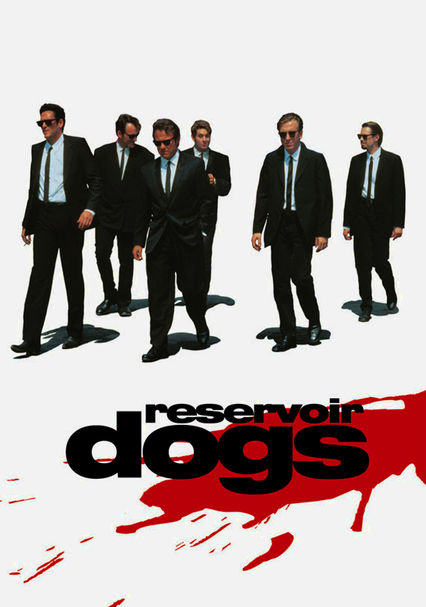
Reservoir Dogs-1992

Director Quentin Tarantino

Starring Harvey Keitel, Tim Roth, Chris Penn

Top 250 Films #107

Scott’s Review #1,332

Reviewed January 9, 2023

Grade: A

Reservoir Dogs (1992) is the film that began an essential transition in cinema history.

The 1980s saw way too many watered-down or oversaturated films with enough sappy or melodramatic thematics to make a seasoned cinema lover want to gag and run for a good television series.

The 1990s were different.

It’s impossible to think of the decade in film and not speak the name Quentin Tarantino, an iconoclast who took the crime thriller genre and riddled it with violence, dark humor, comic book-style characters, and dozens of other eccentricities and spun the world on its head.

It was needed.

But before anyone assumes Reservoir Dogs is the most fantastic Tarantino film, it’s not. Many list it as his weakest catalog entry.

That’s open to debate, of course, but in my view, the film’s influence accounts for much of my enjoyment of it.

It’s not as developed and stylized as Django Unchained (2012) or as powerfully fucked up or odd as Pulp Fiction (1995). Still, the rawness, the gore, the go-for-broke scenes shot like a play, and the small budget make watching Reservoir Dogs a reminder of the genius that is Tarantino.

Countless scenes mirror sequences to come in his later films, so much so that a game can be played to discover where something from another Tarantino film played out.

The film gave new recognition and merit to the independent film genre, which was huge and opened doors for young filmmakers everywhere who had ideas and just needed to get their films known.

The influence of Reservoir Dogs is immeasurable, and a double feature of Reservoir Dogs and Pulp Fiction is suggested.

Even though the latter was released later, most people saw Pulp Fiction first and then discovered Reservoir Dogs.

A group of unsavory thieves assembles to pull off the perfect diamond heist. It turns into a bloody shit show when one of the men turns out to be a police informer.

But which one is it, and who is responsible for the ambush?

As the group begins to question each other’s guilt, the tensions and suspicions threaten to blow up the situation before the police step in and save the day. But how many will die first?

Tarantino cleverly casts himself in a small role as Mr. Brown and refers to all the men by the same formal title. There are Mr. White (Harvey Keitel), Mr. Orange (Tim Roth), Mr. Blonde (Michael Madsen), Mr. Blue (Edward Bunker), and, finally, Mr. Pink (Steve Buscemi), who is my favorite of all.

In 1992, many scenes were shocking. When sinister Mr. Blonde cuts off the ear of a cop and prepares to set him on fire, the brutality and sadism are hard to watch.

The blood-soaked Mr. Orange lies in a pool of blood throughout nearly the entire film. As his skin turns whiter and whiter and his clothes redder and redder, it’s a masterful example of cinema and creativity.

The few exterior shots are in Los Angeles, which gives the film a low-budget, raw look.  It’s to be celebrated, as the potent sun and the city of angels’ grizzled veneer are on display.

I’m not a fan of the lack of female representation, but it only enhances the characters’ muscles and masculinity. As they sit in a diner mulling over whether tipping is necessary, we could easily be in a men’s locker room, witnessing banter about getting laid, or watching an episode of Seinfeld.

There are no romantic entanglements to mess up the plot, nor is there any need to rescue the girl from criminals. The closest we come is a couple of homoerotic moments of men embracing men amongst bullets and blood.

Reservoir Dogs succeeds as a whodunit, a heist film, and a vile look at the inhumanity of some of the characters.

The influence and relevance of Reservoir Dogs in 2023 are as abundant as they were in 1992. Cinema is like fine wine, and sometimes the more time that passes, the more appreciation a film warrants.

It’s not perfect and is unpolished and sometimes underdeveloped, but it’s been emulated so many times that it’s become a blueprint of the crime thriller.

Independent Spirit Awards: 1 win-Best Supporting Male-Steve Buscemi (won)

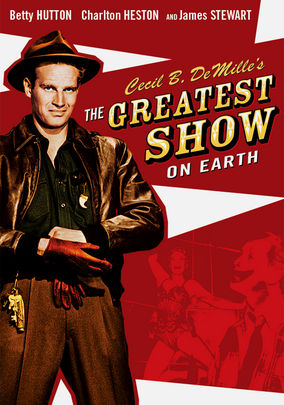
The Greatest Show on Earth-1952

The Greatest Show on Earth-1952

Director Cecil B. DeMille

Starring Charlton Heston, Betty Hutton, James Stewart

Scott’s Review #204

60034703

Reviewed December 14, 2014

Grade: B+

Considered by some critics to be one of the worst Best Picture winners of all time, The Greatest Show on Earth (1952) is quite an impressive Hollywood spectacle.

It tells the story of the world’s largest railroad circus as it launches a tour across the United States, with plenty of drama throughout.

The film stars Charlton Heston, Betty Hutton, and James Stewart as the general manager, acrobat, and clown of the show, respectively.

The film used over 1,400 real Ringling Bros. and Barnum & Bailey employees and hundreds of animals in its production, giving it an authentic circus feel.

Unfortunately, the film also has a schmaltzy quality and lacks strong acting, which, surprisingly, does not bother me and, strangely enough, works in a way.

Various characters have affairs with each other or fall in and out of love rather quickly- it makes for good drama, anyway.

Of course, the main appeal is the extravagant show. While the drama sometimes takes center stage, the lavish production and actual circus events shine through.

My favorite character, and arguably the only interesting character with any depth, in The Greatest Show on Earth is Buttons the Clown, played by James Stewart.

Buttons wears his clown costume, complete with full makeup, at all times. He is kind and mysterious. We learn that he “mercy killed” his dying wife and has joined the circus for protection from the police.

A wonderful human being, he was once a Doctor and tends to anyone in the circus troupe who needs assistance. Later in the film, he plays a vital role after a tragic accident.

His heartbreaking, tender conversation with his elderly mother, whom he only sees in secret once a year for a few seconds as she tearfully and discreetly visits him in the audience, is painfully sad to watch and such a sweet scene.

The Greatest Show on Earth’s best scene by far, still impressing today, is the massive train wreck near the conclusion.

The special effects and direction in Cecil B. DeMille’s 1952 film are brilliant. The train perfectly derails one night—it collides with an oncoming train and derails, highly effective in its enormity.

The scene does not look silly.

The way all the drama comes together in this scene—Harry, the crooked midway concessionaire and vicious elephant trainer; Klaus, who is responsible for the accident; Button’s true identity being revealed; and a significant character in peril—makes it top-notch and a satisfying conclusion to the film.

The stories involving Brad, Holly, Sebastian, and Angel are soapy and melodramatic, making them the film’s weakest point.

As a viewer, I couldn’t care less which character lusted after which or who wound up in bed together, but the movie itself is a spectacle, which is my main enjoyment.

The brightness, the revelry, and the circus performances are all wonderful.

Oscar Nominations: 2 wins-Best Motion Picture (won), Best Director-Cecil B. DeMille, Best Story (won), Best Costume Design, Color, Best Film Editing

Golden Globe Nominations: 3 wins-Best Motion Picture-Drama (won), Best Director-Motion Picture-Cecil B. DeMille (won), Cinematography-Color (won)