Tag Archives: Donald O’Connor

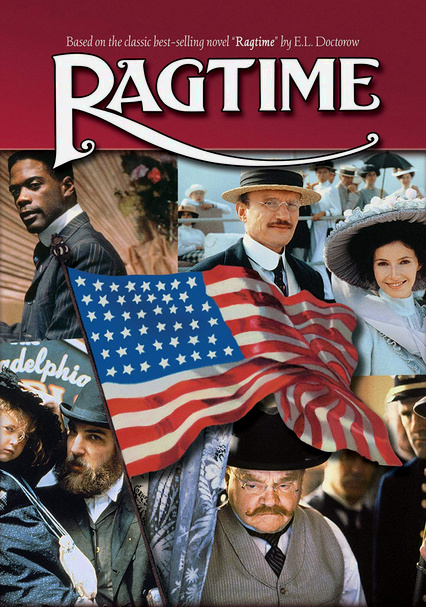
Ragtime-1981

Ragtime-1981

Director Miloš Forman

Starring Howard Rollins, Brad Dourif, Mary Steenburgen

Scott’s Review #1,183
Reviewed October 1, 2021

Grade: A-

Miloš Forman, best known for directing 1975’s One Flew Over the Cuckoo’s Nest and 1984’s Amadeus, crafts a relevant period drama with a moving racial storyline.

Set in turn-of-the-twentieth-century New York, Ragtime (1981) mixes an important message with gorgeous costumes and a sprinkling of romantic intrigue.

The film was honored with an astounding eight Academy Award nominations but came away empty-handed.

The cast is enormous, and I love that aspect of the film. At two hours and thirty-five minutes, the experience nearly felt too short, since there were plenty of stories left to tell, especially in the subplots.

Some resolutions are not clearly explained, but of course, the central story ends tragically.

A fun fact is that Robert Altman was initially signed on to direct the film, but was replaced by Forman. My mind conjures up endless juicy moments that Altman likely would have added. As good as Forman is, Altman would have been even better.

There are also a few real-life people sprinkled in among the fictitious characters, which may cause some confusion, especially with the large cast. Newsreels of Theodore Roosevelt, Houdini, and architect Stanford White are featured.

A flurry of juicy tales based on E.L. Doctorow’s eponymous novel dissects life in pre-World War I New York City. The haves and have-nots see their lives intersect in many different ways.

A lavish party in Atlantic City is a fabulous highlight of Ragtime.

One day, a rich white family living in New Rochelle, New York, finds a black baby in their yard and takes in the mother (Debbie Allen) as a maid. A black pianist, Coalhouse Walker Jr. (Howard Rollins), returns for his woman and child after finding success in a Harlem jazz band.

A group of small-minded firefighters, irritated to see a successful black man own a Model-T Ford, deface it, and Walker demands retribution. This sets the main chain of events in the film as a war rages between Walker and his friends and the white firefighters.

There are more stories presented in a lesser form than I would have loved, like the interesting friendship between the black Walker and the white younger brother, played by Brad Dourif.

In a strange scene, millionaire industrialist Harry Kendall Thaw (Robert Joy) makes a scene when White unveils a nude statue atop Madison Square Garden, modeled after former chorus girl Evelyn Nesbit (Elizabeth McGovern), Thaw’s wife.

Convinced that White has corrupted Evelyn, Thaw publicly shoots him dead.

From an acting perspective, the film belongs to Howard E. Rollins. I immediately treasured the character he plays and rooted for him to win. Intelligent yet put upon, he goes through several incarnations of the character and twice as many emotions. He was by far the richest character of all as far as substance.

Other characters intrigued, but dissecting them would be impossible since there were so many. McGovern, Mandy Patinkin, and Mary Steenburgen are my favorite characters.

The only slight drawback is that the film has a glossy look, and the gritty scenes are not powerful enough. As intense a moment as the finale is, for example, I wanted something dirtier. When Walker’s fate was sealed, I wanted to be more frightened, not feel like I was being fed high drama.

Ragtime (1981) successfully and nearly flawlessly combines artistic style with an enormous social message. It looks polished and representative of the early 1900s, and it challenges audiences to take a look at how different cultures co-existed in another time.

Oscar Nominations: Best Actor in a Supporting Role-Howard Rollins, Best Actress in a Supporting Role-Elizabeth McGovern, Best Writing, Screenplay Based on Material From Another Medium, Best Art Direction-Set Direction, Best Cinematography, Best Costume Design, Best Music-Original Score, Best Music-Original Song-“One More Hour”
Singin’ in the Rain-1952

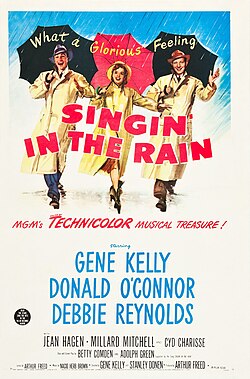
Singin’ in the Rain-1952

Director Stanley Donen, Gene Kelly

Starring Gene Kelly, Debbie Reynolds

Scott’s Review #874

Reviewed March 4, 2019

Grade: A-

Singin’ in the Rain (1952) is most closely associated with the entertainment industry in the oversaturated field of musicals released during the mid-twentieth century.

The battle between the transition of silent pictures to “talkies” is the basis of the story, giving the film an important, along with fun, subject matter.

Likable stars and sing-along tunes make the film memorable and decidedly All-American, though perhaps not the greatest in the crowded musical field.

During the late 1920s, Don Lockwood (Gene Kelly) was a famous and well-regarded silent film star. His co-star and studio-created romantic attachment is Lina Lamont (Jean Hagen), an annoying and shallow leading lady with a harsh singing voice.

As more successful “talkies” (films with sound) are produced, Don finds himself smitten with musical chorus girl Kathy Selden (Debbie Reynolds). The plot to dub Lina’s voice with Kathy’s leads to comical chaos and an idea to create a new musical amid a blossoming romance between Don and Kathy.

The fun and frolicking Singin’ in the Rain is lightweight but never silly nor superfluous, thanks to the overriding message of the change in Hollywood priorities.

Critically acclaimed from the get-go, this is unsurprising since Hollywood loves stories about Hollywood, especially since the film was made only slightly more than two decades since sound-laden films overtook the world.

Furthermore, in 1952, television was making its debut to legions of fans, and the accessibility presented a serious threat to the cinema, making the subject matter even more relevant.

Kelly and Reynolds make a nice enough pair, but I never thought they completely knocked it out of the park from a chemistry perspective.

One slight flaw is the lack of hurdles preventing the couple from an inevitable union. Lina is the transparent foil and ultimately played for laughs, so she is not a serious threat.

The plot-driven conflict involving Kathy’s initial dislike of Don because she values stage over film is cute, but ultimately revealed to be a sham since she has been a fan of his all along.

The musical is a comedy, but better hurdles might have made for a more interesting story.

Nonetheless, Singin’ in the Rain is a pleasure and a largely non-threatening experience. The hi-jinks involved as the characters strive and struggle to put on their production are comical, and Lina’s New York accent and shrill singing voice threaten to steal the show from the more grounded central characters.

The musical numbers are a dream, and I especially like favorites like “Make ‘Em Laugh,” “Good Morning,” and the epic title song.

Through no fault of the film’s title number, “Singin’ in the Rain” will forever not be associated with this film for me but rather with the dark and cerebral A Clockwork Orange (1971). As the villain beats and rapes his victim by cheerily singing this tune, the song will forever hold a much darker association for me.

The dramatic final act is the highlight as a lavish premiere of The Dancing Cavalier is unveiled to a live theater audience hungry for something good.

When the crowd chomps at the bit for Lina to perform live, the big reveal of Kathy being the truly talented singer is displayed as the wizard in The Wizard of Oz style as Don and Kathy kiss and ride off into the sunset together in a grand show biz fashion.

In the crowded genre of the 1950s and 1960s musical productions that ravaged American cinema at the time, I mainly chose to watch West Side Story (1961), Gypsy (1962), The Sound of Music (1965), and Oklahoma! (1955) for pleasure, but Singin’ in the Rain (1952), an earlier gem, is worthy of value, especially for the memorable musical soundtrack it offers.

The story is light but also relevant and, most importantly, highly entertaining.

Oscar Nominations: Best Supporting Actress-Jean Hagen, Best Scoring of a Musical Picture