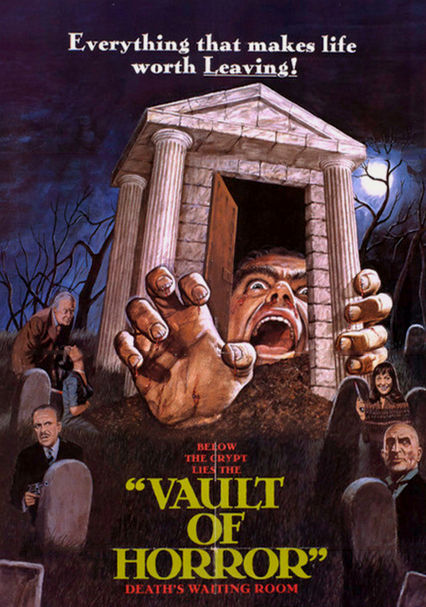
Vault of Horror-1973
Director Roy Ward Baker
Starring Curd Jürgens, Daniel Massey
Scott’s Review #1,038
Reviewed June 26, 2020
Grade: A-
Horror anthologies are usually a treat and a nostalgic reminder of childhood afternoons watching Twilight Zone reruns on television.
This is hardly much of a stretch since Vault of Horror (1973) is a British anthology based on Tales from the Crypt (1972), which in turn was based on stories from the EC Comics series.
Each chapter is superior storytelling, providing bloodthirsty horror viewers with suspense, adventure, and surprise endings.
Below is a summary, review, and rating of each vignette.
Framing Story- A
Events get off to an intriguing start as, one by one, five businessmen enter an elevator in a corporate office in downtown London. They are taken to the basement level, though none of them has pressed that floor, and emerge to find a gentlemen’s club.
With no way to get back onto the elevator, they begin to drink, each discussing a recurring nightmare.
This segment immediately grasps the viewer as we ponder questions. Is someone holding the men there for a reason, who is behind it, and why? Are the men’s nightmares only nightmares, or are they revealing deeper secrets?
Midnight Mess- A
Harold Rodgers (Daniel Massey) is a suave, well-dressed man who tracks down his missing sister Donna (real-life sister, Anna Massey!) in a peculiar village. He fiendishly kills her to acquire her share of their father’s inheritance.
Working up an appetite, he dines at a local restaurant that serves blood soup and blood clots as the main course. Sophisticated vampires inhabit the village, and his sister is one of them!
This vignette is my favorite because the restaurant decor is warm and toasty, the village provides a stylish ambiance, and the writing is clever throughout. The bloody feast the eatery serves is a devilish delight in macabre humor.
And the fangs are great.
The Neat Job- A
Arthur Critchit (Terry-Thomas) is an elegant man suffering from obsessive-compulsive disorder. He is married to Eleanor (Glynis Johns), a trophy wife, who, despite wanting to please her husband, is a lousy housekeeper.
Constantly criticized for being incompetent, Eleanor loses it and kills Arthur with a hammer. She proudly cuts him to bits and stores his remains in glass jars, all neatly labeled.
This story is simply delicious, offering elegant British furniture to salivate over and macabre, witty comedy as the viewer eagerly anticipates what Eleanor will do when she finally snaps, and we know she will snap.
Bravo!
The Trick’ll Kill You- A-
Sebastian (Curd Jürgens) is a magician on holiday in India, where he and his wife Inez (Dawn Addams) are searching for new tricks for their act.
Frustrated, they encounter a girl charming a rope out of a basket with a flute. The couple persuades her to come to their hotel room, where they murder her and steal the enchanted rope. They gleefully plot how to incorporate the rope into their act, assuring them of riches.
Inez experiments with climbing the rope only to disappear with a scream. An ominous patch of blood appears on the ceiling, and the rope coils around Sebastian’s neck and hangs him. Their smirking victim reappears alive in the bazaar.
This vignette provides a good glimpse of the Far East and is culturally outstanding. The story is compelling, though a letdown from the earlier entries.
Bargain in Death- B+
Maitland (Michael Craig) is buried alive as part of an insurance scam concocted with his friend Alex (Edward Judd). They each plan to double-cross and kill the other to get the money.
Two trainee doctors bribe a gravedigger to dig up a corpse to help with their studies. When Maitland’s coffin is opened, he jumps up gasping for air, and the gravedigger kills him. At the same time, Alex’s car crashes into a tree, and he dies.
In humorous comedy, when trying to close the sale of the corpse, the gravedigger apologizes to the doctors for the damage to the head.
This segment is more comical than the others, and a nice aside is that the trainee doctors are named Tom and Jerry. The plot is a bit convoluted and doesn’t succeed as much as the other stories.
Drawn and Quartered- A
Moore (Tom Baker) is a struggling painter living in Haiti. When he learns that his paintings have been sold for high prices by art dealers after being praised by a critic, he goes to a voodoo priest for help in exacting revenge.
He is instructed that whatever he paints or draws can be harmed by damaging its image.
Returning to London, Moore paints portraits of the three men who cheated him and mutilates the paintings to exact his revenge. After the displays, his portrait, each one, including Moore, suffers an agonizing experience.
This story is top-notch, and the loss of the eyes and the hands is the highlight of the fun.
As the film wraps up, we learn the mysterious puzzle involving the five men satisfyingly.
Vault of Horror (1973) is a horror anthology that hardly disappoints. I am eager to watch this one again, which is a major achievement for a cinematic offering to have on a viewer.