Tag Archives: Loretta Devine

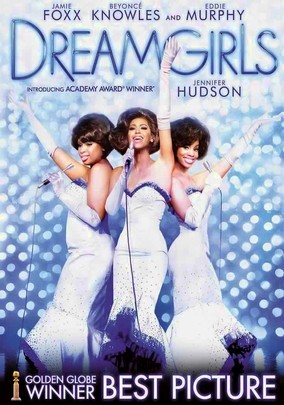
Dreamgirls-2006

Dreamgirls-2006

Director Bill Condon

Starring Beyonce, Jennifer Hudson, Eddie Murphy

Top 250 Films #159

Scott’s Film Review #792
Reviewed July 20, 2018

Grade: A

Dreamgirls (2006) is a glossy show business-style drama with plenty of glitz and glamour. Adapted from the Broadway production of the same name, the story is loosely based on the trials and tribulations of The Supremes, a popular all-girl group from the 1960s.

Despite the film being heavily focused on the drama and tension between the characters, it boasts a wonderful soundtrack and fantastic acting- most notably newcomer Jennifer Hudson, who garnered a surprising Best Supporting Actress Oscar win for her role.

The film tells the story of the evolution of American R&B music during the 1960s and the 1970s- the action mainly taking place in Detroit, Michigan, where the genre began.

Taking center stage is the incarnation of a girl group called The Dreams, who are controlled by their manipulative record label executive.

A womanizer and creep, Curtis Taylor (Jamie Foxx), guides the girls to stardom, but beds both the beautiful Deena (Beyonce) and the talented yet overweight Effie White (Jennifer Hudson). This leads to conflict as Curtis decides that less talented Deena is more marketable and thus should be the central figure of the band.

With a stellar cast in tow, Dreamgirls contains a plethora of talent and a good history lesson to boot. The main draw in the acting department is the revelation of the talented Jennifer Hudson.

Winner of the talent show American Idol, many pooh pooed her film direction, apparently assuming she was a flash in the pan and a “reality television” star. The challenging role of Effie is perfectly suited for Hudson- brazen, pipes for days, and plenty of attitude.

Her acting aside, Hudson scorches through an unforgettable rendition of “And I Am Telling You I’m Not Going”, which is assuredly what won her the Oscar.

Otherwise, the supporting cast is worthwhile and impressive is Beyonce in a pivotal role. Surely, the singer/actress faced her share of detractors, along with Hudson, but their chemistry is amazing and she nails all of her songs.

Eddie Murphy is a gem in the role mirrored after James Brown, James “Thunder” Early.  The role is perfect for Murphy- a far cry from his standard comedic roles that have grown stale over the years.

This role rejuvenates the actor’s credibility.

Dreamgirls does at times falter a bit with the drama, almost soap opera-like situations. A triangle develops between Effie, Curtis, and Deena, which leads to tension, bad blood, cattiness, and melodrama.

If the film were a standard drama this would undoubtedly make the film suffer from a tired script or generic writing.

But the musical numbers are so riveting that these flaws can be overlooked completely. The ritzy glamour and sparkles that erupt during “Dreamgirls” and “One Night Only” are wonderful fun and the songs are memorable leaving audiences humming along as they dance in the aisles.

The story has been told many times before. A dream of rising to musical stardom and the many trials and tribulations that go along with these hopes and desires.

Comparisons can be made to Chicago (2002), Valley of the Dolls (1967), or even Gypsy (1962), but the mostly black cast and the 1960s Motown theme is interesting, particularly as the Civil Rights movement of the time was upon us.

The film does not invest much time in politics, sticking mainly with drama and music, which may be a wise move to avoid too much of a message theme.

As the film concludes in 1975, Effie is reaffirmed as a meaningful member of The Dreams after her career has tanked and she has wound up on welfare.

A paternity twist is also thrown in for good measure, but the film has a clear “happily after ever” vibe to it which softens the film and keeps it more on the PG-13 level instead of going for darker themes.

Dreamgirls (2006) is a musical that is highly memorable for me because it made Jennifer Hudson a household name and confirms the talent and glory that she is rightfully due.

In subsequent years the star lost weight, softened her image a bit, and became, well, more generic. But thankfully we have a gorgeous performance to always appreciate her for.

Oscar Nominations: 2 wins-Best Supporting Actor-Eddie Murphy, Best Supporting Actress-Jennifer Hudson (won), Best Original Song-“Listen”, “Love You I Do”, “Patience”, Best Sound Mixing (won), Best Art Direction, Best Costume Design
I Am Sam-2001

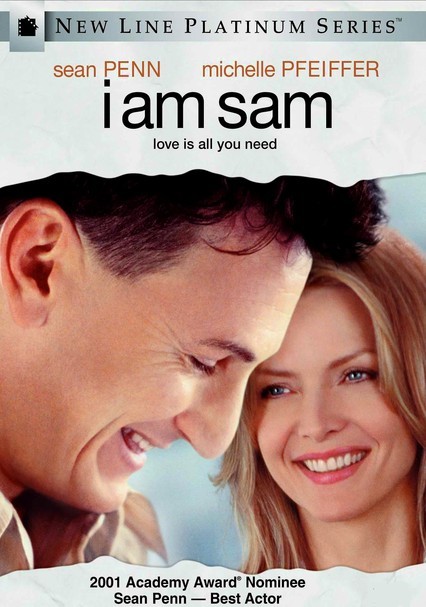
I Am Sam-2001

Director Jessie Nelson

Starring Sean Penn, Michelle Pfeiffer

Scott’s Review #1,097

Reviewed December 30, 2020

Grade: B-

Sean Penn stars as a mentally disabled man who fathers a child and is determined to cling to the custody of her after he is deemed unfit to parent in I Am Sam (2001), a drama that garnered Penn an Oscar nomination.

The brilliant actor may have deserved the win, since he breathes life into a film riddled with every imaginable cliché.

Aside from his performance and that of the novice Dakota Fanning, the film would be drivel.

As it is, it’s mediocre at best.

Somewhere, sometime, somehow, in cinema history, the consensus became that if an actor plays a mentally challenged character, they are assured an Academy Award nomination.

Juliette Lewis tried and failed with the cringeworthy The Other Sister (1999), but Penn has better credibility. Dustin Hoffman also succeeded with Rain Man (1988).

Sam (Penn) is a well-adjusted man and has a supportive group of friends with disabilities.

His neighbor, Annie (Dianne Wiest), assists in raising Sam’s daughter, Lucy (Fanning), but the eight-year-old quickly exceeds her father’s mental capacity, leading to frustration and conflict.

Lucy’s mother, a homeless woman, has vanished from the scene.

The justice system determines that Lucy must be placed with a foster family led by Randy (Laura Dern), prompting Sam to hire a no-nonsense attorney, Rita (Pfeiffer). Both Randy and Rita sympathize with Sam and must convince the courts that he can raise her.

Jessie Nelson, who directed I Am Sam, also directed safe films like Corrina, Corrina (1994) and Stepmom (1999), so her intention to present a warm, soft experience is easy to discern.

This is not meant to criticize her direction style as much as to point out that the result is not a hard-edged, gritty experience.

It’s a crowd-pleaser, and there is never a moment where Nelson wants the audience to root against Sam keeping custody of Lucy, regardless of the reality.

Penn saves the film from being a complete stereotype. It’s apparent that Sam adores Lucy, and the actor is not afraid to cry and express genuine emotion on cue. He’s a great actor and makes the most out of the role.

He does his best to insinuate that mentally challenged people are like everyone else- they can keep a job, pay bills, hire a lawyer, and fight for their kids. His task is tough, but he succeeds.

That’s what raises I Am Sam as an overall product.

Fanning, who in 2001 was about to embark on a fabulously rich acting career, is wonderful. Unlike many child actors, cast because they are cute or bubbly, she has real acting chops. She is neither girly nor overly sad.

Fanning is as strong, focused, and detailed as her eight-year-old character is.

Speaking of stereotypes, Pfeiffer is awarded the grand prize in female attorney banality. She is haggard, absorbed in her work, and has no time for her son, taking Sam’s case only to prove she is a kind person, since she agrees to pro bono work.

Predictably, she realizes through Sam that she is wasting her life away, leaving her husband and spending more time with her son.

Dern does her best with a weak role as the one-dimensional foster parent who realizes she cannot be half the parent Sam can be.

The film’s title is derived from the opening lines “I am Sam / Sam I am” of the book Green Eggs and Ham, which is read in the movie.

This makes the film showcase sentimentalism and hammers home the point that the mentally disabled are child-like and need the help, patience, and understanding of non-disabled adults, as if that isn’t obvious.

The conclusion to I Am Sam is expected.

The lengthy courtroom scenes are wrapped in a nice, shiny bow as Sam predictably retains custody of Lucy. At the same time, the supporting cast gathers on a soccer field and dutifully gushes with delight at how great a father he is.

This is a fine tribute or fantasy, and if only real life were like this, what a better world it would be. I would have preferred a story with more meat.

I Am Sam (2001) is recommended only for huge Sean Penn fans or those who desire an overly sentimental experience.

It might have been better suited for Lifetime television.

Oscar Nominations: Best Actor-Sean Penn

Crash-2005

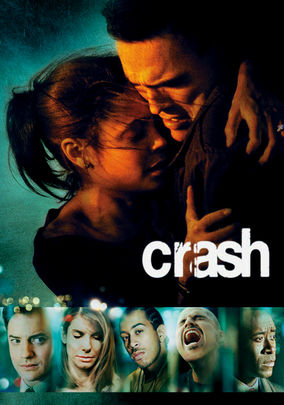
Crash-2005

Director Paul Haggis

Starring Matt Dillon, Thandie Newton, Don Cheadle

Scott’s Review #799

Reviewed August 3, 2018

Grade: A-

A superior film that has unfortunately suffered greatly after controversy, Crash (2005) is a story of intersecting vignettes all interrelated.

The controversy stems from the film’s very surprising Oscar win over the heavily favored Brokeback Mountain. Many thought the latter was a shoo-in, poised to set the LGBT genre ahead of the game.

Sadly, now when Crash is discussed by film lovers, it’s usually in tandem with Brokeback, and usually on the heels of its having stolen the Oscar crown.

On its own merits, the film excels as a social story exploring the many facets of race, racism, and bigotry.

The events in Crash take place within one thirty-six-hour day in metropolitan Los Angeles. Featuring a slew of characters that would even impress Robert Altman, the audience witnesses situations involving many races and backgrounds.

We meet Rick and Jean Cabot (Brendan Fraser and Sandra Bullock), a white affluent couple who are carjacked when driving home from dinner. The black men who carjack the couple then strike a Korean man and bring him to the hospital.

A racist police officer, John Ryan (Matt Dillon), cares for his troubled father who cannot afford insurance. A Persian father and daughter wish to buy a gun for protection, and a Hispanic father (Michael Pena) worries about a rash of drive-by shootings.

The stories go on and on as a myriad of the characters come into situations involving other characters.

The interconnecting stories all cascade into overlapping situations of interest. The point of Haggis’s film is racism but with a creative twist.

The director points out and shows that those who are racist have good qualities too and those who are discriminated against in turn discriminate against others themselves.

The most interesting character is Dillon’s, John Ryan. On the surface a racist, wise-ass, who in one scene embarrasses an affluent light-skinned black woman (Thandie Newton), simply because he carries a gun, then ends up saving her life in a horrific car accident.

But is he redeemed? Does he see the world as black people getting ahead and he is left behind? What about the Persian man, discriminated against, but then vowing revenge on a Hispanic man after a misunderstanding?

The black men who carjack the white couple then release a group of immigrants who will surely be sold, perhaps even for sex trafficking. Does this act make the men good?

The point that Haggis makes is that each character is neither all good nor all bad, but rather complicated and nuanced with emotions based on past experiences and discrimination themselves.

Crash is highly similar to Traffic (2000) and Babel (2006) in terms of pace, style, and the way the stories align. The film is different, however, in that the location is strictly confined to Los Angeles, making the setting of monumental importance.

How would events be different in a setting like Middle America? Or in a different country? These possibilities are worth contemplating based on the perception that Los Angeles is one of the most diverse cities in the United States. If racism occurs there it can occur anywhere.

Now more about that pesky Oscar controversy! In later years critics would largely agree that the inferior film had won that year and Brokeback Mountain lost due to a level of homophobia on the part of the voting academy.

Since the academy is filled with Hollywood liberals, albeit of an older generation, an alternative way of thinking is that perhaps Crash won because it was the “safer” film.

Everyone seems to have forgotten the other three nominated films that year. Alas, Crash is permanently marred for winning Best Picture. It would undoubtedly have more supporters had it lost.

Ranked as one of the lowest-scoring Best Picture winners, I still believe Crash has some worth- though I agree that it should not have won over Brokeback Mountain.

Taken on its own merits the film is quite good. A message film with great atmosphere, it succeeds in making the viewer think and ponder perhaps their discrimination, whether conscious or subconscious.

The ensemble acting and character representations are all very good and worthy of a second watch.

Oscar Nominations: 3 wins-Best Picture (won), Best Director-Paul Haggis, Best Supporting Actor-Matt Dillon, Best Original Screenplay (won), Best Original Song-“In the Deep”, Best Film Editing (won)

Independent Spirit Award Nominations: 2 wins-Best Supporting Male-Matt Dillon (won), Best First Feature (won)