Tag Archives: William Mapother

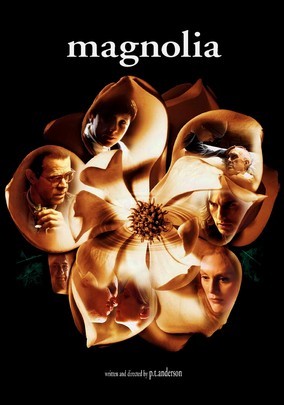
Magnolia-1999

Magnolia-1999

Director Paul Thomas Anderson

Starring John C. Reilly, Julianne Moore, Melora Walters

Top 250 Films #67

Scott’s Review #777
Reviewed June 21, 2018

Grade: A

Paul Thomas Anderson is one of my favorite modern directors. In my opinion, his best film is Boogie Nights (1997), but he has also created other dark offerings, such as Phantom Thread (2017) and Inherent Vice (2014).

Arguably, his most distinctive effort might be Magnolia (1999), a cerebral film that explores themes of forgiveness and the meaning of life.

An ambitious effort, featuring a stellar ensemble cast, makes the film a fantastic experience.

Set in the San Fernando Valley (a mountainous area of Los Angeles), the film resembles David Lynch’s Mulholland Drive (2001) in its setting and oddness, as well as its unusual dialogue and offbeat characters.

A narrator explains three situations of extreme coincidence and surmises that chance may not be the only responsible party. Anderson then weaves an intricate tale involving numerous characters, intersecting lives, and a riveting climax on a rainy California day (an oddity in itself!).

The plot begins when we meet Jim Kurring (John C. Reilly), a police officer who is called to investigate a disturbance.

After finding a woman’s body in an apartment closet, events turn bizarre as a children’s game show host (Philip Baker Hall), his estranged daughter (Melora Walters), the show’s former producer, Earl (Jason Robards), who is dying from cancer, his drug-addicted wife Linda (Julianne Moore), Earl’s male caretaker (Philip Seymour Hoffman), a former game show champion (William H. Macy), and finally, an intense motivational speaker (Tom Cruise).

Quite a bevy of talented actors!

As the plot progresses mysteriously, the connections among the characters are revealed, and their peculiar motivations begin to take shape.

For example, Linda, who married Earl for his money, seems to have an epiphany and demands her lawyer change Earl’s will. Later, a character may have a connection to Earl and Linda, but is it all as it seems?

In Magnolia, the film is so wonderfully strange that it leaves the audience guessing for most of its running time.

Bizarre scenes are commonplace throughout the film. My favorite one is a marvelously creative scene. Suddenly, frogs begin to fall out of nowhere from the Los Angeles sky, with numerous consequences for the characters.

The incident causes a ripple effect, of sorts, as many of the characters’ fates are determined. Though one may not be able to make heads or tails of this scene or take complete logic from it, it’s enthralling all the same.

Magnolia has an overall quirky tone- sometimes upbeat, sometimes melancholy- that I adore. Films that are tough to figure out and feature an interesting musical score are so rich in flavor.

Aimee Mann is responsible for composing many of the songs on the musical soundtrack, so much so that she received a title credit on the soundtrack itself. Mann infuses her music with moody, diverse richness and ambient essentials.

Many actors make frequent appearances in Paul Thomas Anderson’s films. Magnolia alone seems almost like a Boogie Nights reunion with Moore, Walters, Macy, Baker Hall, and Philip Seymour-Hoffman, to name just a handful.

The amazing aspect is that all of the aforementioned actors play vastly different, and arguably even more complex roles than they did in Boogie Nights.

Similar to Quentin Tarantino’s actors appearing in many of his films, this must be a creative treat for them.

There is no doubt that Magnolia (1999) is a complex, dream-like film. Open to interpretation and reflection, I find it a brilliant movie that I would like to revisit and dive into further with each viewing, hopefully for a better understanding and even deeper appreciation.

Oscar Nominations: Best Supporting Actor-Tom Cruise, Best Screenplay Written Directly for the Screen, Best Original Song-“Save Me”

Minority Report-2002

Minority Report-2002

Director Steven Spielberg

Starring Tom Cruise

Scott’s Review #1,318

Reviewed November 27, 2022

Grade: B+

If you study his body of film work, the fascinating thing about acclaimed director Steven Spielberg is the growth and groundbreaking cross-genre categorization of many of his films.

Traversing blockbuster popcorn films like Close Encounters of the Third Kind (1977) and E.T. the Extra-terrestrial (1982) to heavy drama with the 1993 masterpiece Schindler’s List, the man can do it all.

With 2002’s Minority Report, he bravely delves into science-fiction territory with a crime thriller and action tint.

The film is tough to follow and mostly reminds me of Inception (2010), a Christopher Nolan film influenced by it.

Despite its cerebral tone, Minority Report is a fascinating study of futuristic crime-fighting styles with enough twists and turns to keep you engaged.

It turned out well, though I confess that at times I had no real idea what was going on plot-wise.

The casting of Tom Cruise is a major win. Who better to carry a film like this, except maybe Bruce Willis, though Cruise is a better actor. Nonetheless, he is believable as a crime chief with a slick edge and a wicked smile.

Unsure whether to trust him, he remains at the heart of the film’s success.

Based on a story by science fiction writer Philip K. Dick, ‘Minority Report’ contains a perfect premise to bring to the big screen.

Set in Washington, D.C. in 2054, police are now intelligent enough to utilize psychic technology to arrest and convict murderers before they commit their crimes.

The setup is fabulous and rife with possibilities.

Cruise plays Chief John Anderton, the head of this Precrime unit, and is himself accused of the future murder of a man he hasn’t even met.

Following an audit, it is predicted that in thirty-six hours, Anderton will kill a man who is a stranger to Anderton. Anderton flees, prompting a search led by a searcher (Colin Farrell).

It is revealed that Anderton joined the Precrime program after his son was kidnapped and never found. He is depressed, withdrawn, and addicted to hard drugs, and his wife Lara (Kathryn Morris) has since left him.

But is this all a setup, and are others involved in the conspiracy?

The plot goes way off the rails in terms of explanation or logic, but the fun is in trying to put the never-ending puzzle pieces together. Truthfully, after a while, I simply gave up and enjoyed the visual eye candy and terrific futuristic style.

I rarely am a proponent of visuals over storytelling, but the intelligence of the sequences and the thrilling nature of the acting assured me there was something there.

I just wasn’t completely getting it.

Since Spielberg directs it, I was confident that the complexities I was being served were not shit. I was comforted by this knowledge, and my enjoyment escalated.

Enough props can’t be given for Cruise’s dynamic performance, heightened by the coldness and harshness of the film’s overall tone.

Many of Spielberg’s films are heartwarming, but that was not the case in Minority Report (2002), and I liked it even more for that reason.

Spielberg gets another win by suckering me into a cinematic world that he can magically create. This time with perplexities and perhaps even some influence from the Matrix (1999) movies.

Oscar Nominations: Best Sound Editing

In the Bedroom-2001

In the Bedroom-2001

Director Todd Field

Starring Tom Wilkinson, Sissy Spacek

Scott’s Review #1,313

Reviewed October 29, 2022

Grade: A

Todd Field is an American actor and director who has made very few films. This shows that he must choose his projects carefully.

Little Children (2006) is one of my favorite films.

Based on a 1979 short story titled ‘Killings’ by Andre Dubus, In the Bedroom (2001) is an independent film that exemplifies what independent films do brilliantly.

They tell stories about real people, with emotions, conflict, choices to make, and repercussions to face.

The story depicted in In the Bedroom is one that anyone viewing the film can either directly relate to or sympathize with any number of characters within.

The film centers on the inner dynamics of a family in transition. Matt Fowler (Tom Wilkinson) is a successful small-town doctor practicing in Maine and married to Ruth Fowler (Spacek), a music teacher.

Their son Frank (Nick Stahl) is involved in a summertime love affair with an older single mother, Natalie Strout (Marisa Tomei). He professes it to be merely a fling, but her violent ex-husband is jealous.

As the beauty of the summer comes to an end, these characters find themselves amid an unimaginable tragedy. They must make difficult choices to persevere through the dark autumn and winter.

Having seen the film when it was released in 2001 and not again until 2022, I wondered how it would hold up over twenty years later.

Would it feel dusty and dated or fall into the ‘one and done category like many films do?

The story is just as riveting, thanks to superior acting from the entire cast and exceptional direction and pacing by Field.

The lurid, quiet landscape is still and lonely in most scenes, and this is frightening unto itself. The lush, serene Maine waters, lobsters, lighthouses, and cabins are fraught with danger because of the human threat lurking in their midst.

The atmosphere is everything.

Fields reveals a story about a small town and the secrets buried beneath the surface. Even during a summer barbecue, there is tension when an unwelcome guest arrives unannounced.

With glances between characters, there is a lot of unspoken communication.

The acting is top-notch, especially by Wilkinson and Spacek. Before the tragedy, they both hedgingly accept their son’s relationship with an older woman but hope it’s only a phase. They see the relationship as a major roadblock to his education at a good university.

After the tragedy, Matt and Ruth change. She becomes angry and cold; he is stoic and vengeful. Both actors seamlessly portray their characters just like real-life people.

Other players, like Marisa Tomei and Nick Stahl, as the younger couple who met a tragic end, perform their roles flawlessly.

This is a major reason why In the Bedroom resonates so well. Any viewer can put themselves in the shoes of Matt, Ruth, or even Natalie Strout. Circumstances can change our perspectives and turn us into different people, at least temporarily.

The last sequence is great. A decision made by Matt and Ruth is shocking and will follow them for the rest of their lives. The key is that they do not hastily make this decision but rather calmly ponder and strategize each step.

They are satisfied and have no regrets.

In the Bedroom (2001) is an emotionally honest and compelling journey into character exploration. It is powerful and humanistic, quietly draws the viewer in, and takes a firm grip.

It uses silence to its advantage, making that silence haunting and melancholy.

Oscar Nominations: Best Picture, Best Director-Todd Field, Best Actor-Tom Wilkinson, Best Actress-Sissy Spacek, Best Supporting Actress-Marisa Tomei, Best Adapted Screenplay

Independent Spirit Nominations: 3 wins-Best First Feature (won), Best Male Lead-Tom Wilkinson (won), Best Female Lead-Sissy Spacek (won), Best Screenplay