Tag Archives: Marisa Tomei

In the Bedroom-2001

In the Bedroom-2001

Director Todd Field

Starring Tom Wilkinson, Sissy Spacek, Marisa Tomei

Scott’s Review #1,313

Reviewed October 29, 2022

Grade: A

Todd Field is an American actor and director who has made very few films. This shows that he must choose his projects carefully.

Little Children (2006) is one of my favorite films.

Based on a 1979 short story called ‘Killings’ by Andre Debus, In the Bedroom (2001) is an independent project representing what independent films do brilliantly. They tell stories about real people, with emotions, conflict, choices to make, and repercussions to face.

The story depicted in In the Bedroom is one that anyone viewing the film can either directly relate to or sympathize with any number of characters within.

The film centers on the inner dynamics of a family in transition. Matt Fowler (Tom Wilkinson) is a successful small-town doctor practicing in Maine and married to Ruth Fowler (Spacek), a music teacher.

Their son Frank (Nick Stahl) is involved in a summertime love affair with an older single mother, Natalie Strout (Marisa Tomei). He professes it to be merely a fling but her violent ex-husband is jealous.

As the beauty of the summer comes to an end, these characters find themselves amid an unimaginable tragedy. They must make difficult choices to persevere through the dark autumn and winter.

Having seen the film when it was released in 2001 and not again until 2022 I wondered how it would hold up over twenty years later. Would it feel dusty and dated or fall into the ‘one and done category like many films do?

The story is just as riveting and this is because of superior acting by the entire cast and exceptional direction and pacing by Field.

The lurid, quiet landscape is still and lonely in most scenes and this is frightening unto itself. The lush and serene Maine water, lobsters, lighthouses, and cabins are fraught with danger because of the human threat lurking in its midst.

The atmosphere is everything.

Fields reveals a story about a small town and the secrets buried beneath the surface. Even during a summer barbeque, there is tension when an unwelcomed guest arrives unannounced. With glances between characters, there is a lot of unspoken communication.

The acting is top-notch, especially Wilkinson and Spacek. Before the tragedy, they both hedgingly accept their son’s relationship with an older woman but hope it’s only a phase. They see the relationship as a major roadblock to his education at a good university.

After the tragedy, Matt and Ruth change. She becomes angry and cold, he is stoic and vengeful. Both actors seamlessly portray their characters just like real-life people.

Other players like Marisa Tomei and Nick Stahl as the younger couple met with tragedy perform their roles flawlessly.

This is a major reason why In the Bedroom resonates so well. Any viewer can put themselves in the shoes of Matt, Ruth, or even Natalie Strout. Circumstances can change our perspectives and turn us into different people, at least temporarily.

The last sequence is great. A decision made by Matt and Ruth is shocking and will follow them for the rest of their lives. The key is that they do not hastily make this decision but rather calmly ponder and strategize each step.

They are satisfied and have no regrets.

In the Bedroom (2001) is an emotionally honest and compelling journey into the exploration of character. It is powerful and humanistic, draws the viewer in quietly, and takes a forceful grip. It uses silence to its advantage making that silence haunting and melancholy.

Oscar Nominations: Best Picture, Best Director-Todd Field, Best Actor-Tom Wilkinson, Best Actress-Sissy Spacek, Best Supporting Actress-Marisa Tomei, Best Adapted Screenplay

Independent Spirit Nominations: 3 wins-Best First Feature (won), Best Male Lead-Tom Wilkinson (won), Best Female Lead-Sissy Spacek (won), Best Screenplay
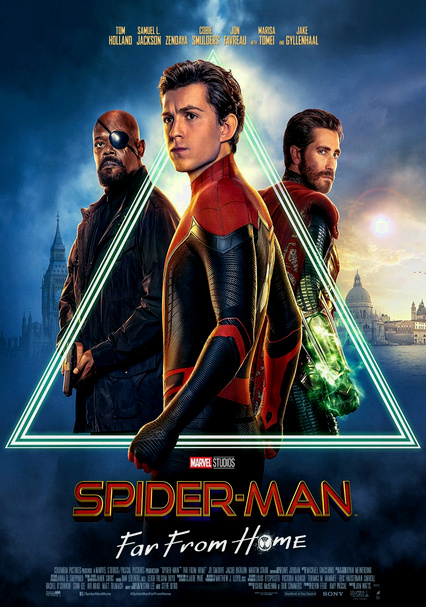
Spider-Man: Far From Home-2019

Spider-Man: Far From Home-2019

Director Jon Watts

Starring Tom Holland, Jake Gyllenhaal, Samuel L. Jackson

Scott’s Review #916

Reviewed July 5, 2019

Grade: B

Having not seen the first two installments of the latest Spider-Man franchise, nor with any prior knowledge of the Avengers franchise or the cross-sectional connections of the characters to other films, I walked into Spider-Man: Far From Home (2019) with little expectation.

And an admittedly limited understanding of the Marvel universe altogether.

The film is no better or worse than a summer popcorn flick with enough adventure and lovely locales to keep a non-super-hero buff entertained for over two hours without fidgeting too much.

The film begins with a nod to a past film, where a mysterious “Blip” occurred, erasing people for five years, and then returning them to normalcy, with no aging.

Shots of various Avengers characters, including Tony Stark (Iron Man), who have died, appear on the screen amid a musical tribute to Whitney Houston’s “I Will Always Love You.”

Peter Parker (Spider-Man) (Tom Holland) still mourns his mentor as he embarks on a two-week European vacation with his classmates as part of a school trip. He plans to confess his love for MJ (Zendaya) atop the Eiffel Tower in Paris.

Peter’s Aunt May (now reduced in age and sexy with the casting of Marisa Tomei) quickly packs his Spider-Man suit as Nick Fury (Samuel L. Jackson), a former director of S.H.I.E.L.D. attempts to enlist Peter’s help on a mission and provide him with Stark’s special glasses, named E.D.I.T.H. which possess all the databases of Stark Industries.

Quentin Beck/Mysterio (Jake Gyllenhaal), a master of Illusions, is recruited to help Spider-Man and serve as a fabulous Uncle figure.

These events all happen as Peter travels abroad.

The film is undeniably light and fun, with a bright and safe ambiance. The perilous scenes are not particularly scary or dangerous, despite the characters being at risk of death.

The teen romance angle enhances this assessment as it is a central component of the film, even as much as the adventure and superhero antics are.

Even before the teenage classmates traverse Europe, a triangle develops between Peter, MJ, and Peter’s hunky high school football rival, as does love at thirty-five thousand feet between lovebirds Ned and Betty Brant.

Tom Holland is very well cast in the lead role and is charismatic and believable. Charming with youthful innocence, he is part nerd and part hero, yet always empathetic and benevolent without feeling forced.

As a viewer unfamiliar with the first two chapters, I was immediately catapulted into his world of teen angst, romance, and his responsibility of saving the world. The young actor could have a promising future ahead of him if he avoids typecasting and chooses well-chosen roles.

The guts of the film, meaning the action sequences and the standard genre elements, are palpable and worthy of admiration on their own merits.

The visual effects are tremendous and crowd-pleasing, especially whenever Mysterio is involved. With a twisting, tornado-like blue and green swirling motion, he flies in and out of sequences with enough pizzazz to put the Wicked Witch of the West to shame.

Similarly, the gusty, unnatural storm, Earth Elemental, and the dangerous Fire provide magical and atmospheric power that enhances the film’s look.

Comedy, rather than dark and foreboding scenes, appears to be the filmmakers’ goal with this project.

As class trip chaperones and the students’ teachers, the comic duo of Julius Dell and Roger Harrington trade barbs with themselves and the kids, part bumbling and part incompetent, always offering comic moments of relief.

When Harold “Happy” Hogan becomes smitten with Aunt May, his awkwardness is cute and fresh rather than sappy and clichéd. The supporting characters have the substance to do so, but I would have preferred a bit more darkness or gloominess.

The sequences that raise Spider-Man: Far from Home above mediocrity are the excellent and plentiful European scenes, a feast of riches for this fan of world travel and culture.

The canals of Venice and the magnificence of Prague are nearly rivaled by the sophistication of London and the history of Berlin. Sadly, the film does not culminate in Paris as I had hoped and was hinted at, causing a slight hiccup in my vicarious travel pleasures.

Spider-Man: Far From Home (2019) is a film perfectly crafted for summer, and it was fittingly viewed on a scorching hot July day.

The film is not a masterpiece, sticking to a tried-and-true formula and limiting the dangerous possibilities when one threatens to destroy the world in favor of humor.

The cast is likable, the villain is compelling, and the romance showcases more than just the main couple, being careful not to limit the cash cow of special effects and adventure that the film provides in abundance.

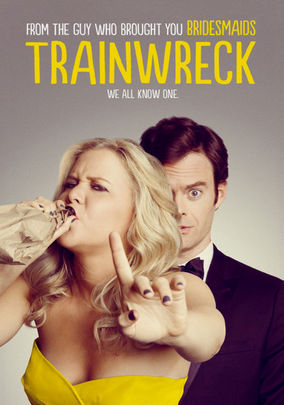
Trainwreck-2015

Trainwreck-2015

Director Judd Apatow

Starring Amy Schumer, Bill Hader

Scott’s Review #463

80036402

Reviewed August 13, 2016

Grade: B

Trainwreck is a raunchy 2015 comedy/romantic comedy that lends its success largely to its star.

Amy Schumer makes this film as good as it can be (after all, she wrote it) and despite the raunchy girl power themes that are currently the popular trend in films of this genre, Trainwreck has some laughs and good times thrown in, thanks to Schumer.

Judd Apatow directs, who has successfully made a gazillion of these types of films in modern times.

The film does teeter off into predictability toward the conclusion. It has its moments of fun and is not boring.

Unapologetic, sexually promiscuous, and boozy, Schumer plays a successful magazine writer (Amy) given an assignment she despises- interview a sports medicine doctor, named  Aaron (played by SNL alum, Bill Hader).

Amy hates sports and knows nothing about them, she also goes from man to man, nothing serious, and is currently dating a sexy bodybuilder named Steven (John Cena), who she thinks may be gay.

Predictably, Amy and Aaron fall in love.

In typical fashion, Trainwreck contains stereotypical characters or characters who are merely there to bounce off the main action.

SNL alum Vanessa Bayer, and Tilda Swinton are the most obvious examples, as the loyal best friend and rigid, type-A boss, respectively.

Brie Larson and Colin Quinn co-star as Amy’s family members. Both give one-note performances that are fine, but unspectacular, and one surmises that Brie Larson agreed to this role before her Oscar-winning turn in Room (2015).

Despite the comedy clichés, I had some good fun with Trainwreck.

Schumer is likable as an ordinary girl, think of her as the new Melissa McCarthy, to whom many people can relate. I am not sure Schumer and Hader had the best chemistry, but the point was that she found love with a “regular” guy, a tad dull, to counter-balance her big, loud personality.

And they do make a charming pair.

Some scenes work. When Amy encourages a naked Steven to “talk dirty to her” in the bedroom and he attributes everything to bodybuilding, the scene is funny.

When Amy and Steven banter with an angry couple at the movie theater, fall flat.

Certainly not high art, for the raunchy comedy genre, Trainwreck is a treat and entertaining to watch, in large part due to the comedic talents of Amy Schumer.

More often than not, when the masses rave about a current comedy as being “great”, I am usually disappointed. While Trainwreck (2015) is not great, it is good, with some laughs.

Otherwise, it is a rather by-the-numbers film.

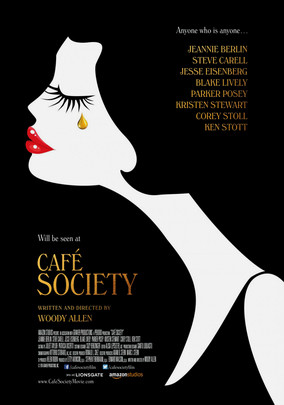
Café Society-2016

Café Society-2016

Director Woody Allen

Starring Jesse Eisenberg, Steve Carell

Scott’s Review #462

80106775

Reviewed August 11, 2016

Grade: B+

Having received sub-par reviews but wanting to see this film for myself, as it is a Woody Allen film, and I have yet to see an Allen film I did not like, I traversed to my local theater to see this flick.

I was not disappointed, though others did not share my opinion.

To love Woody Allen films is to love quirky characters who are either neurotic, damaged, or, more often than not, both.

Also notable to Café Society (2016) is the stellar cast of who’s who, many in minor cameo roles, another trademark of Woody Allen films.

Marisa Tomei, Daniel Radcliffe, and television stars Anna Camp (True Blood) have tiny roles, as do stars such as Sheryl Lee (Twin Peaks) and Tony Sirico (The Sopranos).

Additionally, Woody Allen himself narrates the film- a highlight.

The main stars of Café Society are Jesse Eisenberg and Kristen Stewart, both ideally cast.

The setting (which I adored) is 1930s Hollywood, and the action traverses between California and New York City, another common bond in Allen’s films.

Eisenberg plays Bobby Dorfman, a Jewish son of a working-class jeweler who has many siblings. Tired of New York, he flies to Los Angeles to obtain work with his hotshot Uncle Phil, played by Steve Carrell, who knows every celebrity.

There, he meets Vonnie (Stewart), and they fall in love, Bobby unaware of her on-and-off love affair with Phil.

The set and costume designs are to die for, and as a fan of this glamorous period in history, I find it an extraordinary visual treat.

Café Society is a prime example of a film that feels authentic to its time rather than appearing staged with actors merely dressed up in appropriate attire. This is tougher to achieve than one might imagine.

Despite contrary opinions, I enjoyed how most characters were wishy-washy and unsure of their motivations or feelings toward others.

Vonnie loves Phil, and then she warms to Bobby, who has been in love with her since their first meeting. She innocently shows him around Hollywood’s palatial mansions.

She is honest with Bobby but then makes a decision and becomes everything she once despised about Hollywood: a shallow, trophy wife.

Ironically, Bobby becomes involved with a stunning new woman named the same as his ex back in New York. This coincidence is crucial to the film’s point. He transfers his feelings to another woman, but is he pleased?

It did not bother me, though perhaps it should have, that several characters were introduced for a scene or two and then mysteriously dropped.

For instance, the novice hooker, Candy, having tried to make it as an actress and failed, has a heart of gold. However, after her awkward attempt at a tryst with Bobby, the character is never seen again.

Another characteristic of the film that I enjoyed is the natural, overlapping dialogue between the characters. It makes them more genuine and evokes my fondness for Robert Altman films, which used a similar technique with their actors.

The point of Café Society is that nobody ever gets what they want, and the film makes a point that nobody knows what they want.

Containing elements common to other Woody Allen films, Café Society (2016) is intended for fans of his lengthy work.

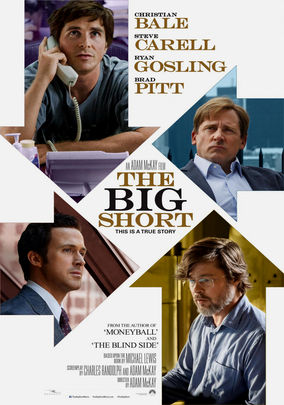
The Big Short-2015

The Big Short-2015

Director Adam McKay

Starring Christian Bale, Steve Carell

Scott’s Review #369

80075560

Reviewed January 10, 2016

Grade: A-

The Big Short (2015) is a confusing film and is its intention and also its genius.

Throughout some of the film, I was uncertain how much I liked it (or got it) and found many of the characters unlikeable, but at the conclusion, I realized that is exactly what the filmmakers intended is a clever tactic and makes The Big Short a success.

On the surface, the film has some humor but a very dark story at its core and left me a bit depressed and terrified at the conclusion.

I am happy that the film is receiving accolades and is the “thinking man’s” hit movie of the season.

To attempt to summarize the film, the film begins in 2005, approximately two years before the financial crisis of 2007-2008.

Eccentric hedge fund manager Michael Burry (Christian Bale), realizes the U.S. housing market is unstable and predicts a crash.

He attempts to profit by betting against the market, a move laughable to all around him, especially the banks who anticipate a windfall at Michael’s expense. Trader and fellow market managers, Jared Vennett and Mark Baum (played by Ryan Gosling and Steve Carrell) catch wind of Michael’s theory and try to get in on the action.

There is a sub-plot involving two younger investors also attempting to profit through the guidance of a retired banker (played by Brad Pitt).

The financial collapse is a tender subject and certainly no laughing matter, especially since it is so recent and affects many people.

The Big Short is touted as a comedy, which is strange. I found the audience didn’t know exactly what to laugh at or when. The film’s “laughs” were cynical, witty, and sometimes wicked. Many people do not get this type of humor.

In real life, people were kicked out of their homes and lost their jobs, pensions, etc. and it was all the result of greed, which The Big Short hammers home.

Several scenes include frat-boy investor/trader types getting rich by enabling almost anyone to afford a new house. Little did these people realize that there was a catch.

The film paints a jaded picture of Wall Street. The rich get richer at the expense of the middle class and the poor. It is an age-old sad tale.

Performance-wise, Carrell and Bale are the standouts. They both play characters who are damaged. Bale’s Michael is socially awkward, and has a false eye, but is also a genius. Carrell’s Mark is angry, grizzled, and is in therapy as a result of his brother’s suicide.

Both actors are great and have developed into worthy, credible acting talents. Worth mentioning, are small, but meaningful roles by Melissa Leo and Marisa Tomei.

The Big Short is shot interestingly, and highly unusual. From time to time, the action will stop and a famed celebrity (Selena Gomez, a world-renowned chef, or a model in a bubble bath) will explain the events, thus far, or give some review.

Also, more than once the actors will turn to the camera and speak directly to the audience. A personal touch that I found effective.

In the end, not much in life has changed, which is the message, and a frightening one. As one character brilliantly puts it “people will go back to blaming the poor and the immigrants”, which is a sad message.

After millions lost everything, not much has changed in the world and The Big Short makes that very clear. The people responsible have gotten away with crime, the banks bailed out, and a new scheme is undoubtedly in place.

It’s a sad world.

The Big Short (2015) is a gritty, harsh look at reality and a terrific film.

Oscar Nominations: 1 win-Best Picture, Best Director-Adam McKay, Best Supporting Actor-Christian Bale, Best Adapted Screenplay (won), Best Film Editing

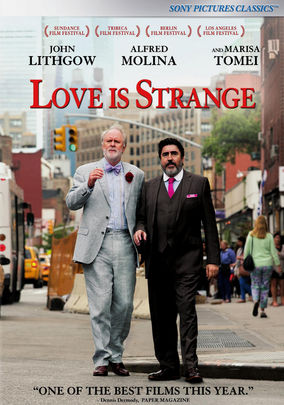
Love Is Strange-2014

Love Is Strange-2014

Director Ira Sachs

Starring John Lithgow, Alfred Molina

Scott’s Review #174

70299861

Reviewed September 24, 2014

Grade: B

Love Is Strange (2014) is sweet, though not nauseatingly sentimental, looking at many different types of relationships, at the forefront is the same-sex couple, Ben and George, played by John Lithgow and Alfred Molina respectively.

They are a successful New York City couple of a certain age, together for nearly thirty years, and finally legally wed in a low-key ceremony surrounded by friends and family.

George teaches music at a strict Catholic high school where the students and staff know and love him and his new husband. The bishop is not supportive of his marriage and he is unceremoniously fired.

This causes Ben and George to become homeless and rely on family and friends for a roof over their heads.

The film features several secondary character relationships.

Ben’s nephew and wife balance busy careers with a temperamental, rebellious, confused son; Ben’s niece from Poughkeepsie seems neurotic.

Neighbors who are gay police couples have loud parties seemingly every night. Marisa Tomei, who plays Ben’s niece by marriage, Kate, and Charlie Tahan as Joey, Ben’s great-nephew are probably the most prominently featured in the supporting cast.

While well-meaning and accommodating, Kate bottles her anger and comforts herself with nightly consumption of red wine. Joey lashes out at his great Uncle in frustration criticizing his artwork and scolding him for using his teen friend in a portrait, a friend whose sexuality is unclear.

Most other characters are not fleshed out well and are there to move the plot along. This is slightly disappointing. I would have preferred a bit more backstory regarding the rest of the cast.

Throughout the film, a few clues are dropped surrounding Joey and his friend’s sexuality, but not pursued further than on the surface.

I was curious about the cop’s back story. How long have they been together? Do they face conflict at work? Numerous scenes show both cops in uniform while running errands or visiting the hospital, which seems to be the film’s desire to emphasize that cops can be masculine and gay- a fact I love, yet the characters are only one-dimensional.

Why is Ben’s niece neurotic? This is also not pursued at all.

The film belongs to Lithgow and Molina. The two have such effortless, natural chemistry that the audience instantly believes they have been together for decades. The fact that Lithgow and Molina are lifelong friends in real life surely adds to the realism and naturalness.

Ben is the yin to George’s yang. The performances of Lithgow and Molina are so understated and calming that one might overlook how excellent they are since they are both low-key characters.

Love Is Strange (2014) is a film about strength, courage, loyalty, and perseverance through life’s challenges.

It is a sensitive and lovely film.

Independent Spirit Award Nominations: Best Feature, Best Male Lead-John Lithgow, Best Supporting Male-Alfred Molina, Best Screenplay