Tag Archives: W. Earl Brown

Scream-1996

Scream-1996

Director Wes Craven

Starring  Neve Campbell

Top 250 Films #161

Top 40 Horror Films #25

Scott’s Review #710
Reviewed January 5, 2018

Grade: A-

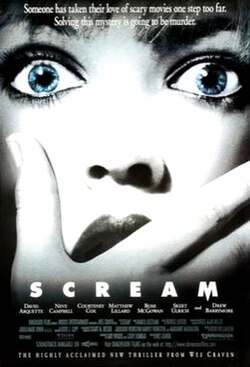
Wes Craven’s 1996 film Scream is a film that greatly helped bring the horror genre back into relevance after a long drought in the late 1980s and early 1990s, when horror films suffered from both oversaturation and clichéd messes.

Thanks to Scream, creativity and plot twists and turns returned to the forefront of good horror films, and a clever film was born.

Fast-forward to 2018, and the film does suffer a bit from a dated 1990s look, but it is still great fun to watch and a treat for all classic horror buffs, with references to classic greats galore.

The film is sectioned off nicely and gets underway quickly (in the best sequence of the film) as Casey Becker (Drew Barrymore) receives a flirtatious phone call from a man asking her to name her favorite horror film while making popcorn.

The friendly game quickly turns vicious as the caller threatens to kill her boyfriend should she answer a question incorrectly.

In a clever twist (think 1960s Psycho!) Casey and her boyfriend meet deadly fates as the opening credits roll.

Given Barrymore’s huge star in 1996, this twist was all the more shocking and attention-grabbing.

The remainder of the film centers around Sidney Prescott (Neve Campbell), a popular California high school student, as she is pursued by an attacker known only as “Ghostface”, who dons a creepy costume and terrorizes victims via phone calls.

The small town, led by police officer Dewey Riley (David Arquette) and bitchy newswoman Gale Weathers (Courteney Cox), is determined to unmask the killer and understand their motivations.

Sidney’s boyfriend, Billy (Skeet Ulrich), and other friends are along for the ride as a possible connected sub-plot involving Sidney’s deceased mother is introduced.

A romance between Dewey and Gale is also broached.

Scream is an enormous treat for fans of the horror genre, with numerous references (and film clips!) to classics such as 1978’s Halloween throughout.

Other references to Friday the 13th, Prom Night, and A Nightmare on Elm Street appear during the film.

Writer Kevin Williamson, a horror enthusiast, must have had a ball writing the screenplay that would become Scream.

In 1996, the mega-success of the film not only jump-started the entire genre but also introduced younger fans of Scream to classics from their parents’ generation, sparking their interest in the films.

Classic horror films are not only referenced during the film but also explained, mostly by the supporting character of Jamie, the nerdy kid who works at the video store and adores horror films.

A sequence in which he explains several “rules” of the horror genre is superlative, creative, and just great fun. He tells the teenagers at a party that anyone who drinks, has sex, or says “I will be right back” is doomed to suffer a violent fate.

This clever writing makes Scream enormous fun to watch.

The climax of Scream is quite surprising in itself, and the “great reveal” of the murderer (s) is also intelligent writing and quite the surprise.

Several red herrings are produced along the way, casting suspicion on other characters who may or may not be the killers.

A small gripe of the writing is the motivations of the murderers- when the explanation is given for their killing spree, the reasoning is a bit convoluted and hard to fathom, but this is horror. Suspension of disbelief is always a necessity.

Scream is best remembered for giving the horror genre a good, hard kick in the seat of the pants and shaking up the elements a bit while preserving the core ideals of a good slasher film (suspense, a whodunit, and good, solid kills).

Scream (1996) was followed by several sequels, some of which achieved greater success than others.

In 2018, the film may not be quite as fresh as it once was, but it is still a solid watch and memorable for relaunching a genre.

There’s Something About Mary-1998

There’s Something About Mary-1998

Directors Peter Farrelly, Bobby Farrelly

Starring Ben Stiller, Cameron Diaz

Scott’s Review #1,428

Reviewed June 16, 2024

Grade: B+

Since many films are released within the romantic comedy genre, most are disposable and forgettable. Very few stand out initially, let alone stand the test of time.

Decades later, There’s Something About Mary (1998) holds up well mostly because of its chemistry and laugh-out-loud memorable moments. It also has a heart and is not mean-spirited, showcasing a brewing romance people can relate to.

Watching in 2024, particularly interesting is the appeal of Cameron Diaz since she retired from acting, and a young Ben Stiller, who was then in his heyday and a box-office gem.

Brett Favre, who then was a superstar NFL quarterback, makes a cameo appearance.

It’s a pleasure to watch a hit film from decades ago that still holds appeal.

Ted’s (Ben Stiller) unexpected dream prom date with Mary (Cameron Diaz) in 1985 is disastrous when an embarrassing injury at her home prevents them from getting to the prom. Mary leaves town shortly after.

Thirteen years later, pre-social media in 1998, Ted hires shady investigator Pat Healy (Matt Dillon) to track down Mary so he can reconnect with her. Pat becomes obsessed with her and lies to Ted about Mary, learning everything she can about her to trick her into dating him.

Ted realizes the truth and travels to Miami, Florida, to meet Mary, a successful orthopedic surgeon, and reconnect with her.

Instantaneous hilarity comes to mind at the mention of two legendary scenes involving Ben Stiller’s Ted that most people have heard of.

While using the bathroom at Mary’s house before leaving for the prom, Ted gets his private parts, or ‘frank and beans’, caught in his zipper.

Every male viewer will squirm in imagined discomfort, but the hijinks with Mary’s parents and neighborhood firefighters who get involved make the sequence legendary.

This pairs well with a later scene when Ted masturbates just before his date with Mary to relax. Mary mistakes some ‘residue’ on Ted’s ear for hair gel and hilariously applies it to her hair, causing it to stick straight up in the air during dinner.

Both scenes still feel fresh and natural years later and are now historical.

The introduction of Tucker (Lee Evans), a third admirer of Mary, doesn’t work so well in hindsight. The revelation that he is not a British architect but merely a pizza deliverer who injured his back to get close to Mary feels forced and unnecessary.

The triangle between Ted/Mary/Pat is just enough.

The inclusion factors are impressive. In 1985, Mary had a black stepfather and a mentally disabled brother, both of whom she adores.

When Ted drives from Rhode Island to Florida, he stops at a rest area and is assumed to be gay. This is preceded by a session with a psychiatrist who suspects Ted may be gay.

These additions go a long way to showcase normalcy in these individual areas.

It’s also impressive that the Farrelly brothers (Peter and Bobby), who direct the film, make Mary a surgeon, paving the way for female viewers to aspire to the same.

There’s Something About Mary gets a slight knock for exploiting female breasts. Mary is seen at least twice through a window putting on a bra while a male spies on her from a distance.

The characters are benevolent, especially Ted and Mary, making it easy for the audience to root for them.

Thanks to the tremendous chemistry between Diaz, Stiller, and Dillon, There’s Something About Mary (1998) feels fresh and romantic without a forced feeling.

Backdraft-1991

Backdraft-1991

Director Ron Howard

Starring Kurt Russell, William Baldwin

Scott’s Review #1,216

Reviewed January 2, 2022

Grade: B

Backdraft (1991) is a highly entertaining yet completely implausible action thriller film directed by Ron Howard.

If made today, it would be on par with Chicago Fire or any other of the slew of similar procedural NBC television shows that currently exist.

The film is even set in Chicago, just like the television series.

The story involves an arsonist on the loose and the subsequent investigation to catch them.

Howard is an influential and respectable director, but his films frequently harbor a safe territory, rarely veering too far left of center.

With Backdraft, I assumed I would get a by-the-numbers masculine film, and that is exactly what I received.

The beefy cast includes Kurt Russell, Billy Baldwin (brother of Alec), and Robert De Niro, with Jennifer Jason Leigh and Rebecca De Mornay serving as secondary female characters.

Chicago firefighting brothers Stephen (Russell) and Brian (Baldwin) have been rivals since childhood. Brian, struggling to prove himself as a worthy firefighter, transfers to the arson unit where he aids Inspector Don Rimgale (De Niro) in his current investigation.

There is a rash of fires involving oxygen-induced infernos called backdrafts.

But when a conspiracy implicating a crooked politician and an arsonist leads Brian back to Stephen, he is forced to overcome his brotherly competitiveness to crack the case.

Anyone involved in their local fire department or who has a strong sense of loyalty or brotherhood in a blue-collar vein will love Backdraft for its message.

The strong family unit that pervades most firehouses and police stations is evident throughout the film, fostering a sense of community.

It’s a nice feeling and sets the tone for the viewer to feel a part of things and root for the heroes to defeat whoever is responsible for the arson.

Could it be an unstable member of the fire community or an outsider harboring a grudge?

The story, despite being somewhat of a whodunit, is not the strongest aspect of Backdraft, nor is it much of a reason to tune in and follow. Too often, the writing is lazy or languishes in television-drama territory, with obvious, melodramatic situational setups.

The realism is not there. The fire sequences are completely stagy and meant to perfectly parlay the story elements rather than have an identity of their own.

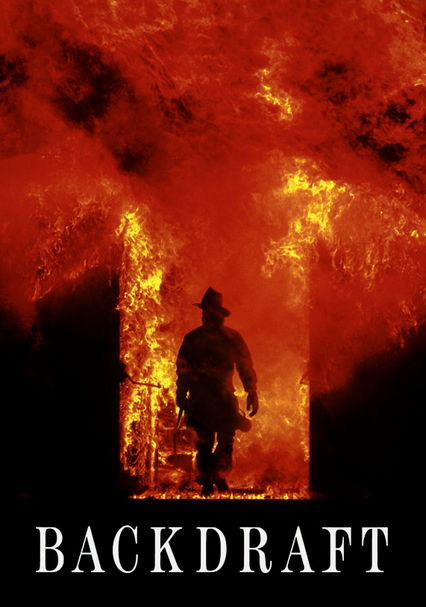
With all that said, the star of the film is its visuals, which give Backdraft its adventure and edge-of-your-seat thrills. Even though I knew the fires and explosions were manipulated, I felt like I was inside a burning room with the hissing and crackling sounds of the fire and wind enveloping me.

It’s all for dramatic purposes, of course, but the state-of-the-art special effects are cool to experience.

This is the key to the success of a film like Backdraft and is enough for me to keep watching and become invested in the entire work.

Yes, many characters are types, and despite the big A-list stars, Russell and Baldwin are the only ones who have much of anything to do.

Their brotherly relationship, though fraught with friction, is at the heart of the characters, though the corny dialogue sometimes slips into soap-opera territory.

Backdraft (1991) is a cinematic Hollywood mainstream film that works on many levels. Forget the lazy storylines and the predictability factors for a minute. It provides a blazing-hot inferno of sharp visuals that are worthy of commendation and appreciation.

Oscar Nominations: Best Sound Effects Editing, Best Visual Effects, Best Sound

The Sessions-2012

The Sessions-2012

Director Ben Lewin

Starring John Hawkes, Helen Hunt

Scott’s Review #413

70209251

Reviewed June 18, 2016

Grade: B-

The Sessions (2012) is a cute, sentimental type film that is pleasant but not much more.

I found the film to be a bit safe, although Helen Hunt’s full-frontal nude scenes are surprising to me and quite brave of the actress. I’ve never been much of a Helen Hunt fan and I have always found her to be overrated, but her performance is very good.

I felt, for the subject matter, the film is too sentimental and too Hollywood, though I do admit to enjoying it.

It might have been grittier and the characters explored a bit more though.

I did not enjoy William Macy’s silly priest character. His character seems rather unnecessary to the rest of the film and has no real point except being the unnecessary moral compass.

The dynamic between John Hawkes and Helen Hunt’s characters is the best part, otherwise, The Sessions (2012) is a mediocre offering.

Oscar Nominations: Best Supporting Actress-Helen Hunt

Independent Spirit Award Nominations: 2 wins-Best Male Lead-John Hawkes (won), Best Supporting Female- Helen Hunt (won)

Black Mass-2015

Black Mass-2015

Director Scott Cooper

Starring Johnny Depp

Scott’s Review #278

Black_Mass_(film)_poster

Reviewed September 28, 2015

Grade: B+

A dark tale of crime, corruption, and Irish mob ties encompass Black Mass (2015), a drama based on the life and times of infamous Boston crime lord Whitey Bulger.

Set primarily in Boston, with a segue to sunny Miami during the 1970s and 1980s, the film mainly focuses on the intricate dealings between Bulger and childhood friend John Connelly. Now FBI, he uses Bulger as an “informant” to secretly bring down an Italian mafia figure, but slowly becomes more involved in Bulger’s sinister world.

Beginning in 1975, the film is authentic in its use of the styles, cars, and looks of the times in Boston during that period. Plausibility is apparent, and powerful acting is shown from top to bottom.

The stellar cast of Black Mass and the hefty cast features an array of well-known and capable actors, adding realism.

Led by Johnny Depp as Whitey, Depp gives an eerie, hypnotic performance as his bright blue eyes sparkle in a devious way.

Whitey is ruthless and will do whatever is needed to keep power and control. Like Connelly, Joel Edgerton is arguably the film’s lead character, though Depp gets top billing. Edgerton, in real life handsome, appears frumpy, and as a regular Joe type.

Supporting turns by Benedict Cumberbatch, as Whitey’s powerful Senator brother, is crafty and sleek, but corruption shrouds him.

Kevin Bacon, Dakota Johnson, Peter Sarsgaard, and Julianne Nicholson portray smaller yet pivotal roles and all do a fine job.

The screenplay is intelligently written. The story is quite dark and there are no laughs or light moments.

There are numerous deaths, the victims shot at point-blank range, but also two deaths in particular, where the victim’s suffering is prolonged and the scenes are cringe-worthy. The film is very violent and given the subject matter, is riddled with foul language.

One impressive aspect of Black Mass is the character-driven tale and that it is based on a real-life person adds to this.

Not only is Bulger fleshed out, but John Connelly is written very well. Gradually becoming immersed in the crime world as opposed to the world of law, we see Connelly sink deeper and deeper into Bulger’s world, and not so unwillingly either.

He loses his wife Marianne (Nicholson) along the way as she tires of the danger and corruption surrounding her. A chilling scene occurs when Bulger confronts Marianne in her bedroom, after observing negative vibes from her, and warns her in a flirtatious way, never to cross him.

As he caresses her face and slowly firms his grip, it is a rather frightening scene.

The dialogue is crisp. When Bulger is invited to a steak dinner at Connelly’s house, there is awkward tension at the dinner table. Jovial small talk over the preparation of the delicious marinated steak everyone is eating comes to the forefront as Bulger asks Connelly’s partner to reveal his family secret recipe for the favorite steak he has ever eaten.

When the partner eagerly confesses the recipe, he is coldly quizzed whether he would give up Bulger’s secrets as easily.

This is one of the best scenes in the film.

Comparisons to Goodfellas (1990) are evident but without the fun. I thought of The Departed (2006) throughout the viewing as well.

I think director Scott Cooper goes for and successfully achieves, good straight-forward, dark story-telling. Take the number of killings. The organized crime world is dirty, intense, and unkind and Black Mass portrays this well.

Black Mass (2015) is a success on many levels. The superior acting, detailed writing, and truthfulness create a good film. Just be sure to remember it’s a heavy one.

Wild-2014

Wild-2014

Director Jean-Marc Vallee

Starring Reese Witherspoon

Scott’s Review #249

80013281

Reviewed June 21, 2015

Grade: B+

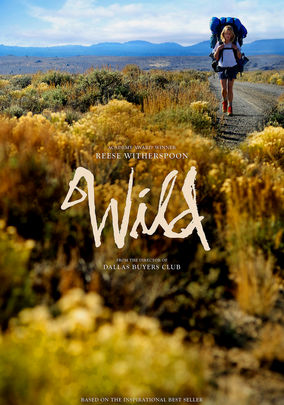
Wild (2014) is a personal story of a young woman’s 1995 challenge to hike the 2,650-mile Pacific Crest Trail as a form of therapy for her divorce and her recovery from drug addiction.

The film stars Reese Witherspoon in a thoughtful biography of a real-life figure, Cheryl Strayed, and is adapted from a novel entitled Wild: From Lost to Found on the Pacific Trail.

The film depicts Cheryl’s struggles to survive in remote northern California through harsh weather and her encounters with strangers.

The film is a showcase for Witherspoon as she takes center stage, appearing in almost every frame of the film.

Her producing the project undoubtedly contributes to this. Regardless, it is a winning turn for Witherspoon as she is excellent.

She portrays the role with vigor, emotional rawness, and vulnerability, which comes across on-screen.

She deserved her Oscar nomination for this part.

What sets her apart from other actresses who may have played this role is that Witherspoon is a small, which makes her physical struggle to navigate trails and wilderness while hauling a large backpack of necessities believable.

Through flashbacks of Cheryl’s life before the enormous hike, we are introduced to her and the challenges she faced. We know that she is a recovering addict, but we do not know what led to these events.

Living in Minneapolis, she is very close to her mother, Bobbi, played by Laura Dern, who tragically dies.

This leads Cheryl down a path of destructive behavior and ultimately to her divorce from her husband, Paul, who periodically sends her care packages along the way.

Cheryl’s bond with her mother, a struggling woman herself, is deep. Bobbi struggles to raise a family and improve her education and life, which the flashback scenes featuring Cheryl as a teenager explore.

I love the encounters Cheryl faces along the trail, and I feel they add depth to the film.

Few and far between are these gems of interchange since she is mostly alone with nature, and the characters are interesting. Alone in the dark and desperate for a meal, she flags down a farmer named Frank.

At first, Frank seems dangerous and wields a gun, so Cheryl is wary as she goes home with him for dinner. Happily, Frank is married to a kindhearted woman named Annette, and the three of them enjoy a lovely feast.

Later, she encounters a young boy whose mother has died. They bond as the boy sings a song his mother used to sing to him, and when he leaves, Cheryl sobs with emotion for her mother.

These small snippets of real-life conversations and togetherness make the film feel happy, and we root for Cheryl to accomplish her enormous feat.

Thanks to a bravura performance by Witherspoon, Wild (2014) is much more than a woman surviving on her own in the wilderness. It is encased in quiet emotion and understated supporting performances that give layers to a human story.

Oscar Nominations: Best Actress-Reese Witherspoon, Best Supporting Actress-Laura Dern