Tag Archives: Vondie Curtis-Hall

Falling Down-1993

Falling Down-1993

Director Joel Schumacher

Starring Michael Douglas

Scott’s Review #1,192
Reviewed November 6, 2021

Grade: B+

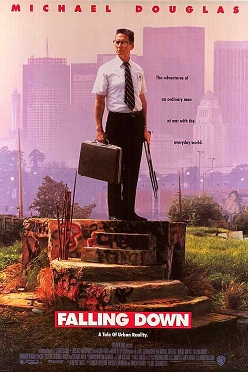
Falling Down (1993) is a film with a message, or arguably several messages.

It’s about a man fed up with almost everything, on the brink of a full-throttle meltdown.

The film blends entertainment with a message about socio-economic unfairness, inequality, and related issues.

Whether people take these elements as seriously as they should is at risk due to the popcorn qualities. It’s almost like it doesn’t know what it is.

Is it a kick-ass thriller, a black comedy, or a fantasy?

The film certainly entertains.

This is unsurprising because Joel Schumacher is at the helm. The man is a mainstream director churning out hits like The Client (1994), Batman Forever (1995), and Batman & Robin (1997) throughout the 1990s.

Some were more successful than others, but Falling Down is his best work.

I am a big fan of Falling Down, with the awareness that the messages peppered throughout may not be taken as seriously as they ought to be. And the reason is that there are too many of them. It’s almost as if they are boxes being checked off a list.

But it bears repeating that the entertainment factor is fabulous.

One scorching summer day in Los Angeles William Foster (Michael Douglas) an already frustrated middle-aged man who is unemployed and divorced is having a terrible day.

When his car breaks down on the freeway, he leaves his vehicle and begins a trek across the city to attend his daughter’s birthday party.

As he makes his way through urban neighborhoods, William’s frustration and bitterness are tested at every turn, resulting in violent encounters with various people, including a vengeful gang and a pursuing veteran police sergeant, Martin Prendergast (Robert Duvall).

Unfortunately for Prendergast, today is the day before his long-awaited retirement.

Douglas delivers an excellent performance as Foster. He makes the character relatable to every viewer who has ever felt so fed up that they want to discharge the people responsible for the unfairness.

He takes his anger out only on those who deserve it, which makes the character something of a hero.

The white supremacist, the belligerent Korean grocery store owner, the gang members, and the lazy construction workers all deserve their just desserts.

Throughout the film, I cheered Foster mightily and chuckled at his wit.

My favorite sequence takes place at the fast-food joint Whammy Burger. All Foster wants is his breakfast, but he arrives one minute past the cut-off as the unsympathetic cashier smugly tells him.

He proceeds to ravage the restaurant in anger.

Despite the humor that Schumacher adds, the message must be taken seriously. Minority characters are aptly shown as repressed or not treated well, and that point sticks with me until the end.

The least interesting story point is the entanglement between Foster and his ex-wife Beth, played by a woefully underutilized Barbara Hershey.

The Oscar-nominated actress can do so much, but her talents are wasted in a throwaway role as an underdeveloped wife.

I never warmed to Robert Duvall’s police sergeant character either, and while sympathetic to Foster’s cause because of a situation with his son, the plot point never develops fully. Prendergast’s overbearing wife and a young police officer he seems obsessed with are never explored well.

Despite great talent, the film belongs to Michael Douglas.

The mood and cinematography deserve accolades. The humidity is suffocating, and the layers of smog hanging over Los Angeles hammer home the film’s stuffy nature. One can imagine the sweaty environment leading to explosions of anger.

What Schumacher does, besides entertaining the audience, is show them that a once-successful man who had a great job and a happy family life can lose it all and snap.

Falling Down (1993) shows that what happens to Foster can happen to anyone.

Let’s live each happy day to the fullest while we can.
Harriet-2019

Harriet-2019

Director Kasi Lemmons

Starring Cynthia Erivo, Leslie Odom Jr.

Scott’s Review #1,031

Reviewed June 10, 2020

Grade: B

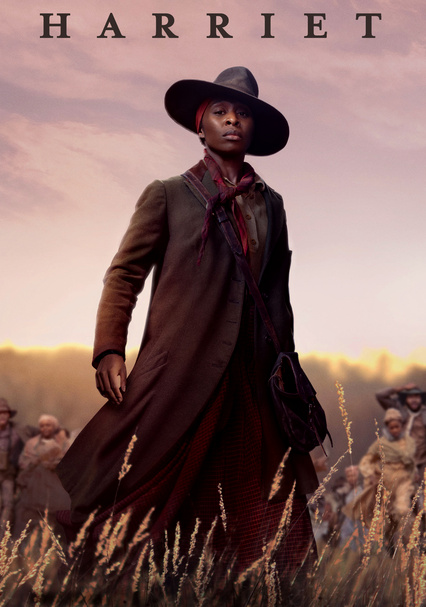
The story of real-life American freedom fighter Harriet Tubman, a woman who risked her life multiple times to rescue enslaved people from the pre-Civil War South of the United States, is a story of monumental importance to get right.

An escaped enslaved person herself, Harriet was more than an Abolitionist; she was a political activist and hero to all whose lives she touched. She was a figure that all women and men should aspire to emulate with her message of freedom and civility.

The cinematic telling of Harriet’s story, titled Harriet (2019), is a mild success, mostly deserving of praise for being told at all.

At well over one hundred and fifty years post-civil war, racism still runs rampant across the United States, so the release of the film is essential.

A gutsy performance by Cynthia Erivo, a British singer-turned-actor, is the high point. Still, unfortunately, the rest of the offering is lackluster, frighteningly modern in look and feel, with clear heroes and villains, and nobody with muddied motivations to be found anywhere.

We first meet young Harriet (Erivo), then named “Minty” Ross, in 1840s Maryland, then a slave state. She is to be married to her intended, John Tubman (Zackary Momoh), already a free man.

Minty’s father, also free, asks her owner to release her as his grandfather had promised before his demise.

Refusing, his son, Gideon (Joe Alwyn), decides to sell Minty as punishment. Savvy, Minty flees for the northern states and settles in Philadelphia, a newly free woman with her life ahead of her.

She risks capture and death to return to Maryland, in disguise, to rescue her family from the horrors of slavery.

Her plight was so essential and so heroic that I wanted to love this film.

It is okay, but it does not do justice to the real-life Harriet, nor does it succeed as a cinematic offering. The weakest point is the modern look that the film and the actors possess, and I think this was done intentionally.

Every single actor, black and white, looks like a present-day actor dressed in mid-nineteenth-century garb, and it does not work. My hunch is that filmmakers wanted to add relevance to the current racial issues, and I am all for that, but the film suffers as a result.

I am all for feminism in cinema, but Harriet can be accurately accused of stomping that point into the ground.

During some of the numerous action sequences when Harriet becomes a flawless sharpshooter, she nearly rivals a Marvel superhero instead of a simple woman championing a cause. And why is Harriet psychic?

This is a silly addition that feels plot-driven. Director Kasi Lemmons, known for films like Eve’s Bayou (1997) and Black Nativity (2013), knows her way around a picture, but Harriet will not be known as her finest achievement.

There are some positives to mention. Erivo, not known for her acting as much as her singing ability, rises to the occasion. Viola Davis nearly ended up being cast, who would have been brilliant, but Erivo nonetheless impresses.

She is both pretty and plain, which humanizes Harriet and makes her relatable to many.

Erivo strikes a balance between toughness and sympathy, allowing the audience to champion her cause without it feeling forced. Early in the year, thought to be a lock for the Best Actress Oscar, the film lost ground critically, and Erivo limped to an Oscar nod, and she was lucky to get that.

She lost.

The cinematography is credible, which is another positive aspect of the film. The green, lush landscapes are distinctly southern and peaceful, featuring roaring rapids, bridges, and spacious forests that make for atmospheric backdrops serving as settings for many sequences.

Casting Janelle Monae as the gorgeous (and free) Marie Buchanan is okay and adds a Color Purple (1985) comparison, reminiscent of Celie and Shug Avery.

Ironically, the acting among the black actors is superior to that of the most over-the-top or cartoon-like white actors.

Best described as a formulaic Hollywood film with a good message, Harriet (2019) could be a launching pad for Erivo, a new name in Hollywood films.

She tackles a challenging role and is the standout performer in the production. The sleekness and modernism make the resulting experience less than the grittiness that a film like Harriet needs.

Much better biographies of legendary figures exist, a shame since Harriet Tubman is one of the most prominent to have their story told on the big screen.

Oscar Nominations: Best Actress- Cynthia Erivo, Best Original Song-“Stand Up”

Black Nativity-2013

Black Nativity-2013

Director Kasi Lemmons

Starring Forest Whitaker, Angela Bassett

Scott’s Review #46

70279001

Reviewed June 18, 2014

Grade: C-

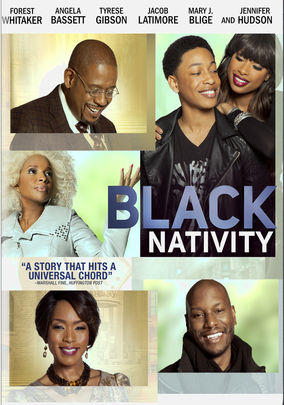
Black Nativity (2013) is a family holiday movie about a poor Baltimore teen sent to live with his affluent, estranged grandparents (Forest Whitaker and Angela Bassett) in Harlem.

Jennifer Hudson plays the teen’s financially struggling mother.

The estrangement stems from a silly misunderstanding years ago, when Hudson’s character was pregnant with her now-teenage son.

I enjoyed the performances of Whitaker, Bassett, and Hudson, and the sprinkling of songs performed by the leads was nice, but the story was incredibly sappy and predictable and wrapped up in a nice bow at the end of the film.

Scene one screams predictable and safe.

I did not sense any real conflict or grit throughout the movie, and it felt like watching a Hallmark-made-for-television movie- not a compliment.

Black Nativity (2013) is a nice family story, but a little more.

Skip unless you enjoy the watered-down family fare.