Tag Archives: Wayne Duvall

Falling Down-1993

Falling Down-1993

Director Joel Schumacher

Starring Michael Douglas, Robert Duvall

Scott’s Review #1,192

Reviewed November 6, 2021

Grade: B+

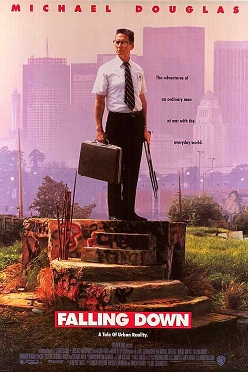
Falling Down (1993) is a film with a message or arguably several messages. It’s about one man who is fed up with almost everything and is on the brink of a full-throttle meltdown.

What the film does is mix entertainment with this message about socio-economic unfairness, inequality, etc.

Whether or not people take these elements as seriously as they should is at risk from the popcorn qualities. It’s almost like it doesn’t know what it is.

Is it a kick-ass thriller, a black comedy, or a fantasy?

The film certainly entertains.

This is unsurprising because director Joel Schumacher is at the helm as director. The man is a mainstream director churning out hits like The Client (1994), Batman Forever (1995), and Batman & Robin (1997) throughout the 1990s.

Some were more successful than others but Falling Down is his best work.

I am a big fan of Falling Down with the awareness that the messages peppered throughout may not be taken as seriously as they ought to be. And the reason is that there are too many of them. It’s almost as if they are boxes being checked off a list.

But it bears repeating that the entertainment factor is fabulous.

One scorching summer day in Los Angeles William Foster (Michael Douglas) an already frustrated middle-aged man who is unemployed and divorced is having a terrible day.

When his car breaks down on the freeway, he leaves his vehicle and begins a trek across the city to attend his daughter’s birthday party.

As he makes his way through urban neighborhoods, William’s frustration and bitterness are tested at every turn resulting in violent encounters with various people, including a vengeful gang and a pursuant veteran police sergeant Martin Prendergast (Robert Duvall).

Unfortunately for Prendergast, today is the day before his long-awaited retirement.

Douglas delivers an excellent performance as Foster. He makes the character relatable to every viewer who has ever felt so fed up they want to discharge the people responsible for the unfairness. He only takes his anger out on those who deserve it and that makes the character somewhat of a hero.

The white supremacist, the belligerent Korean grocery store owner, the gang members, and the lazy construction workers all deserve their just desserts.

Throughout the film, I cheered Foster mightily and chuckled at his wit.

My favorite sequence occurs at the fast-food joint named Whammy Burger. All Foster wants is his breakfast but he arrives one minute past the cut-off as the unsympathetic cashier smugly tells him.

He proceeds to ravage the restaurant in anger.

Despite the humor that Schumacher adds the message must be taken seriously. Minority characters are aptly shown as repressed or not treated well and that point sticks with me until the end.

The least interesting story point is the entanglement between Foster and his ex-wife Beth, played by a woefully underutilized Barbara Hershey.

The Oscar-nominated actress can do so much but her talents are wasted in a throwaway role as the underdeveloped wife character.

I never warmed to Robert Duvall’s police sergeant character either and while sympathetic to Foster’s cause because of a situation with his son, the plot point never develops fully. Prendergast’s overbearing wife and a young police officer he seems obsessed with are never explored well.

Despite great talent, the film belongs to Michael Douglas.

The mood and cinematography deserve accolades. The humidity is suffocating and the layers of smog overlooking Los Angeles hammer home the stuffy nature of the film. One can imagine the sweaty environment leading to explosions of anger.

What Schumacher does besides entertain the audience is show them that a once successful man who once had a great job and happy family life can lose it all and snap.

Falling Down (1993) shows that what happens to Foster can happen to anyone.

Let’s live each happy day to the fullest while we can.
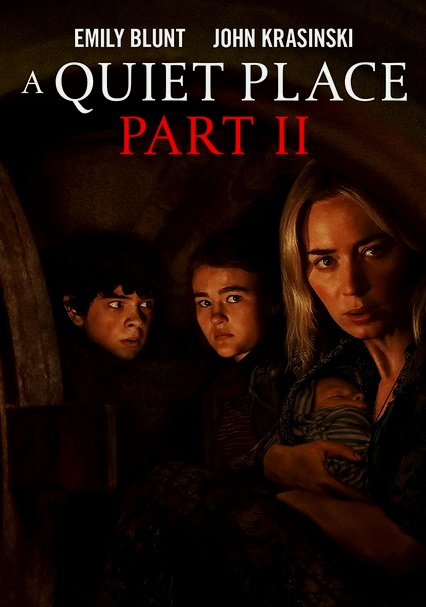
A Quiet Place Part II-2021

A Quiet Place Part II-2021

Director John Krasinski

Starring Emily Blunt, John Krasinski

Scott’s Review #1,170

Reviewed August 12, 2021

Grade: B+

A Quiet Place Part II (2021) makes excellent use of sound, almost a character in itself, by featuring a deaf character and aliens who are blind and rely solely on their acute sense of hearing to stalk and annihilate their prey.

The big sounds and the deafening silences keep the film fresh, capitalizing on its novel approach.

The film is both a sequel and a prequel, presumably allowing director, writer, and actor John Krasinski the chance to reprise his ill-fated character, offering a neat timeline to the events of the first film, A Quiet Place (2018).

Since that film was an enormous success, a sequel was green-lit by the studio almost immediately. It offered Krasinski a great deal of freedom, which he runs within this offering.

I can’t say the plot exactly comes together as tidily as I had hoped, and there is no explanation for the alien’s actions or motivations – what is it they want, and where do they come from?

The lack of explanation gnawed at me. After all, they must have been created from somewhere. The lack of motivation of a horror character like Michael Meyers is understandable, but aliens?

The film is raised quite a bit above average thanks to a thrilling and fascinating opening sequence. This lengthy scene was astonishing with differing character points of view, meticulous filmmaking, and frights galore.

Plus, the appearance of Lee (Krasinski, who was killed in the first film) immediately piques our intrigue.

I wish the rest of the film had remained as breathtaking, but it’s not bad either. As a northeasterner, I was treated to some of the action taking place on a dilapidated Metro-North railway train. Any commuter will appreciate this nod.

And who doesn’t enjoy numerous shots of Emily Blunt playing bad-ass with a loaded shotgun? The talented actress, wife of Krasinski, adds credibility to the horror genre.

I know someone who saw A Quiet Place Part II without having seen A Quiet Place and still enjoyed it, but I think it’s helpful to see the material to appreciate the first scene.

We begin on Day one, and the Abbott family-husband, wife, and three children-enjoys a little league game on a summer afternoon. When suddenly a cloud-like object plummets to Earth, all hell breaks loose, and the town is in a terrified flight as aliens destroy all in their path.

This plot point is interesting since viewers will know that two of the family members will not survive very long.

A year later, the Abbott family-Evelyn (Blunt), Regan (Millicent Simmonds), Marcus (Noah Jupe), and a newborn must leave their farm with a calculated plan to reach safety. They realize through a never-ending song played on the radio that there is a sanctuary on a nearby island.

Clever Regan, who is deaf, can combine a microphone with her cochlear implant to kill the aliens.

Young actress Simmonds is quite a find, and alongside Jupe, emerges as the star of the film. The teenagers spent a great deal of time on the run and battling the aliens. Setting events up for another sequel, Kransinki and Blunt may want less to do with follow-ups.

Deaf in real life, she is a standout and supports a female empowerment slant, especially given her own disability. She is a unique character because she is unconventional-looking and authentic, lacking the typical characteristics that attempt to get moviegoers into theaters. She is my favorite character.

Geography is an issue here. Presumed to be located in upstate New York and shot in western New York, possibly in the Utica area, the sanctuary is situated in Long Island Sound off the coast of Stamford, Connecticut.

This would require the Abbots to travel hundreds of miles, but the film makes it seem that both areas are neighboring. This mistake may not be noticed by most, but since I live in the area, it’s apparent.

A Quiet Place Part II feels reminiscent of the television series The Walking Dead. The additions of the family traversing the countryside, a sanctuary, and ravaging humans all support this comparison.

There are some predictable plot points to endure that prevent it from straying too far from the fray, but A Quiet Place Part II (2021) also offers a film about the senses that still feels unique.

By part III, this may become redundant, but John Krasinski proves he can make a compelling sequence with enough suspense to keep his viewers engaged.

The Trial of the Chicago 7-2020

The Trial of the Chicago 7-2020

Director Aaron Sorkin

Starring Sacha Baron Cohen, Eddie Redmayne, Joseph Gordon-Levitt

Scott’s Review #1,136

Reviewed April 26, 2021

Grade: B+

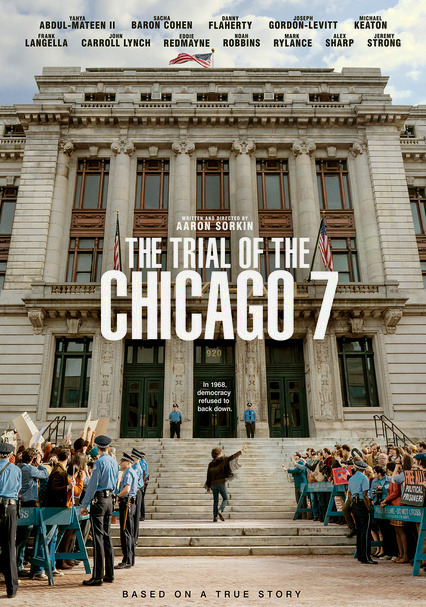
The Trial of the Chicago 7 (2020) is a Hollywood film with an important message. It’s conventional and explores a historic episode of great importance, and the story is told well with many liberties taken for effect.

Director Aaron Sorkin sticks to a familiar formula, peppering humor with the standard heavy drama, and creates a film that will appeal to mainstream audiences. He was rewarded with several Oscar nominations for the film.

It’s a crowdpleaser first and foremost.

I would have been bothered more by the traditional approach had the subject matter not been so weighty or not presented in a left-leaning way, which it was.

Solidly anti-war, this made the film more powerful and meaningful, though some of the comedic elements seemed silly and trite, and added to lighten the mood.

The period is 1969, though the main subject at hand occurs in 1968, so there is much back and forth. After antiwar activists clash with police and National Guardsmen at the important 1968 Democratic National Convention in Chicago, violence erupts.

Charged with conspiracy and inciting to riot, seven of the protestors are put on trial. The charges are controversial because a new president, Richard Nixon, has just been elected, and a revenge-seeking Attorney General lusts for an example to be made of them.

The casting is tremendous.

John Doman is fabulous in the quick role of the evil Attorney General John Mitchell (historians know that he was later a convicted criminal), and Frank Langella makes Judge Julius Hoffman into the asshole he was.

I’ve never been as impressed with Sacha Baron Cohen (or rather, this is the first time I’ve been impressed) as he steamrolls into the role of Abbie Hoffman, a social and political activist.

Eddie Redmayne, John Carroll Lynch, Mark Rylance, and Joseph Gordon-Levitt also deserve praise as either a member of the seven or lawyers for either side.

Whether or not specific accuracy is achieved is not top of mind for me. The Trial of the Chicago 7 provides a historical account of the events that unfolded the night of the riots and the subsequent courtroom proceedings the following year. I’m okay with a few exaggerations for cinema’s sake.

The product is a safe and glossy affair and incredibly slick to the eyes.

The editing is fantastic. Snippets of the real Chicago riots of 1968 are interspersed with the created scenes, creating a sound effect through the back and forth. But before this, real-life comments from Martin Luther King Jr. and Robert Kennedy kick off the action. Both assassinated, their existence is essential to witness before the point at which the film is ever made.

Justice is not always served. Sorkin’s point in including the sequences seems to hit home that there are good politicians out there fighting for truth and fairness.

My favorite scene is the final one. At the end of the trial, Hayden (Redmayne) is given a chance to make a case for a lenient sentence. However, over Judge Hoffman’s objections, Hayden uses his closing remarks to name the 4,752 soldiers who were killed in the Vietnam War since the trial began.

This act prompts many in the court to stand and cheer. Viewers will as well.

The main problem that gnawed at me is the same concern I had when I realized that Sorkin was at the director’s helm. He is a dazzling screenwriter, making the dialogue crisp and rich with intelligence.

But, known for television successes such as The West Wing (1999-2006) and Sports Night (1998-2000), this causes The Trial of the Chicago 7 to look like a made-for-television production versus a raw film experience.

I realize that Sorkin will likely never be a film auteur. Sorkin is the reason that The Trial of the Chicago 7 is a B+ film and not an A film.

The late 1960s were a prominent and sometimes tragic time in United States history. The Trial of the Chicago 7 delves into a pivotal event where several were railroaded and punished for something they did not do.

The film makes sure that the railroaders get their just desserts, and that’s fun to see.

Oscar Nominations: Best Picture, Best Supporting Actor-Sacha Baron Cohen, Best Original Screenplay, Best Cinematography, Best Film Editing, Best Original Song-“Hear My Voice”

The Hunt-2020

The Hunt-2020

Director Craig Zobel

Starring Betty Gilpin, Hilary Swank

Scott’s Review #1,117

Reviewed February 26, 2021

Grade: B

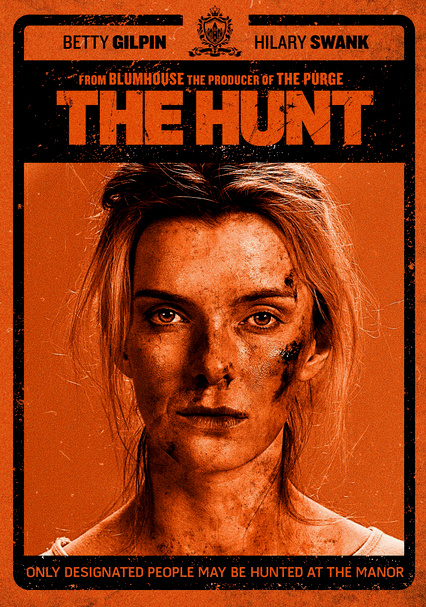
A disturbing satirical effort presumably produced because of the volatile United States political climate circa the 2016-2020 time period, The Hunt (2020) is timely and thought-provoking.

The premise is admittedly intriguing and relevant.

Unfortunately, the film doesn’t always come together and has little character development. It is cartoon-like and mired in B-movie appeal.

I wanted more background from the characters to understand what made them tick. It’s not always clear if the film intends to provide dark comedy, provoke horror, or mock stereotypes.

Perhaps a bit of each?

The Hunt is quite violent and bloody, like a horror film should be, but has tinges of cerebralism. Your political affiliation will dictate which characters you root for. Unclear is whether the message evoked is a liberal slant or a conservative one, and which side the filmmaker leans.

Who is the target audience, liberals or conservatives?

While the effort is praiseworthy and will undoubtedly leave the viewer pondering many details, some confusing elements aren’t worked through. There is also ridiculousness that doesn’t work.

On the plus side, The Hunt includes two-time Oscar winner Hilary Swank, one of my favorite modern actresses! She doesn’t appear until the finale, but it was the high point for me.

Twelve strangers wake up in a forest clearing. They have no idea where they are, how they got there, or even what country they’re in.

A large box is in the middle of the field. When they pry it open, a pig emerges along with a plethora of guns and ammunition. Confused, rapid gunfire erupts from the forest, and the group realizes they have been kidnapped and are being hunted for their conservative beliefs.

With most of the group dead, Crystal (Betty Gilpin) and Don (Wayne Duvall) traverse the nearby locale, which includes an Arkansas service station and other booby traps. To make matters worse, it is uncertain whether the people they encounter are enemies or allies.

Finally, they realize they are really in Croatia.

It’s quickly revealed that a group of liberal corporate executives led by Athena Stone (Swank) anticipates an upcoming hunt of “deplorable” people at a manor through a group text. Done as a joke, they are caught, fired, and decide to set out to perform the hunt as revenge for their dismissals.

Let’s mention how each side is portrayed because it’s essential. The liberals are portrayed as elitist, martini-sipping, kale-eating, judgmental “libtards” who mock conservatives at every turn. They are overly politically correct, live in a bubble, and are essentially pricks.

The conservatives are written as racist, dumb, simple-minded, poorly dressed people who love their guns and believe in conspiracy theories. Crystal is written to be a bad-ass tomboy from Mississippi who can shoot guns, blow things up, and fight.

Her character is overdone and not my favorite, although the twist at the end and the references to George Orwell’s Animal Farm (1945) are pleasing.

The opening sequence and the final sequence are the best parts of The Hunt. As the liberals fly in luxury, sipping champagne and munching on caviar, a conservative wanders to the front of the plane and is killed.

At this point, the premise isn’t yet revealed, so the audience has no idea what is going on. This immediately made me engaged and intrigued.

I loved the final fight sequence between Crystal and Athena. Craig Zobel, who directed The Hunt, borrows heavily from Quentin Tarantino’s Kill Bill (2003-2004) during this scene, and the result is a marvelous battle involving kitchen knives, glasses, blood, and bruises.

The Hunt (2020) is a brave and clever effort. I only wish the mechanics of the characters were better explored. My takeaway is that the intent is not to take the film too seriously.

But I wanted to.

Richard Jewell-2019

Richard Jewell-2019

Director Clint Eastwood

Starring Paul Walter Hauser, Sam Rockwell, Kathy Bates

Scott’s Review #1,035

Reviewed June 19, 2020

Grade: B

With most Clint Eastwood films, especially in the latter part of his career, one should expect a mainstream story with a conservative edge. The man has lost his touch with age, unlike greats like Martin Scorsese.

This may not always make for the most cutting-edge cinematic experience, but the results can still be compelling.

Richard Jewell (2019) was not on my radar, but for the last minute, a surprising Oscar nomination for Kathy Bates.

I am still smarting that she presumably took the last spot over the snubbed Jennifer Lopez (Hustlers-2019).

But I digress.

As anticipated, the project has a predictable edge and a safe feel, Eastwood sending a nasty note to the media and the FBI shaming them for their corruption and ineptness.

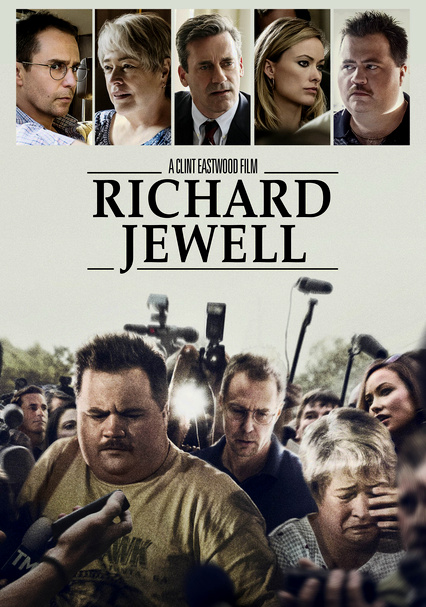
The biography, centering around the Centennial Olympic Park bombing and its aftermath during the 1996 Summer Olympic Games in Atlanta, Georgia, tells the story in a nicely paced way but feels light, pulling too much of a right-wing slant.

Lead actor Paul Walter Hauser is the standout of the film, bringing empathy and heroism to his portrayal of the one and only Richard Jewell.

Our title character is an overweight, average-looking man who lives with his mother in a modest apartment in Georgia. He works as a supply clerk in a small law firm where he meets arrogant attorney Watson Bryant (Rockwell).

They bond over video games and become fast friends.

The time is 1986.

Jewell, aspiring to become a police officer, lands a job as a security guard at Piedmont College, where he is subsequently fired for overstepping his grounds. Finally, he begins a job running security for a concert series near the Olympic Games.

He has a keen eye for law enforcement and is passionate about doing his job well.

Hauser, who had supporting roles in I, Tonya (2017) and in BlacKkKlansman (2018), has reached his breakout role.  Hauser makes the character likable and loyal. Law and order are his passions, and he eats, sleeps, and breathes life.

The actor makes it clear to the audience that Richard is not dumb. He is brilliant but has not been handed an easy life. The relationship with his mother is touching, and he genuinely wants to protect those whom he serves.

As far as the supporting roles go, Rockwell is fantastic as Watson, who ultimately defends Richard against the FBI. With wit, sarcasm, and outrage, his passion comes across on screen as a gruff but loyal friend.

Other big-name stars are not as lucky with their roles.

Jon Hamm plays FBI Agent Tom Shaw, a made-up character who wants to railroad Richard at all costs. He tricks Richard into confessing, which he then records. Olivia Wilde is Kathy Scruggs, an unpleasant journalist who will trade sex for stories.

The character is unlikable, and rumors abound that the writing is sharply embellished. Both Hamm and Wilde suffer from one-note characters.

Let’s discuss Kathy Bates’s performance.

Bates is a legendary actress and well-regarded. In the film, her best role is that of the maniacal Annie Wilkes in Misery (1990). Over the past few years, she has brightened the small screen with daring and unique roles on American Horror Story. Her role as the sympathetic and kindly Bobi Jewell is not one of her best.

There is nothing wrong with her performance, but the character never has a big, memorable scene.

Unclear is the historical accuracy of the story, and my hunch is that liberties could offer good drama. Inexplicable is the omission of anything related to the real bomber, who is never mentioned.

What were his motivations? Whatever happened to him? Viewers can conduct their research, but a notable omission is not including this.

The story only centers around Richard’s accusers and attempted railroading simply because he fits the profile of a bomber. The film could have gone further.

Also, viewers are left with no knowledge that Richard traditionally put a rose on one of the bombing victims’ graves or other niceties that could have been included.

Why did Eastwood need to hammer home the point that Richard was fretting about the perception that he may have been gay? True or false the point feels like a homophobic tidbit thrown in to appeal to a likely redneck audience.

Richard Jewell (2019) will not appear on Eastwood’s “greatest hits” of top films or even top 10 lists. Mystic River (2003) and Million Dollar Baby (2004) would get my votes for “best of” the year.

The film is only a slightly above-average biography of a falsely accused man who eventually gains justice. The spin is a politically conservative one, portraying the main characters as heroes who meet unfortunate circumstances.

Oscar Nominations: Best Supporting Actress- Kathy Bates

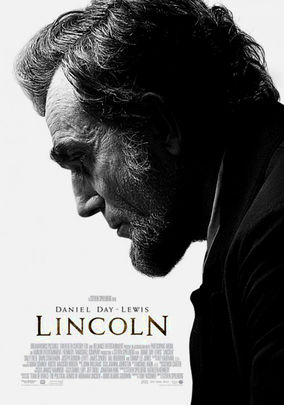
Lincoln-2012

Lincoln-2012

Director Steven Spielberg

Starring Daniel Day-Lewis, Sally Field, Tommy Lee Jones

Scott’s Review #476

70251896

Reviewed September 10, 2016

Grade: A

Lincoln is a 2012 film, which received a slew of Academy Award nominations. There appear to be differing opinions about the film itself, however.

Lincoln has audiences divided over whether it’s a brilliant film or a snore-fest.

My opinion leans decisively toward the former.

I recognize that (especially the first half) the film is slow-moving, but I found it engrossing and well-made.

Even the subtle aspects (costumes, art direction, lighting) are masterfully done.

I found Daniel Day Lewis’s (Abraham Lincoln) lengthy stories intriguing, not dull and found it to be a wonderful history lesson.

Steven Spielberg does what he does best- he creates a Hollywood film done well. He also has done controversial, shocking, or experimental, but the mainstream fare is his forte.

This film is not for everyone, but if you can find the patience it will be an enlightening experience. If nothing else, a thing or two may be learned.

Oscar Nominations: 2 wins-Best Picture, Best Director-Steven Spielberg, Best Actor-Daniel Day-Lewis (won), Best Supporting Actor-Tommy Lee Jones, Best Supporting Actress-Sally Field, Best Adapted Screenplay, Best Original Score, Best Sound Mixing, Best Production Design (won), Best Cinematography, Best Costume Design, Best Film Editing

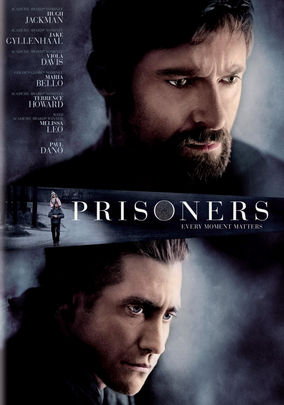
Prisoners-2013

Prisoners-2013

Director Denis Villeneuve

Starring Hugh Jackman, Jake Gyllenhaal

Scott’s Review #75

70273235

Reviewed June 27, 2014

Grade: B+

The film Prisoners (2013) weaves a gripping, taught, psychological tale amid a well-acted stellar cast of Hugh Jackman, Jake Gyllenhaal, Maria Bello, Viola Davis, and Paul Dano for starters.

That is what separates it from other similar, yet mediocre thriller types.

The gray, somber, Pennsylvania town is a perfect backdrop for a story involving child abduction and a father that seeks a confession from the presumed kidnapper.

The mood and cinematography are impressive and the bleakness is perfect for the tone- a cold Thanksgiving holiday weekend in a working-class, steel town.

At two hours and twenty-six minutes, the film is lengthy, but on the edge of your seat.

What intrigued me most was the audience conflict of whom to root for. Is the father purely innocent? Is the kidnapper guilty? Is someone else involved?

These questions go through the viewer’s mind during the film.

Prisoners possess a major drawback in the high number of plot holes and questions asked after the film.

The kidnapper’s motivations are weak and never fully explained. Portions of the story do not add up and make little sense.

The film is similar in style to Zodiac (2006) and Mystic River (2003).

Prisoners (2013) is an intense, thrill ride to be enjoyed, but not over-analyzed.

Oscar Nominations: Best Cinematography