Tag Archives: Sean O’Bryan

Vantage Point-2008

Vantage Point-2008

Director Pete Travis

Starring Dennis Quaid, William Hurt

Scott’s Review #1,271

Reviewed June 25, 2022

Grade: B-

The premise of Vantage Point (2008) is clever and hook-laden, stirring intrigue. After all, the idea of several ‘vantage points’ to one perilous event, in this case, an assassination in a European country, exudes promise and excitement.

An imagined fun game of whodunit or what happened to whom and when, and from whose perspective, prompted me to want to see this film.

The trailer looked good.

The film doesn’t satisfy and feels like a muddled mess, with little character development and, surprisingly, mediocre acting given its A-list cast.

The dialogue is forever repetitious with characters yelling out the same expletives in frustration that soon results in the incredible, teetering on laughably bad.

It plays too much like a carbon copy of the popular and exceptional television series ’24,’ which ran on FOX during the 2000s when Vantage Point was made.

The inspiration, Vantage Point, borrows heavily from the political thriller setup and the day-in-the-life concept popular during this decade.

The editing is rapid-fire quick.

I struggled to find a couple of redeeming qualities in the otherwise forgettable film.

Usually, seeing a film on the big screen in a slick, air-conditioned movie theater is a treat and increases my enjoyment of it, and that matters here.

In the case of Vantage Point, this raised its final grade from a mediocre C+ to a not-much-improved, generous B-.

A stellar company of actors, including Dennis Quaid, Sigourney Weaver, Forest Whitaker, William Hurt, and others, joins Matthew Fox, who was then hot for his lead role in the massively successful ABC television series Lost.

Did these actors read the script before signing on?

Witnesses with different points of view try to unravel an assassination attempt on U.S. President Henry Ashton (Hurt) while he is giving an important speech in Salamanca, Spain.

Special Agents Thomas Barnes (Quaid) and Kent Taylor (Fox) are assigned to protect Ashton during the summit on the war on terror. Television producer, Rex Brooks (Weaver), directs news coverage while American tourist Howard Lewis (Whitaker) films the audience.

After the leader’s arrival, shots ring out, and Ashton is down. In the resulting chaos, Howard comes forward with his camcorder, which he believes contains an image of the shooter.

Everyone attempts to solve the mystery by giving different accounts of what transpired.

Vantage Point is fantastic for about the first thirty minutes until it quickly runs out of gas. The setups are rapid, with Rex, Howard, Barnes, and Taylor each offering different perspectives, and the film moves well through the timeline from pre- to post-shooting.

The novelty wears thin once the perspectives are revised repeatedly and the plot becomes unnecessarily complicated and downright convoluted.

This makes a normally fast-running time of one hour and twenty-nine minutes feel like a lifetime commitment.

Comparisons I’ve heard to a 1950 Japanese film called Rashomon, which I have unfortunately never seen, are laughable.

My hunch is that the art film is worlds away from the slickly Americanized Vantage Point, and a slow build in the former is superior to the quickly edited mainstream latter.

Vantage Point (2008) is not a well-remembered film, nor should it be. There is no reason to watch it a second time.

A better choice is to watch the series 24 again instead.

It’s nearly the same, with one being superior.
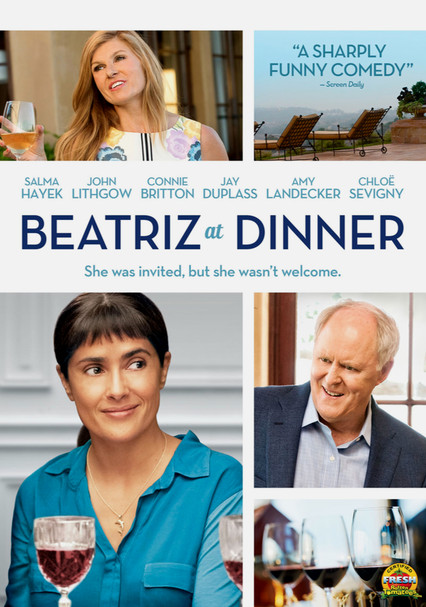
Beatriz at Dinner-2017

Beatriz at Dinner-2017

Director Miguel Arteta

Starring Salma Hayek

Scott’s Review #844

Reviewed December 18, 2018

Grade: B+

Thanks to a well-written screenplay and a thought-provoking idea, Beatriz at Dinner (2017) spins an interesting concept about politics and class systems discussed over dinner.

Salma Hayek and John Lithgow give tremendous performances as characters with opposing viewpoints, helping the film succeed, though a flawed ending and cookie-cutter supporting characters detract from the overall enjoyment.

Set in southern California, presumably around Los Angeles, Beatriz (Hayek) is a holistic health practitioner. Moonlighting as a massage therapist, she becomes stranded at the wealthy home of one of her clients, Kathy (Connie Britton), whom she views as a friend.

Kathy invites Beatriz to stay for dinner, where she encounters real-estate mogul Doug Strutt (Lithgow). The two gradually develop a feud based on their differing politics and viewpoints.

The setup and flow of Beatriz at Dinner are commendable and pace the film nicely. The film is sort of a day in Beatriz’s life. It begins as the character awakens to her pet dogs and goat noisily beginning their day and culminates late at night when the dinner party concludes, and the last glass of wine is consumed.

This way, the film has a nice packaged feel that keeps the story confined and structured.

Being an independent film, the budget is small, and most scenes are shot in a spacious modern house overlooking the Pacific Ocean, which works well. Gorgeous and vast, many rooms are used as conversations among the characters occur, many overlapping each other.

Beatriz at Dinner could have been a play, which helps with the good flow.

Hayek and Lithgow are the main draws as their initial guarded pleasantries progress to venom and violence, albeit primarily imagined.

Initially thinking that Beatriz is the household help, Doug is inquisitive about her entry into the United States and makes numerous insulting gestures, mispronouncing her Mexican hometown and mocking her profession.

Beatriz calmly endures his racism and begins discussions about how his business harms animals and people as emotions escalate. The actors play off each other wonderfully and share chemistry.

With each glass of wine, Beatriz becomes brazen and shares how people in her village lost their land to real estate development. She shares a humanistic viewpoint, while Doug sees life as to be lived while you can.

Despite their dislike for each other’s lifestyles, the film shows Beatriz and Doug at least listening to each other and attempting to understand the other’s opinions, which is more than can be said for the supporting players’ motivations or lack thereof.

Besides Kathy, while sympathetic to Beatriz’s calm demeanor and life-rich philosophies, she also realizes that Doug is her family’s meal ticket.

The other party attendees are written as polite yet uninteresting twits with nothing to talk about except a reality star’s nude photos, dinner, or a handful of other nothing topics.

Chloë Sevigny, Jay Duplass, Amy Landecker, and David Warshofsky have little to do other than stand around and react to the meatier written material that Hayek and Lithgow get to play.

Beatriz at Dinner had me in its corner until the film took a jarring turn during the final act. As Beatriz leaves the party and sets about on her way home, she hastily decides to grab a letter opener and bludgeon Doug to death as the dinner guests hysterically realize what is happening.

Instead of leaving things be, the film chooses to make this only Beatriz’s fantasy and then have her go to the ocean and walk into the waves. Does this mean she commits suicide, or is this another fantasy? This final sequence is unclear and unsatisfying.

I am not sure why Beatriz at Dinner is considered a comedy. Perhaps a mild dark comedy, I argue that the film is a straight-ahead drama and lacks the witty humor that made dinner party-themed films such as Who’s Afraid of Virginia Woolf? (1966) and The Boys in the Band (1970) masterpieces.

Beatriz at Dinner (2017) is a valiant attempt at offering social commentary at a time when discussions like these are needed in films, and the project largely succeeds.

Hayek’s impassioned yet subdued performance deservedly earned her a Female Lead Independent Film nomination. The film’s rich writing garnered a Best Screenplay nomination, too, but a big whiff at the end lowers the overall experience a notch.

Independent Spirit Award Nominations: Best Female Lead-Salma Hayek, Best Screenplay

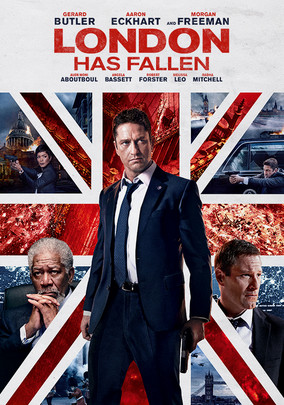
London Has Fallen-2016

London Has Fallen-2016

Director Babak Najafi

Starring Gerard Butler

Scott’s Review #608

Reviewed January 13, 2017

Grade: D

Save for many enjoyable, incredible London shots of mostly aerial views, London Has Fallen (2016) is a complete drivel of an experience.

The film’s attempt at being a red-blooded, patriotic film comes across as insulting and racist, with a machismo that is cringe-worthy.

The dialogue is terrible, and the “us against them” mantra has been done to death in film, mainly in the 1980s and 1990s. To quote one reviewer, “London Has Fallen is Donald Trump in film form.”

I don’t understand how the film convinced such a talented cast to appear (it must have been money), and several parts are so small (Robert Forster, Melissa Leo, Jackie Earle Haley) that they are nearly glorified extras.

The plot is painfully contrived, not to mention the ludicrous nature of the entire story.

To retaliate against a drone strike killing a Pakistani leader, terrorists take advantage of the death of the UK Prime Minister to assassinate several world leaders who have gravitated to London to attend funeral services.

The President of the United States (played by Aaron Eckhart) is naturally in attendance, and his murder is thwarted by top Secret Service official Mike Banning (Gerard Butler), our film’s hero.

The rest of the film involves the President and Mike running throughout London, attempting to catch the terrorists and bring them to justice while avoiding death.

The London locales are superb, but sadly, they mainly appear at the film’s beginning and end. The London Eye, the River Thames, the Underground, and various metro stations appear.

The film also gives the numerous London bridges some exposure.

The best part is how the film showcases London’s vastness, not just the up-close shots of historic places like Westminster Abbey or Buckingham Palace.

Undoubtedly, London is known for those gems, but the aerial views give the viewer an appreciation of all London offers.

I loved only this aspect of the film.

The supporting roles are abysmal, and given the more artistic parts they’ve received in the past, one imagines the actors cringing as they read some of the scripts.

I hesitate to think what possessed Leo, Forster, and Haley to accept meaningless roles save for a hefty paycheck. Each played a member of the President’s staff and was reduced mainly to reactionary shots.

As an ill-fated Secret Service Director, Angela Bassett and Radha Mitchell, as Banning’s weary-looking, pregnant wife, get more screen time but are treated to equally uninteresting roles.

Overall, the performances are forgettable. Respectable actors Butler and Eckhart merely phone in their vapid, dull lines, failing to make any of them believable.

The film never bothers with character development or anything beyond basic good-versus-evil roles. Every character is either 100% good or 100% bad.

It is made crystal clear that the Americans are the good guys, and the foreigners (all Middle Eastern or Asian actors, of course) are simply the bad guys.

The motivations of the “bad guys” are never explained, and one cheesy line after another is written for the “good guys.”

During the finale, Banning professes that “we have been here for thousands of years and always will be” as he beats a lousy guy senselessly. Good grief. I’ve seen better dialogue on a network television drama.

And there is never any doubt about how the film will end. There is an American mole who has used his power to enable all of the assassinations, but when the mole is revealed, it is a character we have never seen before, so who cares?

Indeed, the film will soon be forgotten for its poor story, cliché-ridden script, and numerous stereotypes, but the fantastic London shots were inspiring and lovely.

I would have been happy with one hour and forty minutes of those.