Tag Archives: John Early

Beatriz at Dinner-2017

Beatriz at Dinner-2017

Director Miguel Arteta

Starring Salma Hayek

Scott’s Review #844

Reviewed December 18, 2018

Grade: B+

Thanks to a well-written screenplay and a thought-provoking idea, Beatriz at Dinner (2017) spins an interesting concept about politics and class systems discussed over dinner.

Salma Hayek and John Lithgow give tremendous performances as characters with opposing viewpoints, helping the film succeed, though a flawed ending and cookie-cutter supporting characters detract from the overall enjoyment.

Set in southern California, presumably around Los Angeles, Beatriz (Hayek) is a holistic health practitioner. Moonlighting as a massage therapist, she becomes stranded at the wealthy home of one of her clients, Kathy (Connie Britton), whom she views as a friend.

Kathy invites Beatriz to stay for dinner, where she encounters real-estate mogul Doug Strutt (Lithgow). The two gradually develop a feud based on their differing politics and viewpoints.

The setup and flow of Beatriz at Dinner are commendable and pace the film nicely. The film is sort of a day in Beatriz’s life. It begins as the character awakens to her pet dogs and goat noisily beginning their day and culminates late at night when the dinner party concludes, and the last glass of wine is consumed.

This way, the film has a nice packaged feel that keeps the story confined and structured.

Being an independent film, the budget is small, and most scenes are shot in a spacious modern house overlooking the Pacific Ocean, which works well. Gorgeous and vast, many rooms are used as conversations among the characters occur, many overlapping each other.

Beatriz at Dinner could have been a play, which helps with the good flow.

Hayek and Lithgow are the main draws as their initial guarded pleasantries progress to venom and violence, albeit primarily imagined.

Initially thinking that Beatriz is the household help, Doug is inquisitive about her entry into the United States and makes numerous insulting gestures, mispronouncing her Mexican hometown and mocking her profession.

Beatriz calmly endures his racism and begins discussions about how his business harms animals and people as emotions escalate. The actors play off each other wonderfully and share chemistry.

With each glass of wine, Beatriz becomes brazen and shares how people in her village lost their land to real estate development. She shares a humanistic viewpoint, while Doug sees life as to be lived while you can.

Despite their dislike for each other’s lifestyles, the film shows Beatriz and Doug at least listening to each other and attempting to understand the other’s opinions, which is more than can be said for the supporting players’ motivations or lack thereof.

Besides Kathy, while sympathetic to Beatriz’s calm demeanor and life-rich philosophies, she also realizes that Doug is her family’s meal ticket.

The other party attendees are written as polite yet uninteresting twits with nothing to talk about except a reality star’s nude photos, dinner, or a handful of other nothing topics.

Chloë Sevigny, Jay Duplass, Amy Landecker, and David Warshofsky have little to do other than stand around and react to the meatier written material that Hayek and Lithgow get to play.

Beatriz at Dinner had me in its corner until the film took a jarring turn during the final act. As Beatriz leaves the party and sets about on her way home, she hastily decides to grab a letter opener and bludgeon Doug to death as the dinner guests hysterically realize what is happening.

Instead of leaving things be, the film chooses to make this only Beatriz’s fantasy and then have her go to the ocean and walk into the waves. Does this mean she commits suicide, or is this another fantasy? This final sequence is unclear and unsatisfying.

I am not sure why Beatriz at Dinner is considered a comedy. Perhaps a mild dark comedy, I argue that the film is a straight-ahead drama and lacks the witty humor that made dinner party-themed films such as Who’s Afraid of Virginia Woolf? (1966) and The Boys in the Band (1970) masterpieces.

Beatriz at Dinner (2017) is a valiant attempt at offering social commentary at a time when discussions like these are needed in films, and the project largely succeeds.

Hayek’s impassioned yet subdued performance deservedly earned her a Female Lead Independent Film nomination. The film’s rich writing garnered a Best Screenplay nomination, too, but a big whiff at the end lowers the overall experience a notch.

Independent Spirit Award Nominations: Best Female Lead-Salma Hayek, Best Screenplay
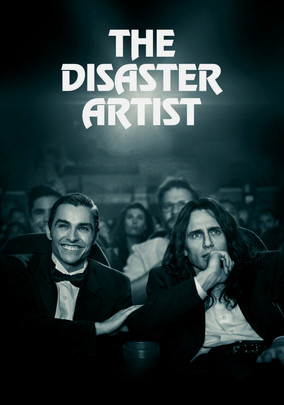
The Disaster Artist-2017

The Disaster Artist-2017

Director James Franco

Starring James Franco

Scott’s Review #781

Reviewed July 2, 2018

Grade: B

The Disaster Artist (2017) is a biography-comedy that I found to be middle of the road to primarily good if I’m judging in overall terms- most I liked with a bit of criticism.

Due to the many accolades, I confess to having anticipated a bit more from the finished product and hardly finding it a masterpiece.

Still, I was both impressed and unimpressed by James Franco’s performance in the lead role. I was awed at the actor’s emergence as a director, and the Los Angeles setting is great.

At times the film teeters almost into bad slapstick or shtick, and a bit silly, and as much as I respect his performance, this criticism is directed at Franco. Nobody can deny his acting talent if he chooses the right films.

His attempt to make his character peculiar is noticeable within seconds, so it seems Franco also makes him a bit of a goof, and I was not able to take the character seriously all of the time.

And the weird accent threw me.

This film is based on the nonfiction book The Disaster Artist. The book chronicles the making of 2003’s The Room, not to be confused with the 2015 film Room. The Room was considered amateurish and one of the worst movies ever made.

Told repeatedly that his acting stinks, oddball Tommie Wiseau (James Franco), a European-American aspiring actor, decided to screw Hollywood and produce, direct, and star in his film.

Wiseau has an endless amount of bank funds, which he uses towards the film. Roommate and friend Greg Sestero (Dave Franco) stars in the movie and thus gets his big break. The duo and various others pitch in to create the project, which suffers from ineptness on the part of Wiseau.

The Los Angeles setting resonates with me, as does the recurring theme of struggle in the Hollywood scene. These are significant pluses of the film as a whole.

Los Angeles can appear to be a sunny and glamorous town, but beneath its shiny exterior, it always has a gloomy, dark underbelly.

The film realistically depicts struggle and success, from the central characters to the supporting players, making it resemble an ensemble.

Thousands struggle daily for a break, and no respect or appreciation is given. The Disaster Artist scores a win by focusing on this.

When Tommie brazenly approaches an influential producer in a restaurant, he is unceremoniously dismissed for having no talent and told he will never get anywhere. In addition to Tommie, several actors associated with the film struggle.

In a fantastic scene, an older actress states that being on a bad movie set beats any other job by miles. The message here is that people in Hollywood are there because they genuinely love it.

The sweet, empowering theme of friendship and empowerment is also to be celebrated, especially given the cutthroat backdrop. Tommie and Greg are best friends and have each other’s backs through thick and thin.

Neither gives up on the other, even during the initial audience reaction to The Room premiere.

Could the film have been slightly darker? Yes, indeed, as very few scenes of drug destruction or the porn that many hopeful talents turn to are mentioned. But the film is not about that. It’s an enchanting tale of hope and fun.

It is interesting to note, and not evident to me while watching the film, that brothers James and Dave Franco play opposite one another. While there is somewhat of a physical resemblance, the chemistry works between the two actors as best friends.

James delivers a worthy portrayal of an unusual character with a strange dialect, long, stringy brown hair, and seemingly cross-eyed. The role is comedic and ideally suited for an unusual actor like Franco- he must have had a ball with the part.

Movies about movie-making always fascinate me. What goes on behind the scenes?

The Disaster Artist (2017) provides enough good film meat to make it an overall good experience. It stays true to some fine Hollywood history—the famous James Dean is referenced, and the spot where he died is even visited—nice touch! Franco is both good and disappointing in the main role.

All in all, this one is worth watching for those who enjoy filmmaking, Hollywood, or L.A.-set films.

Oscar Nominations: Best Adapted Screenplay

Independent Spirit Award Nominations: Best Male Lead-James Franco

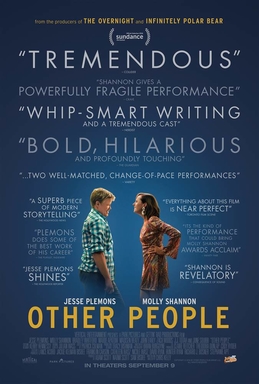
Other People-2016

Other People-2016

Director Chris Kelly

Starring Jesse Plemons

Scott’s Review #676

Reviewed August 24, 2017

Grade: B+

2016’s recipient of numerous Independent Film Award nominations, this film is equal parts a touching drama and witty comedy, offering a experience that crosses more than one genre.

Is it a heavy drama, or is it a comedic achievement?

Without being sappy or overindulgent, Other People is a film that will elicit laughs and tears from viewers fortunate enough to see it.

The subject is a tough one- a woman dying of cancer.

The title, in which one character says he always thought cancer happened to “other people,” is poignant.

Jesse Plemons and Molly Shannon play son and mother. Chris Kelly wrote and directed the film.

The very first scene is a confusing one and caught me off guard. We see the entire Mulcahey clan- father Norman (Bradley Whitford), three kids, David (Plemons), Alex, and Rebeccah, along with their dead mother Joanne (Shannon)- all lying in the same bed, sobbing and clutching hands.

Joanne has just succumbed to her battle with cancer. This powerful opening scene, also the final scene, sets the tone as Kelly works his way back, beginning a year before the critical “death scene.”

Cancer is a challenging subject to cover in film, especially when you go the comedy/drama route.

The sensitive filmmaker must avoid trivializing the subject with too many comedic elements or heavy drama. Kelly successfully blends humor and drama, making it a cross-genre film.

He does this with strong performances from Plemons and Shannon. They share tremendous chemistry in every scene they share.

Scenes that show David and Joanne crying in each other’s arms work well, as do others, such as when David takes a giddy Joanne to meet his comedy friends.

Most impressively, the story in Other People is mainly autobiographical. Kelly, a gay man like the character of David, moved from New York City to Sacramento, California, to tend to his ailing mother, who had also died from cancer.

Actress Shannon reminded him so much of her that he had the fortune of casting the talented lady in his film, the part initially slated for Sissy Spacek.

Along with Joanne’s battle with cancer, a lovely story about David is included. A gay man, David has broken up with his boyfriend Paul, who previously lived together on the East Coast (though he still pretends to spare Joanne worry), and is returning to the West Coast.

Over the next year, we see Joanne and Norman slowly come to terms with David’s sexuality. The film explores their turbulent father/son relationship as Norman, initially hesitant to meet David’s boyfriend, Paul, pays for his airline ticket to attend Joanne’s funeral.

A slight miss is the Norman/David dynamic.

Other than a few hints of Norman encouraging David’s struggling writing career and his obsession with David joining the gym and boxing, it is not clear what issue he takes with his son being gay or why he is uncomfortable with it.

Besides the family being rather conservative, no other reason is given.

David’s sisters and grandparents do not seem to take issue with David’s sexuality, though it is not made clear if the grandparents are even aware of it. Is it a machismo thing with Norman?

This part of the story is unclear.

Still, Other People (2016) is a good, small indie film. It is rich with crisp, sharp writing and a tragic “year in the life of a cancer patient. The film also features strong family drama and the relationships that emerge when a family comes together because of a health threat.

The film isn’t groundbreaking, but thanks to strong direction, a thoughtful, nuanced approach, and the inclusion of one character’s sexuality, it feels relatively fresh.

Independent Spirit Award Nominations: 1 win-Best Male Lead-Jesse Plemons, Best Supporting Female-Molly Shannon (won), Best First Screenplay, Best First Feature