Tag Archives: Chloë Sevigny

After the Hunt-2025

After the Hunt-2025

Director Luca Guadagnino

Starring Julia Roberts, Ayo Edebiri, Andrew Garfield

Scott’s Review #1,504

Reviewed November 29, 2025

Grade: B+

After the Hunt (2025) is a thriller mired in questions and secrets, which, from the outset, director Luca Guadagnino successfully creates. An atmosphere of the Yale University elitist intelligentsia, enshrouded in internal chaos, just reeking to be let go.

Julia Roberts reemerges into the awards conversation with a startlingly raw and introspective performance as Alma, a professor harboring a secret past that is invaded by present circumstances.

Guadagnino, known for the brilliant LGBTQ+-themed Call Me by Your Name (2017), usually incorporates emotional complexity, eroticism, and lavish visuals into his work. This one is highly character-driven, embellishing the thoughts and desires of the leads.

For the viewer, After the Hunt remains compelling because we don’t know whom to believe, with allegiances teetering from character to character, including Alma herself.

Alma drinks too much, pops pills, and has a secret apartment away from her eccentric husband, Frederick, wonderfully played by Michael Stuhlbarg. Despite being a psychiatrist, he coddles Alma and serves as her househusband rather than an equal, causing him peculiar bouts of weird behavior.

Meanwhile, Alma is desperately seeking tenure at Yale.

At a boozy party at Alma’s house one night, amid societal and philosophical conversations, Maggie (Ayo Edebiri), one of her students, uncovers a secret about Alma while snooping in her bathroom.

Later, Maggie, who is black and gay, leaves the party with Hank, one of Alma’s handsome colleagues (Andrew Garfield).

The next morning, Alma finds herself at a personal and professional crossroads when Maggie, a star student, levels an accusation against Hank, claiming she was sexually assaulted.

As the onion is peeled back, it is discovered that Maggie plagiarized a paper and has wealthy parents who help the University maintain its financial status. She is also obsessed with Alma, even wearing the same shade of fingernail polish.

At the same time, Hank is a volatile hothead with a vicious temper. Does he have a romantic past with Alma?

Who should Alma believe, and what should the audience think? Are we supposed to side with Maggie because it’s politically correct to believe a young black female over a white male?

Maggie immediately put me off. Was that the intention? I wanted to like her, but just didn’t. This was even before it was known that she was privileged.

By contrast, I immediately did like Hank. His passion for philosophy and his yearning for debate about the younger generation being coddled resonated with me.

Guadagnino offers more than solely a compelling story in After the Hunt.

As a Connecticut resident, the exterior locales are powerful. Rich camera shots of the massive Yale campus, especially on snowy days, provide wonderful texture to the film. A small, cruddy yet cozy Indian diner, strangely empty, serves as a meeting point for two poignant scenes.

Besides the campus, New Haven, Connecticut, is not the ritzy Greenwich, Connecticut, by any means, and Guadagnino must have realized this by incorporating ugly waterside views and glimpses of factories.

A quiet, introspective director, many scenes of Alma staring into the distance, in thought or pondering life, play well with philosophical debate scenes between faculty and students.

While the film’s pacing is slow, it works for me. And throughout the question remains of what Alma’s secret is and whether Hank sexually assaulted Maggie, or is it all lies?

The film is also reminiscent of Fatal Attraction (1987) or Single White Female (1992). The key to the film may lie in Maggie’s obsession with Alma, which slowly unfolds.

In what may be Julia Roberts’ best film role to date, After the Hunt (2025) doesn’t hit a home run with a slightly ambiguous, unsatisfying ending, but with stellar performances from Roberts, Edebiri, Garfield, and Stuhlbarg, it’s enough to warrant a watch.

Boys Don’t Cry-1999

Boys Don’t Cry-1999

Director Kimberly Peirce

Starring Hilary Swank, Chloe Sevigny

Top 250 Films #177

Top 10 Most Disturbing Films #10

Scott’s Review #340

27422770

Reviewed January 9, 2016

Grade: A

Boys Don’t Cry (1999) is a fitting tribute to real-life figure Brandon Teena, a transgender man from Nebraska, who adopts a male identity and attempts to find love with Lana, played by Chloe Sevigny. Brandon is played by Hilary Swank.

Sadly, Brandon was brutally raped and murdered at the hands of some local men- a fact that the film does not gloss over.

Boys Don’t Cry is a heartbreaking and tragic film that will disturb some with its shocking and violent content- sadly it is a true story.

Swank deservedly walked away with the Best Actress Oscar statuette.

Set in working-class Nebraska and in the heartland, Brandon has the cards stacked against him from the start. Not exactly the most open-minded of areas, the film also sets a working-class environment for Brandon as most of his friends are poor factory or bar workers.

Born as Teena Brandon and female, Brandon (Swank) is a drifter and in trouble with the law for various unpaid tickets. He befriends ex-convicts John and Tom and becomes part of their crowd, falling in love with Lana- they are all unaware of Brandon being a female.

When Brandon’s secret is revealed, Lana is accepting and the pair decide to run away together, but Tom and John decide to murder Brandon.

Swank’s portrayal of Brandon is brilliant and believable and very few actresses could successfully pull this off. Swank has angular, androgynous features to begin with, but her drastic physical transformation is jaw-dropping.

Having closed-cropped hair and a male swagger, Swank immerses herself in the role, so much so, that as I watched the film I completely forgot that Brandon was not physically male.

Her physical transformation is not the sole reason for the fantastic performance though- Swank is emotionally there in the role and in a heartbreaking scene, after being beaten and raped, is treated poorly by a sheriff handling the accusations- just when Brandon could use an understanding ear.

What a cold world it can be for someone different from most others as Boys Don’t Cry reveals in a brutal, honest fashion.

Anyone who knows the true story of Brandon Teena knows he led a painful, tragic life, but was also filled with life and love- mainly for Lana.

Worth mentioning is Sevigny’s performance as Lana- in love with the person that was Brandon, not so much the gender. Sevigny portrays Lana as supportive, confused, and loving.

Director, Kimberly Peirce, became obsessed with the real-life case and does a fantastic job at tackling the film in a true, compelling way. To say nothing of the writing and the acting, Peirce also successfully uses a hand-held camera during Brandon’s strip scene and a surreal, muted light to portray the gloomy mid-west and the cold, hard lives that most of the characters lived.

Impressively, Peirce accomplished all of this on a shoe-string budget and took a wealth of inspiration from independent film legend John Cassavetes, who proved that gorgeous films can be made for very little money.

Many scenes take place in bars as Lana, a devoted karaoke singer, croons one tune after another, the highlight being Restless Heart’s 1988 country hit, “The Bluest Eyes In Texas”, which Lana sings in Brandon’s presence.

The use of somber songs gives the film a tragic soundtrack.

Famed film critic, Roger Ebert, described Boys Don’t Cry as “Romeo and Juliet set in a Nebraska trailer park”.

Boys Don’t Cry (1999) is an enormous victory in film for the LGBT community and, along with Brokeback Mountain (2006), is a perfect double-feature, as both are similar films, only one featuring males, the other females.

Both are tragic, bleak and all too real.

Oscar Nominations: 1 win-Best Actress-Hilary Swank (won), Best Supporting Actress-Chloe Sevigny

Independent Spirit Award Nominations: 2 wins-Best First Feature (Over $500,000), Best Female Lead-Hilary Swank (won), Best Supporting Female-Chloe Sevigny (won), Best First Screenplay, Producers Award

Zodiac-2007

Zodiac-2007

Director David Fincher

Starring Jake Gyllenhaal, Mark Ruffalo, Robert Downey Jr. 

Top 250 Films #223

Scott’s Review #1,134

Reviewed April 16, 2021

Grade: A

Zodiac (2007) is an excellent film in its own right. The attention to detail circa the 1960s and 1970s is spot on and adds to the flavor of the entire experience. The locale of San Francisco is moody and lurking with the antics of the self-professed Zodiac Killer.

With excellent acting, the sum of its parts adds up to a wonderful film experience.

The film is incredibly well-paced, character-driven, and layered in rich texture. What more can be asked of a cinematic production? It simply has it all and will engage any viewer craving mystery and intrigue.

David Fincher, as the director’s chair, creates a world unto itself with carefully crafted sets, artistic nuances, and of course a superb story. A lesson learned is that sometimes evil exists and cannot be caught despite best efforts and the ramifications are endless.

Painfully, the characters in Zodiac slowly realize this.

Zodiac is based on the best-selling non-fiction book by Robert Graysmith, a pivotal character in the film. The novel is very similar to James Elroy’s 1987 novel The Black Dahlia, another unsolved case set in California.

The film tells the story of the manhunt for the Zodiac Killer, a serial killer who terrorized the foggy San Francisco Bay Area during the late 1960s and early 1970s.

Investigators (Mark Ruffalo, Anthony Edwards) and reporters (Jake Gyllenhaal, Robert Downey Jr.) become obsessed with learning the killer’s identity and bringing him to justice.

Meanwhile, Zodiac claims victim after victim and taunts the authorities with endless and specifically graphic letters, bloodstained clothing, and cryptic messages shrouded in menacing phone calls.

The case remains one of the United States’ most infamous unsolved crimes.

Much of the acclaim must go to the three actors cast in the central roles and Gyllenhaal is top of his game in the leading role. As cartoonist Robert Graysmith he is the main hero and the person who spearheads the investigation, prompting disbelievers to listen to him.

Gyllenhaal is sensitive, sympathetic, and obsessed and at first, perceived to be a laughing stock, but audiences will immediately get behind the man and this is thanks to Gyllenhaal’s powerful acting.

The character-driven approach continues as Mark Ruffalo gives a wonderful portrayal of Inspector David Toschi. The tough-as-nails and no-nonsense approach led Toschi into obsession and fudging evidence.

Finally, Robert Downey Jr. provides energetic gusto as Paul Avery, a journalist who turns to drugs and alcohol because of the intensity and emotional investment in the case.

Plenty of red herrings make the film fun and the prime suspect of Arthur Leigh Allen, played by character actor John Carroll Lynch may or may not be the assailant.

It’s breathtaking watching all the twists and turns in this ferociously complex film.

Zodiac is based on real events and reportedly is extremely historically accurate. Fincher and others spent eighteen months conducting their investigation and research into the Zodiac murders.

So, authenticity is everywhere in this film.

Watching a film beginning in 1969 and ending in 1983 is a joy for someone who grew up in that era. Fincher drizzles the film with timely automobiles, clothes, and other sets so it appears to be walking into a time capsule.

I’m sure this only will add to the viewer’s enjoyment.

For fans of films based on the Zodiac Killers, the 1971 film Dirty Harry, starring Clint Eastwood delivers an exceptional experience based on the real-life case.

But Fincher’s Zodiac is just as good.

Despite the behemoth running time- two hours and thirty-seven minutes, Zodiac (2007) is an edge-of-your-seat thriller. The pulsating yet prowling pace is worth several viewings to appreciate the juiciness of all of the elements David Fincher offers.

A hefty round of applause is deserved.

Lizzie-2018

Lizzie-2018

Director Craig Macneill

Starring Chloë Sevigny, Kristen Stewart

Scott’s Review #925

Reviewed July 31, 2019

Grade: B+

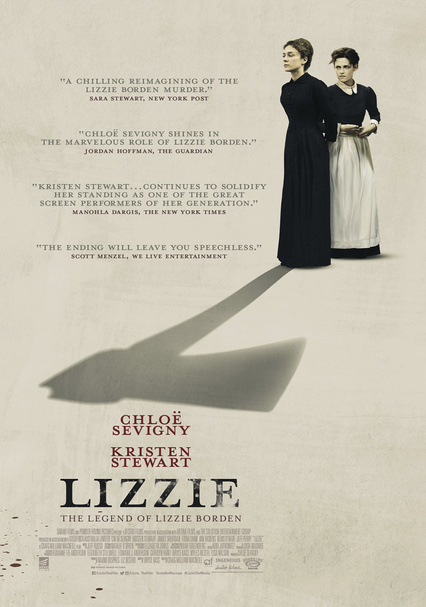
Lizzie (2018) is an odd and macabre interpretation of the life and times of the infamous Lizzie Borden, who was accused and acquitted of hacking her father and stepmother to bits with a deadly ax.

This offering is shrouded in controversy because of inaccuracies and interpretations of the events, specifically Borden’s sexuality, which is called into question. The film is quiet and a tad too slow, but it thunders to a grand climax, more than making up for any negatives.

The casting of its leads is perfect and key to success.

Thirty-two-year-old Lizzie (Chloë Sevigny) lives with her domineering and affluent father, Andrew (Jamey Sheridan), and rigid stepmother, Abby (Fiona Shaw).

Despising both, she lives out a lonely and depressing existence, her only outlet being occasional evenings at the theater. When an Irish immigrant, Bridget Sullivan (Kristen Stewart), moves into the Borden residence to work as a servant, the women form a strong bond, especially after Andrew abuses her.

Sevigny, one of my favorite modern actresses, possesses an astounding range in the myriad of characters she has played in her long career.

Debuting to the masses in the critically acclaimed and depressing Boys Don’t Cry (1999), she has churned out a multitude of independent features portraying one oddball character after another and deserves the strong influence she has achieved over the years.

Director Craig Macneill makes interesting choices with his film, which may or may not please audiences expecting a numbers horror offering. He dives into psychological thriller territory with more of a character study approach that provides layers to the finished product.

Sevigny is center stage, and plenty of camera close-up shots offer an introspective analysis of her feelings rather than from her parents’ perspective. Instead of a crazed killer spontaneously committing the crime, she is careful and calculating in her plan.

Macneill presents Lizzie as the victim and Andrew and Abby as the villains. This is to assume that Borden committed the crimes, which the film never doubts.

Historically, people assume that this is the truth, but Lizzie was set free by a jury refusing to believe a woman of such means would commit such a heinous crime. I wonder if Macneill directed the film with a bit of a smirk at this ridiculous decision of the times when the woman enjoyed the murders.

At the end of the film, what happened to Lizzie and Bridget is explained, which is a good decision and wraps the film up nicely.

Powerful is the quiet subtext that gives a moody and foreboding quality. I adore slow-moving films provided the reward is worth the wait and Lizzie sucker punches once the events begin rolling along.

Another positive is the gnawing feeling of terrible things about to happen but unsure when or how the attacks will occur. Most viewers watching this film will know the context and the reported murders committed.

The atmospheric additions succeed as the late eighteenth-century costumes and daily living are believable. The lavish Borden house is well-kept and brightly lit, offering a friendly New England feel.

Finally, the creaks and noises throughout the house perfectly encompass the danger lurking behind corners, and the fun is in wondering when Lizzie will strike.

Since the film moves back and forth through time, we know she will strike.

The film’s best work is in the relationship between Lizzie and Bridget. Sevigny and Stewart dazzle together with an unleashed chemistry that nearly rivals a similar dynamic seen in 2003’s Monster.

As with Aline Wuornos and Selby, Lizzie is dominant, and Bridget is submissive, following her lead. Both women share a lesbian relationship, and neither pair achieves happiness after the film.

A film sure to fly under the radar and likely to be forgotten before long, Lizzie (2018) is worth the effort. A spooky and controversial interpretation of the events leading up to, during, and after one of the most notorious crimes in United States history is dissected and analyzed from a human perspective.

Macneill makes Borden less maniacal and more sympathetic than some may prefer. He does a fine job and deserves praise for a rich story.

Beatriz at Dinner-2017

Beatriz at Dinner-2017

Director Miguel Arteta

Starring Salma Hayek, John Lithgow, Connie Britton

Scott’s Review #844

Reviewed December 18, 2018

Grade: B+

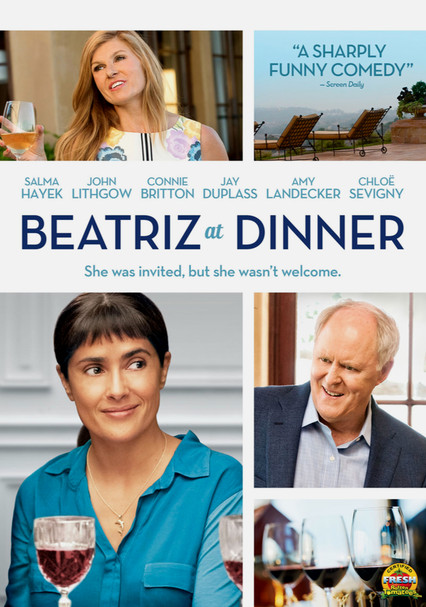
Thanks to a well-written screenplay and a thought-provoking idea, Beatriz at Dinner (2017) spins an interesting concept about politics and class systems discussed over dinner.

Salma Hayek and John Lithgow give tremendous performances as characters with opposing viewpoints, helping the film succeed, though a flawed ending and cookie-cutter supporting characters detract from the overall enjoyment.

Set in southern California, presumably around Los Angeles, Beatriz (Hayek) is a holistic health practitioner. Moonlighting as a massage therapist, she becomes stranded at the wealthy home of one of her clients, Kathy (Connie Britton), whom she views as a friend.

Kathy invites Beatriz to stay for dinner, where she encounters real-estate mogul Doug Strutt (Lithgow). The two gradually develop a feud based on their differing politics and viewpoints.

The setup and flow of Beatriz at Dinner are commendable and pace the film nicely. The film is sort of a day in Beatriz’s life. It begins as the character awakens to her pet dogs and goat noisily beginning their day and culminates late at night when the dinner party concludes, and the last glass of wine is consumed.

This way, the film has a nice packaged feel that keeps the story confined and structured.

Being an independent film, the budget is small, and most scenes are shot in a spacious modern house overlooking the Pacific Ocean, which works well. Gorgeous and vast, many rooms are used as conversations among the characters occur, many overlapping each other.

Beatriz at Dinner could have been a play, which helps with the good flow.

Hayek and Lithgow are the main draws as their initial guarded pleasantries progress to venom and violence, albeit primarily imagined.

Initially thinking that Beatriz is the household help, Doug is inquisitive about her entry into the United States and makes numerous insulting gestures, mispronouncing her Mexican hometown and mocking her profession.

Beatriz calmly endures his racism and begins discussions about how his business harms animals and people as emotions escalate. The actors play off each other wonderfully and share chemistry.

With each glass of wine, Beatriz becomes brazen and shares how people in her village lost their land to real estate development. She shares a humanistic viewpoint, while Doug sees life as to be lived while you can.

Despite their dislike for each other’s lifestyles, the film shows Beatriz and Doug at least listening to each other and attempting to understand the other’s opinions, which is more than can be said for the supporting players’ motivations or lack thereof.

Besides Kathy, while sympathetic to Beatriz’s calm demeanor and life-rich philosophies, she also realizes that Doug is her family’s meal ticket.

The other party attendees are written as polite yet uninteresting twits with nothing to talk about except a reality star’s nude photos, dinner, or a handful of other nothing topics.

Chloë Sevigny, Jay Duplass, Amy Landecker, and David Warshofsky have little to do other than stand around and react to the meatier written material that Hayek and Lithgow get to play.

Beatriz at Dinner had me in its corner until the film took a jarring turn during the final act. As Beatriz leaves the party and sets about on her way home, she hastily decides to grab a letter opener and bludgeon Doug to death as the dinner guests hysterically realize what is happening.

Instead of leaving things be, the film chooses to make this only Beatriz’s fantasy and then have her go to the ocean and walk into the waves. Does this mean she commits suicide, or is this another fantasy? This final sequence is unclear and unsatisfying.

I am not sure why Beatriz at Dinner is considered a comedy. Perhaps a mild dark comedy, I argue that the film is a straight-ahead drama and lacks the witty humor that made dinner party-themed films such as Who’s Afraid of Virginia Woolf? (1966) and The Boys in the Band (1970) masterpieces.

Beatriz at Dinner (2017) is a valiant attempt at offering social commentary at a time when discussions like these are needed in films, and the project largely succeeds.

Hayek’s impassioned yet subdued performance deservedly earned her a Female Lead Independent Film nomination. The film’s rich writing garnered a Best Screenplay nomination, too, but a big whiff at the end lowers the overall experience a notch.

Independent Spirit Award Nominations: Best Female Lead-Salma Hayek, Best Screenplay

Lean on Pete-2018

Lean on Pete-2018

Director Andrew Haigh

Starring Charlie Plummer, Steve Buscemi

Scott’s Review #747

Reviewed April 24, 2018

Grade: B+

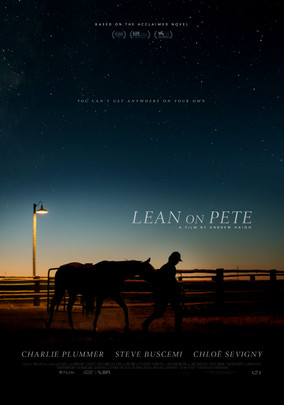
Lean on Pete (2018) is a heartbreaking and emotional slice-of-life film written and directed by British director Andrew Haigh.

The film centers on the relationship between a boy and a horse, so the heartstrings will be tugged a lot as the viewer is taken on a journey as the protagonist struggles through both pain and triumph.

While slow-moving and matter-of-fact, the film celebrates excellent writing and good story chapters, perfectly nestled into the independent drama genre.

Based upon the novel of the same name—reportedly a much darker experience—actor Charlie Plummer portrays Charley Thompson, a fifteen-year-old boy living outside of Portland, Oregon, with his troubled father.

His mother has taken off for parts unknown.

As his already complicated life turns upside down after a violent attack, Charley becomes increasingly attracted to the world of local horse racing and becomes involved with a shady horse trainer, Del Montgomery (Steve Buscemi).

There, he befriends and falls in love with an aging horse named Lean on Pete, who sadly is destined for the slaughterhouse in Mexico.

The film is about Charley’s journey and determination to survive while facing seemingly insurmountable odds and obstacles. The intriguing aspect of Lean on Pete is watching what Charley experiences and hoping against hope that he will come out unscathed and undamaged.

The youngster aspires to reach his estranged aunt, whom he knows only to have been living in Wyoming as a waitress. How on earth will he be able to find her? If he does reach her, will she welcome him with open arms, as he hopes, or will he suffer more defeat?

Several key aspects struck me as I watched this film. Charley embarks on his travels to find his beloved aunt, with Lean on Pete in tow, and encounters many individuals who either aid or hinder his intentions.

However, the common theme of waitresses continues to be portrayed—for starters, his aunt is referenced as working as a waitress at a bar. When Del gives Charley some fatherly advice, he implores him that the best women have always worked as waitresses.

On the road, he is treated kindly by two different waitresses—one of whom gives him free dessert, the other gives him a major break. I am not sure why Haigh chose to add this to the film, but it is a nice touch and effectively gives the story a warm, blue-collar sensibility.

Another intelligent decision Haigh makes is to keep the focus on Plummer and Charley’s facial expressions and reactions during pivotal scenes- for example, a scene where Charley is painting a house for extra money is essential.

As he hears a jovial father and son playing outside, Haigh shoots Charley’s reactions to this poignant scene rather than deciding to show the father and son. Hearing their pleasure is enough to elicit a look of pain on Charley’s face, rather than a blatant scene of said father and son shoved down the viewer’s throat.

Enough praise cannot be given to young talent Plummer, who gives a layered performance that will surely make him a star in future years.

The actor possesses an earnest, trustworthy sensibility, making him a likely hero in any film he appears in. Furthermore, he quietly gives Charley depth with various emotions, including disappointment, fear, and anger at his predicament.

The supporting cast members give well-acted performances that add to the overall meat of the story. As grizzled, yet responsible Del, Buscemi sinks his teeth into a role that allows his sarcastic humor and wit to take center stage, and he is perfect.

Chloë Sevigny, like Bonnie, a female jockey who befriends Charley, yet also gives it to him straight with lessons on life’s hard knocks, offers a satisfactory performance.

Lean on Pete (2018) is a quiet film that elicits an emotional response from its intended audience by giving firm texture to the story and fantastic cinematography of the western United States landscape.

Viewing a likable young adult in constant turmoil seems to be a complex subject, but instead, it is rather beautiful and inspiring, as captured by Haigh’s piece, instead of a complete downer as it might have been.

The film is a tale of a journey and struggle that accomplishes what it sets out to achieve.

Lovelace-2013

Lovelace-2013

Director Rob Epstein, Jeffrey Friedman

Starring Amanda Seyfried, Peter Sarsgaard

Scott’s Review #133

70241594

Reviewed July 24, 2014 

Grade: B

Lovelace (2013) is an account of famous 1970’s porn star, Linda Lovelace, and her rise to stardom and inevitable fall from the spotlight, difficult family life, abusive relationships, and her attempt to escape the porn world for good.

The film portrays the story from Lovelace’s point of view based on her tell-all autobiography and spins her in a very sympathetic way.

Whether all of her abuse and struggles that Lovelace claimed are to be believed is up to the viewer.

Lovelace, the film, comes across as similar to Boogie Nights (1997)- even the 1970s soundtrack is eerily alike, but inferior to that masterpiece.

The only character whose past is fully delved into is Linda Lovelace who is the sole focal point; the others are simply an extension of her character.

One major issue I found with the film is the casting of Amanda Seyfried as Linda Lovelace.

Seyfried does not have the plain Jane or girl next door characteristics that the actual Lovelace had. She comes across as soft and gentle, much too much for this particular role.

Conversely, the casting of Sharon Stone and Peter Sarsgaard is excellent as each is dynamic in their respective roles. Stone should have received much more acclaim than she did for her role.

As Lovelace’s mother, she is gritty, steely, and unsympathetic.

The film contains a whos who of Hollywood names involved in small roles.

Another issue is the film seems like a made-for-television movie and considering the subject matter is the porn industry, it seems awfully watered down and not harsh enough.

Lovelace (2013) is entertaining enough to keep one’s interest but is not riveting or in-depth enough to be a major success.