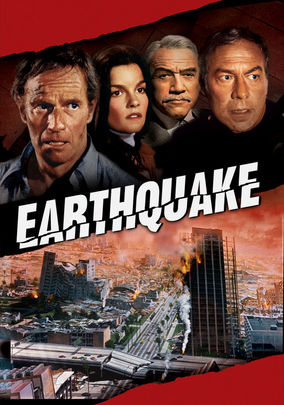
Earthquake-1974
Director Mark Robson
Starring Charlton Heston, Ava Gardner
Top 250 Films #144
Scott’s Review #407
Reviewed June 2, 2016
Grade: B+
One of the several disaster films to populate film screens in the early to mid-1970s, Earthquake is one of the “main four” blockbusters (The Poseidon Adventure, 1972, The Towering Inferno, 1974, and Airport, 1970, being the others) that still resonate with viewers in modern times and are nostalgic to watch.
One might argue that the aforementioned few largely influenced Earthquake since it was the last of the group to be filmed.
Certainly, the influence is apparent.
Earthquake is a classic, traditional disaster film containing many stock characters (or types). It is an ensemble piece- as disaster films always are- frequently containing stars of yesteryear attempting exposure in the modern cinema.
The gender roles in Earthquake are quite mainstream for the day, as the females are all clearly “damsels in distress” types, and the men are portrayed as the heroes.
The action begins as we witness a Los Angeles-based middle-aged couple (the central couple, if you will) engaging in a dispute.
Charlton Heston and Ava Gardner play Stewart and Remy Graff, an affluent couple: a former football star and a boozy socialite.
Her father is the wealthy Sam Royce, played by Lorne Greene. Stewart is having an affair with a young actress, Denise Marshall, creating a soap-opera-style romantic triangle that adds drama to the film.
We meet other characters who round out the characters’ stories: LAPD Sgt. Slade (George Kennedy) shares a flirtation with Rosa (Victoria Principal), while drunkard Walter Matthau and biker character Richard Roundtree provide comic relief.
These stories are merely filler until the inevitable earthquake arrives to ‘shake’ things up.
The earthquake is the main character in the film, just like the tidal wave, the fire, and the airline peril are in other films in the same genre.
The characters’ trivial relationships soon take a back seat to the action as the earthquake shatters the city in subsequent onsets and aftershocks, destroying buildings and resulting in many deaths.
The very lengthy main earthquake sequence is second to none, hovering around the twenty-minute mark. We see many characters in peril. The scene goes on and on but is hardly redundant.
The scene is masterful and well done. The effects, cinematography, and visuals alone hold up well today and must have been breathtaking circa 1974.
In one particularly thrilling scene, a group of office workers on the thirtieth floor of a skyscraper desperately scrambles to the elevator as the building shakes and shimmies.
One businessman shoves a secretary aside and selfishly steps into the crowded elevator as others desperately pound on the door to escape.
Things do not end well for the folks in the elevator as bolts loosen and the car crashes to the ground. An animated blood splat fills the screen in a lighthearted, comical way.
The film wisely does not take itself too seriously.
As fantastic as the destruction sequence is, Earthquake is not a film without a few flaws, mostly from a character standpoint.
Unbelievable is Heston playing Greene’s son-in-law, and Gardner is assumed to be young enough to be his daughter- they appear to be around the same age.
A strange character, Jody, a store clerk, suddenly dresses as a soldier, wearing a wig, following the destruction, and is assumed to be gay by thugs, who tease him, which prompts him to shoot them with a machine gun.
He subsequently becomes obsessed with and nearly rapes Rosa.
The sub-plot seems uneven and very unnecessary.
With spectacular special effects, Earthquake (1974) is a must-see disaster film with a slightly downcast, hopeless tone. It does its job well- it entertains, thrills, and features an all-star cast of former Hollywood elite and a few rising stars.
A fun time will be had.
Oscar Nominations: 1 win-Best Sound (won), Best Art Direction, Best Cinematography, Best Film Editing
Golden Globe Nominations: Best Picture-Drama, Best Original Score