Tag Archives: Don Stroud

Django Unchained-2012

Django Unchained-2012

Director Quentin Tarantino

Starring Jamie Foxx, Christoph Waltz

Top 250 Films #116

Scott’s Review #699
Reviewed November 26, 2017

Grade: A

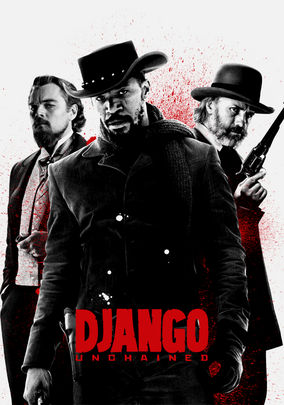
Quentin Tarantino, the brilliant filmmaker, can do very little wrong in my opinion, and he releases yet another masterpiece with 2012’s Django Unchained, a western story centering around the delicate subject matter of slavery.

As with several other talented director’s stories, the main focal point here is a revenge-driven tale with plenty of bloody scenes and stylistic ferociousness, making Django Unchained yet another masterpiece in the Tarantino collection.

Certainly not for the faint of heart, the film will please fans of film creativity and artistic achievement.

As with many Tarantino films a stellar cast is used and each actor cast to perfection- it seems almost every actor in Hollywood is dying to appear in the director’s films- this time Jamie Foxx, Christoph Waltz, Kerry Washington, Leonardo DiCaprio, and Samuel L. Jackson are the lucky ones, all featured in prominent roles- not surprisingly the acting is top-notch.

An interesting fact to note is that whoever appears in a Tarantino film seems to be having the time of their lives- what creative freedom and interesting material to experience.

A comparable director to Tarantino- as far as recruiting fine actors- is Robert Altman- also tremendously popular with talent.

The saga begins with clear Western flair as Django Freeman (Foxx) is led through the scorching heat of Texas with a group of other black slaves, presumably, to be sold by their abusive white captors- the time is 1858, and the abolition of slavery has not yet occurred the Civil War is still two years away.

Doctor King Schultz (Waltz), a former dentist and current bounty hunter, is on a mission to find and kill the Brittle brothers and realizes that Django can help him find the men.

To complicate matters, Django has been separated from his wife Broomhilda (Washington) and vows to find her and avenge her abductors.

As circumstances lead Schultz and Django to a vast Tennessee estate, the duo becomes business partners and friends. The race to rescue Broomhilda takes the pair to sunny (and equally hot) Mississippi- the home of vicious Calvin Candie (DiCaprio) and his dreaded “Candyland”.

The crackling heat and the atmospheric nature of Django Unchained combined with the revenge theme make the film an immeasurable success.

An ode to spaghetti westerns of yesteryear, the film incorporates similar music and grit so that the result is a modernized version of those films, with lots more blood and violence.

Slavery is a tough subject matter to tackle, especially when members of the Ku Klux Klan are featured, but Tarantino does so effortlessly, and as Django gains revenge on his tormentors, there is major audience satisfaction to be enjoyed.

The indignities and downright abuse that several black characters suffer can be quite tough to sit through.

The climactic dinner scene in Mississippi is splendid and the best sequence of the film. Schultz and Django dine with Calvin at his spectacular mansion. Calvin’s sinister and loyal house slave (Jackson) suspects a devious plan is about to be hatched and a vicious shoot-out erupts between the parties involved.

The ingenious and long sequence is a cat-and-mouse affair with all of the characters carefully tiptoeing around the others in fear of being revealed or discovered as fakes.

The scene is exceptional in its craft as we watch the characters dine on delectable food and drink, all the while motivations bubble under the surface.

Django Unchained is not for film-goers seeking either a linear story or a mainstream piece of blockbuster movie-making-Tarantino is not a typical Hollywood guy.

The film is exceptionally carved and constructed in a way that challenges the viewer to endure what some of the characters (specifically Django and Broomhilda) are made to go through. This discomfort and horror make the inevitable revenge all the more sweet and satisfying.

Quentin Tarantino has created masterpiece after masterpiece throughout his filmography of work.

Proudly, I can herald 2012’s  Django Unchained as one of the unique director’s very finest and will be sure to be remembered decades and decades in the future as being able to challenge, provoke thought, and satisfy legions of his fans.

Oscar Nominations: 2 wins-Best Picture, Best Supporting Actor-Christoph Waltz (won), Best Original Screenplay (won), Best Sound Editing, Best Cinematography
Taxi Driver-1976

Taxi Driver-1976

Director Martin Scorsese 

Starring Robert De Niro, Cybill Shepherd, Jodie Foster

Top 250 Films #130

Scott’s Review #776 

Reviewed June 20, 2018

Grade: A

It is incredibly tough to choose a favorite among Martin Scorsese’s films, since nearly all of them are exceptionally well-made.

Goodfellas (1990), Raging Bull (1980), and Taxi Driver (1976) immediately come to mind. Taxi Driver may be Scorsese’s darkest film of all.

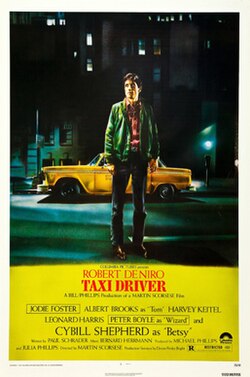
The thriller is intense, dangerous, and ferocious, led by a riveting performance by Robert De Niro, a regular in the director’s earlier films. The film is nail-biting and compelling, and a great, character-driven watch.

Set in the bustling and (at that time) decrepit New York City shortly following the Vietnam War, Travis is a veteran suffering from some degree of post-traumatic stress disorder.

Lonely and angry, he works as an overnight taxi driver who falls for a snooty presidential campaign worker, Betsy (Cybill Shepherd).

He also forges a relationship of a protective nature with an underage prostitute, Iris (Jodie Foster). As he gradually spirals out of control due to the unhappiness surrounding him, he plots to kill Betsy’s boss while protecting Iris from her pimp (Harvey Keitel).

One great aspect of Taxi Driver is the extremely good performance by De Niro. Along with Jake LaMotta’s later role in Raging Bull, Travis Bickle’s role is my second favorite of his. With Bickle, he is unpredictable, on edge, and angry, as De Niro infuses the character with those qualities in a seamless fashion.

As he teeters on the brink of insanity and is ready to snap at any given moment, the character is impossible not to watch with both fear and marvel.

De Niro is that brilliant. 

While not to be outdone by the aforementioned negative and dangerous qualities, Travis also possesses a few benevolent traits, making the character complex. In large part, this comes into play with the protective nature he develops towards Iris.

Almost like a big brother/kid-sister dynamic, the deranged man treats her with kindness rather than taking advantage of her as he easily could have. The diner scene, in which the two actors (De Niro and Foster) share it, is rich in interesting dialogue and binds the characters together.

Travis also harbors love and hate emotions towards Betsy (Cybill Shepherd). As she is a political volunteer for a potential presidential candidate, Travis first encounters her while spying on her through the large glass windows where she works.

Coaxing her to accept a date, they have coffee and eventually attend a film together. Betsy is offended since the film is pornographic, and their date goes south fast. After a vicious showdown between the pair at the campaign office, Travis goes off the deep end and plots revenge.

The gritty, atmospheric approach Scorsese takes in Taxi Driver is an enormous highlight of the film. Dingy, dark, and dangerous, the director creates numerous scenes that show just how seedy New York City was in the 1970s.

Working the night shift, sure to bring out the rancid and most decaying elements of the city, Travis experiences many cretins and undesirables in his work- and arguably is one of them!

Many scenes feature the notorious 42nd Street and its accompanying porn theaters that made New York City famous (or infamous!) at the time.

In one of the film’s most frightening (and best) scenes, Travis can get his hands on a gun. He practices drawing his weapon in the mirror, repeatedly uttering the famous line “You talkin’ to me?” as we wonder if he will pull the trigger.

The scene is fraught with cerebral tension and quite frightening. Later, when Travis shaves his head and brandishes a mohawk, his new look is downright terrifying.

Scorsese creates a dark world enriched by his incredible cinematography and astounding portrayals of compelling characters in dangerous, unstable times.

Taxi Driver (1976) is a treasure to watch closely and appreciate as a timeless piece of art. Instead of decaying in the vaults of cinema, the film gets better and better with age.

Oscar Nominations: Best Picture, Best Actor-Robert De Niro, Best Supporting Actress-Jodie Foster, Best Original Score

Licence to Kill-1989

Licence to Kill-1989

Director John Glen

Starring Timothy Dalton, Carey Lowell

Scott’s Review #1,196

Reviewed November 14, 2021

Grade: B

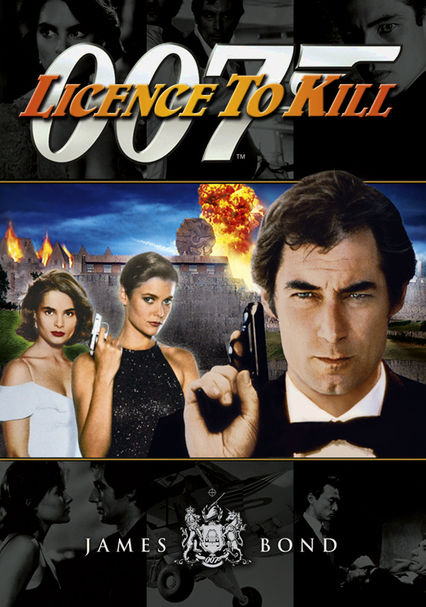
Of the two turns 007 that Timothy Dalton gave us License to Kill (1989) ranks as the weakest with The Living Daylights (1987) being superior. But that doesn’t mean the film has no good qualities.

It’s an okay film and director John Glen, now returning for his fifth James Bond film seems a little out of gas. Many of the stunts and sequences are very familiar territory and the dialogue is far from crackling or exciting.

The James Bond film franchise would go on a six-year hiatus after Licence to Kill and return refreshed in 1995. Perhaps it needed to.

Dalton does his best but his heart doesn’t quite seem in it and the serious tone of the film gets even darker than The Living Daylights. I don’t think this is a bad thing and I love how the franchise regular Felix Leiter (David Hedison) gets more of a storyline. But the wit and charm are lacking.

Events begin in sunny Key West at the impending nuptials of former CIA agent and Bond friend, Leiter. Pursuing one of the international drug cartel’s most brutal and powerful leaders, Franz Sanchez (Robert Davi), events quickly escalate.

After a double-crossing poor Felix is fed to the sharks. While he survives the attack his now wife is murdered. Bond goes rogue and seeks personal vengeance.

What separates Licence to Kill from other Bond entries is the limited locales. Though exquisite, they only take place in North America. The Florida Keys, the Bahamas, and Mexico are used in fine form, especially the latter.

The gorgeous coastline feels European and I surmised that it was shot and set in Spain when in fact it was Mexico.

Also enjoyable is the Latin flair with lots of cultures throughout. Davi is powerful and dangerous as the Latin drug lord and he exudes violence and treachery. He is gleeful when a nemesis falls victim to his pet shark and loses a limb or two before succumbing to death.

A great kill is when dastardly Milton Krest (Anthony Zerbe) topples into a giant microwave oven and explodes into bloody bits. His death is deserved and satisfying.

To build on this, the inevitable death of Sanchez himself is a crowd-cheering moment. Before he explodes into a giant ball of flames Bond is certain to let the villain know that his death is courtesy of Leiter. This is an exciting and fulfilling moment.

The Bond girls are not at their finest in Licence to Kill. Carey Lowell plays Pam Bouvier, an ex-Army pilot, and DEA informant. While sometimes portrayed as a tough-minded and brazen female character she is also written as simpering and pining over Bond.

She can also be silly and foolhardy like when she carelessly plays with dangerous gadgets that Q creates. I would expect more intelligence and wherewithal based on her credentials.

Secondary Bond girl Lupe Lamora (Talisa Soto) girlfriend of Sanchez, lacks much depth. Beautiful, she is quite wooden in the acting department and suddenly falls in love with Bond insisting on her powerful feelings for the man she barely knows.

It’s a bit far-fetched even for Bond standards but she is nice to look at. So there’s that.

License to Kill (1989) usually gets either lost in the shuffle or derided completely and this is unfair. It’s not one of the greats but neither is it garbage.

It feels a bit tired of its time. Truth be told, it’s grown on me since I first saw it and even the title song performed by Gladys Knight has enamored me over the years.

The Amityville Horror-1979

The Amityville Horror-1979

Director Stuart Rosenberg

Starring James Brolin, Margot Kidder, Rod Steiger

Scott’s Review #60

60002141

Reviewed June 23, 2014

Grade: B-

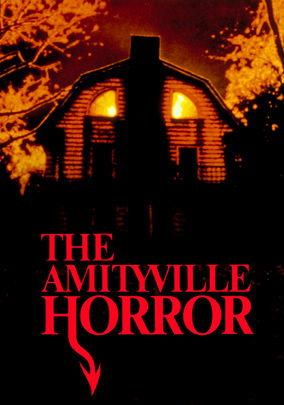
The Amityville Horror was undoubtedly more thrilling upon its original 1979 release, but sadly, time has not been kind to this film, and it does not hold up well any longer.

It feels dated, but that is not to say it is at all unenjoyable.

The movie’s atmosphere, building tension, and sense of dread are effective. The audience knows bad things will eventually occur.

The film’s look is dark and creepy, and the leads, James Brolin and Margot Kidder, are adequate.

The main problem with the film is that all along, there is a feeling that I am watching a pale version of The Exorcist (1973) or The Omen (1976), far superior films, with the religious theme that was heavily used in the horror genre throughout the 1970s.

Also, horror in 1970’s cinema was at its best, and by 1979, horror had shifted into the knife-wielding maniac vein.

Add to this the fact that the supposedly “true story” has since been proven to be a silly hoax, which takes away any shred of seriousness.

The scene involving the herd of flies is scary, but other scenes seem silly and inconsequential.

The Amityville Horror (1979) is not a bad movie, but similar films are far superior.

Oscar Nominations: Best Original Score